Best supplements for skin elasticity: 7 research-backed options for weight loss and aging
See which supplements improve skin firmness, the doses used in trials, and how long results take.
Enjoying this article?Add FoodNourish as a preferred source on Google and see our research-backed guides more often in your search results.
The best supplements for skin elasticity are hydrolyzed collagen peptides at 2.5 to 10 g a day and hyaluronic acid at about 120 mg a day. Both improved elasticity in randomized trials, and collagen needed about 12 weeks to show it [1] [5]. Vitamin C supports the collagen your body makes [11]. No supplement removes large folds of loose skin after major weight loss.
Loose skin after weight loss is common, especially after a large loss. Collagen makes up 80% of your skin’s structure. Years of stretching damage collagen and elastin fibers, so they lose some of their ability to retract [15].
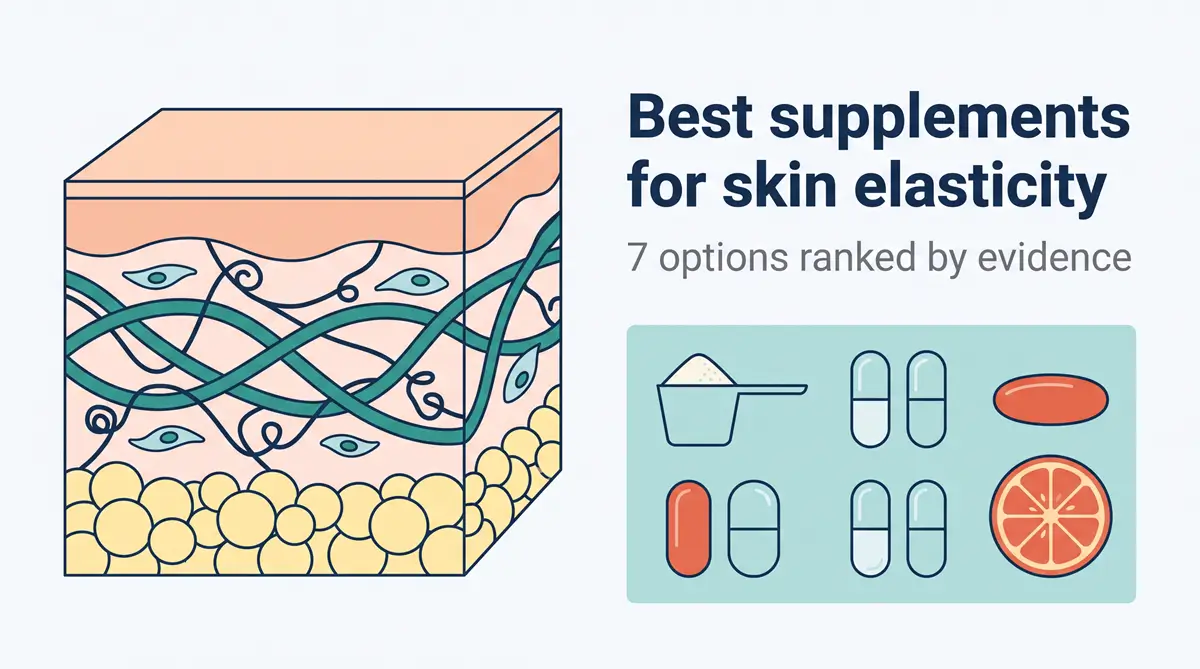
This guide ranks 7 supplements by the strength of the human evidence behind them. It lists the doses used in trials and shows where supplements stop helping and medical treatment starts. If you are still losing weight, pair it with our weight loss tips.
Key takeaways
- A meta-analysis = a study that pools results from many trials. A 2026 meta-analysis of 35 randomized trials with 2,534 people found collagen peptides improved skin elasticity, with gains showing mainly at 12 weeks [1] [21].
- A 2025 meta-analysis of 23 trials found no collagen benefit in high-quality or independently funded trials, so expect modest results [2].
- Oral hyaluronic acid improved hydration, elasticity, and wrinkle depth across 7 randomized trials [4].
- Supplements improve skin quality. They do not remove large folds of excess skin, which often need surgery after major weight loss [15].
What is the difference between collagen and elastin?
Collagen gives your skin strength and firmness. Elastin lets your skin stretch and snap back. Both proteins sit in the dermis, the thick middle layer of your skin, where cells called fibroblasts produce them [15].
Pinch the skin on the back of your hand and let go. The speed at which it flattens shows your elastin at work. Collagen, which makes up about 80% of your skin’s structure, holds the shape in place [15].

Your body makes less of both as you age. Women lose about 30% of their collagen in the first 5 years of menopause [16].
“Do I need a separate elastin supplement?” Probably not. We found no meta-analysis of oral elastin supplements. Collagen peptides have 35 randomized trials behind them, and those trials measure elasticity directly [1].
Why does skin lose elasticity after weight loss?
How well your skin bounces back depends on how far it stretched and for how long. Skin stretched for a few months, as in pregnancy, usually retracts within months. Skin stretched for years has damaged collagen and elastin fibers that cannot fully recover [15].
Six factors predict how loose your skin will be.
- Amount lost. Larger losses leave more excess skin [15].
- Time carried. The longer you carried extra weight, the more fiber damage builds up [15].
- Speed of loss. Rapid loss gives skin less time to adapt. GLP-1 drugs, a class of weight loss medicines, lowered body weight 5% to 18% more than placebo in clinical trials [17][18].
- Age. Older skin holds less collagen and retracts less [15].
- Sun exposure. The Skin Cancer Foundation estimates ultraviolet (UV) light causes up to 90% of skin aging [16].
- Smoking. Smoking damages the collagen in your skin [15].

You control sun exposure and smoking today, and you can often adjust your speed of loss with your doctor. People who have weight loss surgery also form less new collagen than young, healthy skin does [15].
What are the best supplements for skin elasticity?
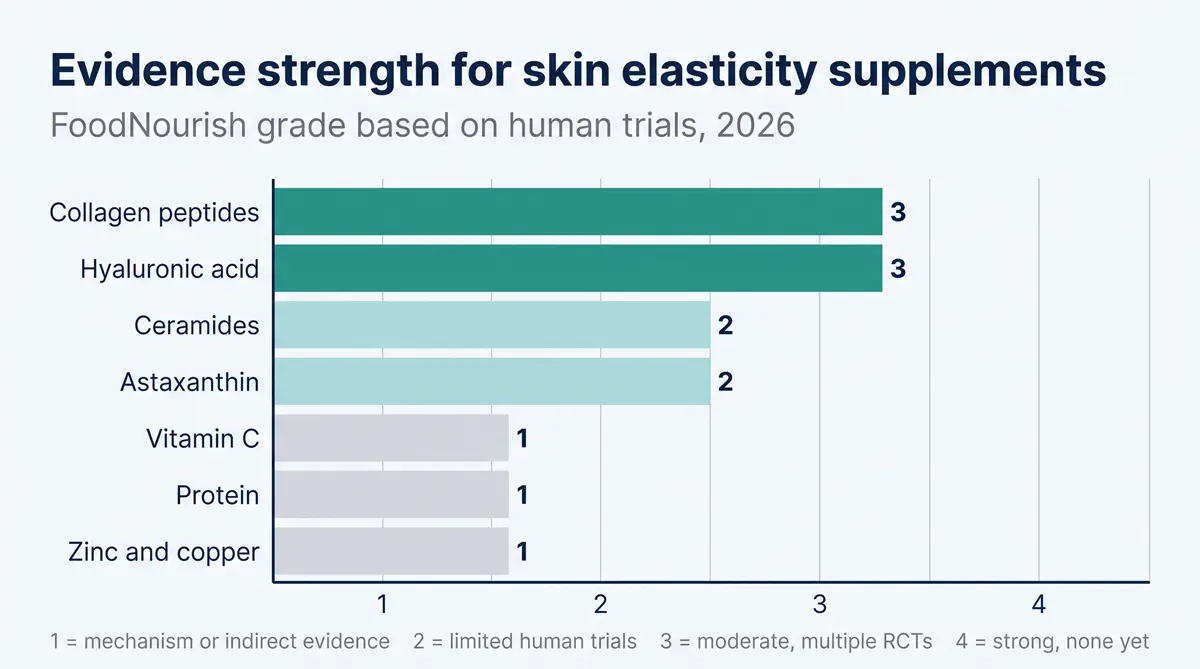
We ranked each supplement by the number and quality of randomized controlled trials behind it. Randomized controlled trial = a study where people receive the supplement or a placebo by chance, which separates real effects from expectation. Use the table to compare, then read the section on any supplement you are weighing.
| Supplement | Evidence strength | Dose used in trials | Time to results | Best for |
|---|---|---|---|---|
| Collagen peptides | Moderate. 35 RCTs, mixed quality [1] [2] | 0.5 to 10 g a day. 2.5 g worked in a key trial [3] [21] | Mainly 12 weeks for elasticity [21] | Elasticity and hydration |
| Hyaluronic acid | Moderate. 7 small RCTs [4] | 120 mg a day [5] | 8 to 12 weeks [5] | Dry skin, fine wrinkles |
| Vitamin C | Required to make collagen. No elasticity RCTs [11] | 75 mg (women), 90 mg (men) a day [11] | Not studied | Filling a diet gap |
| Ceramides | Limited. Small trials, one without placebo [6] [7] | 40 mg rice ceramides or 350 mg wheat extract oil a day | 3 months | Dry, tight skin |
| Astaxanthin | Limited. Meta-analysis of 9 small RCTs [8] | 4 to 12 mg a day. EU safety limit 8 mg [10] | 8 to 16 weeks [10] | Sun-exposed skin |
| Protein | Indirect. Protects muscle during weight loss [18] | 1.2 to 2.0 g per kg of adjusted body weight [18] | Ongoing | Active weight loss |
| Zinc and copper | Mechanism only [12] [13] | Daily recommended intake. Zinc under 40 mg [13] | Not studied | Low dietary intake |
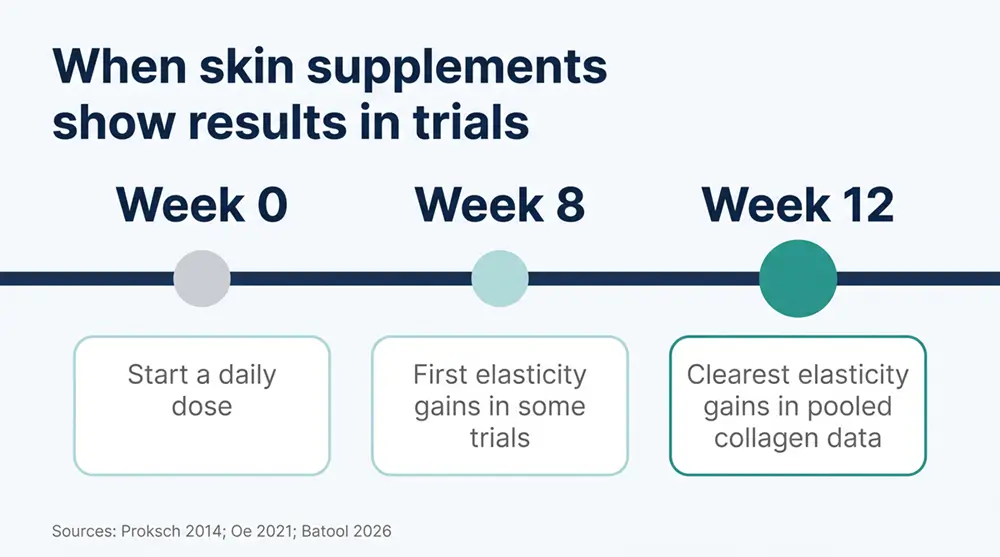
Every supplement with direct elasticity data needed 8 to 16 weeks to show results in trials. If you judge a supplement after 30 days, you will quit before most trials took their final measurements.
1. Collagen peptides
Verdict. This is the best-studied option. Trials used 0.5 to 10 g a day, and elasticity gains showed mainly at 12 weeks [1] [21].
Hydrolyzed collagen peptides = collagen broken into short protein fragments your gut can absorb. The leading theory says some fragments signal fibroblasts to make more collagen. Human trials measure the end results, though, not this step.
The evidence is large and messy. A 2026 meta-analysis pooled 35 randomized trials with 2,534 people, mostly middle-aged women. Collagen improved skin hydration, elasticity, and barrier function, which is your skin’s ability to hold water in. The elasticity benefit emerged mainly at 12 weeks. The wrinkle and skin density benefits did not hold up when the researchers re-checked the data with stricter tests, and they called those results statistical artifacts [1] [21].
A 2025 meta-analysis of 23 trials reached a harsher verdict. Industry-funded and low-quality trials showed benefits, while independent and high-quality trials showed none [2]. (Ed. note: Most supplement brands leave this finding out. We still rank collagen first because no other supplement has more positive trial data. Expect modest changes, though, not visible lifting.)
So does collagen work or not? The fairest reading is that collagen probably improves how hydrated and springy your skin measures, and the effect is small. In one trial, 69 women aged 35 to 55 took 2.5 g or 5 g a day for 8 weeks. Both doses improved elasticity compared with placebo, and the researchers reported no side effects [3].
What happens when you stop taking it? In that same trial, older women still had higher elasticity 4 weeks after their last dose [3].
“Should I take more collagen to see results faster?” The evidence does not support it. Both 2.5 g and 5 g improved elasticity in that trial [3], so you gain little by starting high. Give any dose at least 12 weeks [21]. If you also take collagen for joint or tendon healing, see our guide to supplements for injury recovery.
How to choose a collagen supplement
- Form. Look for “hydrolyzed collagen” or “collagen peptides” on the label. These are the forms used in the trials.
- Source. Bovine and marine collagen both appear in the trials [21]. Skip marine collagen if you have a fish allergy.
- Branded peptides. Some products use peptides with their own trials, such as Verisol. In a recent trial, women taking Verisol had better skin hydration and elasticity and less wrinkle volume after 8 weeks [19]. Branded peptides cost more, but you know which study backs them.
- Dose per serving. Check the grams of collagen per serving, not the grams of powder. Aim for at least 2.5 g, the lowest daily dose that worked in the trial above [3].
2. Hyaluronic acid
Verdict. This has the second-best evidence. A hyaluronic acid supplement of 120 mg a day improved elasticity within 8 to 12 weeks in a placebo-controlled trial [5].
Hyaluronic acid is a sugar molecule that holds water in your skin. Skin levels drop with age and sun exposure [4]. One study found that people aged 75 had less than a quarter of the skin hyaluronic acid of people aged 19 [5].
A 2025 meta-analysis of 7 randomized trials found that oral hyaluronic acid significantly improved skin hydration, elasticity, and wrinkle depth. The effect on firmness was not significant [4]. In one 12-week trial, 40 adults aged 35 to 64 took 120 mg a day. Compared with placebo, they had fewer wrinkles, more water in the outer skin layer, and better elasticity, with no side effects [5].
The weak point is size. Seven trials is a small evidence base. A hyaluronic acid maker funded the 12-week trial, and its authors call for larger studies [5]. Hyaluronic acid is cheap, so it is a reasonable add-on to collagen if dry skin is part of your problem.
3. Vitamin C
Verdict. Your body needs it to make collagen. A supplement helps most if your diet falls short of 75 mg a day for women or 90 mg for men [11].
Your body needs vitamin C for collagen synthesis, and without enough of it, your skin cannot build new collagen [11]. Severe deficiency causes scurvy, which brings poor wound healing and spots on the skin [11].
Why rank vitamin C third if no trial shows it tightens skin? It is the cheapest insurance on this list. Most people in the US get enough from food [11], but strict dieting can cut your fruit and vegetable intake. If you smoke, you need an extra 35 mg a day [11].
Foods high in vitamin C include the following [11].
- Oranges, grapefruit, and their juices
- Red and green peppers
- Kiwifruit
- Broccoli, strawberries, and cantaloupe
- Baked potatoes and tomatoes
If you take a supplement, stay under the adult upper limit of 2,000 mg a day. Higher amounts can cause diarrhea, nausea, and stomach cramps [11].
4. Ceramides
Verdict. Ceramides look promising for dry skin, but the elasticity data is limited. A rice ceramide study used 40 mg a day for 3 months [6].
Ceramides are fats that seal the outer layer of your skin and keep water in. Ceramides made from plants such as rice, wheat, and konjac are sold as phytoceramides.
In a 3-month study, 50 adults took 40 mg of rice ceramides daily. Firmness and elasticity improved on the cheek, neck, and arm, and cheek hydration rose 22.8% [6]. The study had no placebo group, so treat these numbers as early signals [6]. A placebo-controlled trial in 51 women with dry skin tested 350 mg a day of a ceramide-rich wheat extract oil. Their skin hydration on the arms and legs rose after 3 months [7].
Add ceramides if your skin feels dry and tight and you already take collagen.
5. Astaxanthin
Verdict. The evidence is limited but points the same way. Human trials mostly used 4 to 12 mg a day for 8 to 16 weeks [10].
Astaxanthin is a red pigment made by microalgae, and it gives salmon its pink color. It is an antioxidant, a compound that limits cell damage from unstable molecules. A 2021 meta-analysis of 9 randomized trials found oral astaxanthin improved skin moisture and elasticity. Wrinkle depth did not change significantly [8].
Its main proposed benefit is protection from sun damage. Trials show it can reduce skin redness after UV exposure [10]. That makes it the best fit if you spend a lot of time outdoors.
Watch the dose. Many US products contain 12 mg per softgel. The European Food Safety Authority (EFSA) considers up to 8 mg a day from food and supplements combined safe for adults [10]. Studies report good tolerance at 4 to 12 mg a day for up to a year [10].
6. Protein
Verdict. Protein is not a skin supplement, but every other item on this list depends on it. During major weight loss, experts advise 1.2 to 2.0 g of protein per kg of adjusted body weight each day [18].
Adjusted body weight = a number between your ideal and current weight that clinicians use to set protein targets for people with obesity. Ask your doctor or dietitian to calculate yours.
Collagen and elastin are proteins. When your total protein intake drops during a diet, your body has fewer amino acids for skin and muscle. Muscle matters for loose skin because it fills space under the skin that fat used to occupy.
A 2025 joint advisory from 4 obesity and nutrition groups names protein intake and strength training as priorities during GLP-1 therapy. Both protect lean mass, which is muscle and other non-fat tissue [18].
Chicken, fish, eggs, and dairy contain all 9 amino acids your body cannot make. If you eat plant-based, soy protein also covers all 9. Our guide to building muscle as a vegetarian shows how to plan your meals.
7. Zinc and copper
Verdict. Your connective tissue needs both. Supplement only if your diet is low, and keep zinc under 40 mg a day [13].
Your body uses copper to build connective tissue, the fibers that hold skin together [12]. Zinc helps wounds heal [13]. No trial shows that extra zinc or copper improves elasticity in people who already get enough.
Watch the balance between the two. High-dose zinc can block copper absorption and cause copper deficiency [12]. The adult upper limits are 40 mg of zinc [13] and 10,000 mcg of copper [12] a day.
Copper-rich foods include the following [12].
- Beef liver and oysters
- Cashews, sesame seeds, and sunflower seeds
- Chocolate
- Whole grains and wheat-bran cereals
- Potatoes, mushrooms, avocados, chickpeas, and tofu
Zinc-rich foods include red meat, poultry, oysters, lobster, and fortified breakfast cereals [13].
Which supplement products should you buy?
How we chose these products
We did not personally test these products. We compared each label with the doses used in human trials. Then we checked for third-party testing or GMP manufacturing (Good Manufacturing Practice, an audited quality standard) and a clear price per serving. FoodNourish earns a commission if you buy through these links, at no extra cost to you. For a broader checklist, read our tips on choosing high-quality supplements.

Best budget collagen: Nutricost Grass-Fed Collagen Hydrolysate
Each scoop has 11 g of bovine collagen peptides, just above the highest trial dose of 10 g [21].
A half scoop gives you about 5.5 g, which matches the higher dose in the 69-woman trial [3] and doubles the servings in each tub.
The powder is unflavored and mixes into coffee or water.

Best collagen capsule: Xtend-Life Derma Lift
Derma Lift combines marine collagen, elastin, eggshell membrane, and astaxanthin in 2 capsules a day, with 30 servings per bottle.
Xtend-Life reports that its ingredients improved skin elasticity 12.2% and firmness 16.8% in a 12-week clinical study.
That is a brand-reported result, not an independent trial. Capsules hold far less collagen than a powder scoop, so check the label dose. It contains fish and egg.

Best hyaluronic acid: Nutricost Hyaluronic Acid 100 mg
One capsule gives you 100 mg, close to the 120 mg used in a 12-week trial [5].
A 120-capsule bottle was listed at $13.95, about $0.12 per serving, on iHerb at the time of writing.

Best astaxanthin: Nutricost Astaxanthin 12 mg or California Gold Nutrition Astaxanthin 12 mg on iHerb
Both give you 12 mg per softgel, the top of the trial range. That is above the 8 mg daily limit set by European regulators, so ask your doctor which dose suits you. Take it with a meal that contains fat, because dietary fat drives absorption [10].

Best ceramides: Sports Research Phytoceramides on iHerb
Each capsule lists 350 mg of phytoceramide extract, the same amount of extract used in the wheat trial [7].
Extract weight is not the same as ceramide content, so check the label for the plant source. Many phytoceramides come from wheat, which matters if you avoid gluten. Choose this if dry skin is your main complaint.
Best vitamin C gummy: Goli Superfruits Beauty Gummies
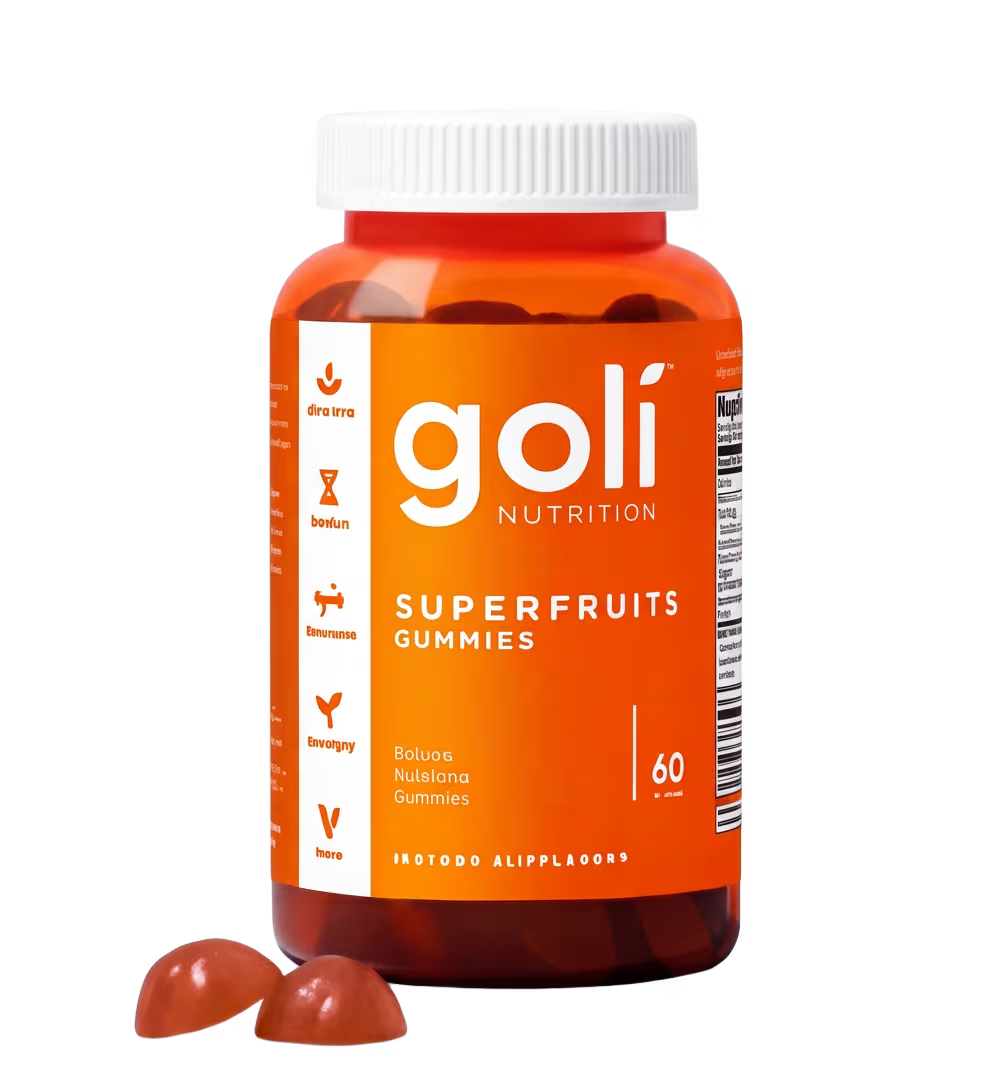
Each gummy has 90 mg of vitamin C, which meets the daily target for men and women on its own.
The label suggests 4 gummies a day, or 360 mg of vitamin C, well under the 2,000 mg upper limit [11].
The gummies are vegan and contain 11 mg of bamboo extract each. Silica has little human skin data, so buy these for the vitamin C.

Collagen in a drink: Strong Cell
lists 2 g of marine collagen along with NADH and CoQ10. That sits at the low end of trial doses [21]. The formula is designed mainly for energy, so treat the collagen as a bonus.
Can supplements tighten loose skin after weight loss or GLP-1 drugs?
Supplements can improve skin quality, but they cannot remove large amounts of excess skin. Collagen trials measured small changes in hydration and elasticity, mostly in middle-aged women [21]. They did not study people with folds of skin after a 50 kg loss.
GLP-1 drugs such as semaglutide (Ozempic, Wegovy) and tirzepatide (Mounjaro, Zepbound) lowered body weight 5% to 18% more than placebo in trials [18].
According to Cleveland Clinic, the drugs themselves do not cause loose skin. Rapid weight loss does, whatever method produces it [17].
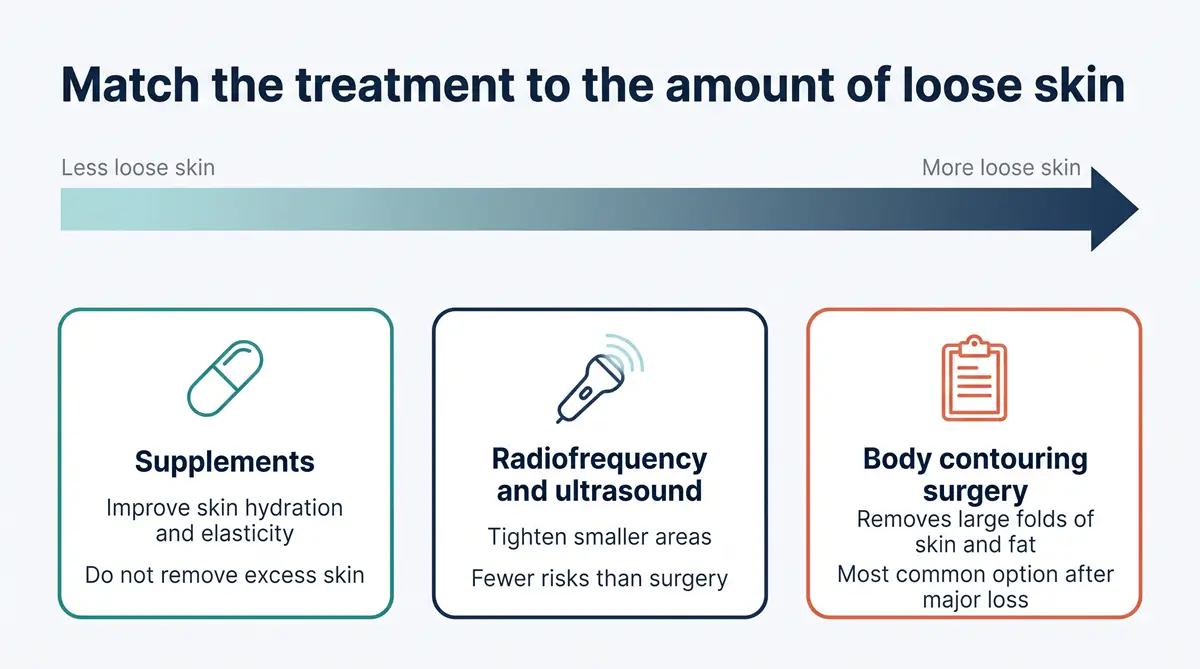
“Will supplements fix the skin on my stomach after losing 100 pounds?” Probably not on their own. Body contouring = surgery that removes excess skin and fat, and it is the most common way to treat large amounts of loose skin. Radiofrequency and ultrasound treatments can tighten smaller areas with fewer risks [15].
Take these steps while you lose weight.
- Lose weight gradually. Cleveland Clinic advises a slower pace because it gives your body time to adjust [9].
- Eat 1.2 to 2.0 g of protein per kg of adjusted body weight daily [18].
- Strength train to keep muscle under your skin [9]. Our arm workouts guide is a simple place to start.
- Start collagen early. Elasticity gains showed mainly at 12 weeks [21], so starting during weight loss gives your skin a head start.
- Tell your prescriber about every supplement you take.
What daily habits protect skin elasticity?
Supplements add to your daily habits. They do not replace them.
- Wear sunscreen daily. UV exposure drives up to 90% of skin aging [16], which outweighs anything a capsule can offset.
- Ask your doctor about a retinoid, a vitamin A-based skin cream. Prescription tretinoin raises collagen production, and many studies show it reverses sun damage [20].
- Quit smoking. Smoking damages collagen fibers, and quitting stops the ongoing damage [20].
- Strength train during weight loss to preserve the muscle under your skin [9].
- Hit your protein target from the protein section above [18].
Weak evidence: elastin, biotin, vitamin D, and vitamin E
Many skin formulas contain these four. None has strong human data for skin elasticity.
- Elastin peptides. We found no meta-analysis of oral elastin supplements. Collagen trials already measure elasticity directly.
- Biotin. Deficiency is rare, and we found no trial linking biotin supplements to firmer skin.
- Vitamin D. Your bones, muscles, and immune system need it. People with obesity or a history of gastric bypass may need more, so ask your doctor about a blood test. Food sources include fatty fish, fortified milk, egg yolks, and mushrooms exposed to UV light [14].
- Vitamin E. Nuts and seeds supply it, and it works as an antioxidant. We found no trial showing that vitamin E alone improves elasticity.
If you take a multivitamin, it likely covers your vitamin D, vitamin E, and biotin.
Are skin elasticity supplements safe?
Most supplements in this guide have a good safety record at trial doses. The collagen and hyaluronic acid trials reported no side effects, and the rice ceramide study reported no adverse events [3][5][6]. The risks come from high doses and medical conditions.

- Vitamin C. Stay under 2,000 mg a day. If you have hemochromatosis, a condition that makes your body store too much iron, high doses could make it worse [11].
- Zinc. Stay under 40 mg a day. Long-term high doses can cause copper deficiency [12][13].
- Astaxanthin. European regulators set a safe limit of 8 mg a day. Ask your doctor first if you take blood pressure, blood-thinning, or diabetes drugs [10].
- Marine collagen. Avoid it if you have a fish allergy, and choose bovine collagen instead.
- GLP-1 users. Review every supplement with your prescriber, because these drugs change how much you eat.
- Quality. The US Food and Drug Administration (FDA) does not approve supplements before they go on sale, so look for third-party testing.
Frequently asked questions
What is the best supplement for skin elasticity?
Hydrolyzed collagen peptides. A 2026 meta-analysis of 35 randomized trials with 2,534 people found better skin elasticity, with gains showing mainly at 12 weeks. Independent, high-quality trials show weaker results, so expect modest changes in how firm and hydrated your skin feels, not visible lifting.
How much collagen should I take a day for skin elasticity?
2.5 to 5 grams a day is a sensible start. Trials used 0.5 to 10 grams of hydrolyzed collagen daily. In one well-known trial of 69 women, both 2.5 and 5 grams improved elasticity within 8 weeks, so starting high adds little. Give any dose at least 12 weeks.
How long does it take for skin elasticity supplements to work?
About 12 weeks. In pooled data from 35 trials, collagen’s elasticity benefit showed up mainly at 12 weeks. Hyaluronic acid improved elasticity at 8 and 12 weeks in a placebo-controlled trial. Take before photos on day one and judge your results at week 12, not after the first month.
Is collagen or elastin better for skin elasticity?
Collagen. Oral collagen peptides have 35 randomized trials that measured skin elasticity directly, while we found no meta-analysis of oral elastin supplements. Your body builds its own elastin from the protein you eat, so a separate elastin supplement likely adds little if your diet and collagen intake are covered.
Can supplements tighten loose skin after major weight loss?
No, not on their own. Supplements can improve skin hydration and elasticity, but they cannot remove large folds of excess skin. Body contouring surgery, which removes excess skin and fat, is the most common treatment after major weight loss, and radiofrequency or ultrasound treatments can tighten smaller areas with fewer risks.
Do supplements help with loose skin from Ozempic or Wegovy?
They may help a little. Loose skin on GLP-1 weight loss drugs like Ozempic and Wegovy comes from rapid weight loss, not from the drug itself. Losing weight gradually, eating enough protein, and strength training do more to protect your skin. Tell your prescriber about every supplement you take.
Are skin elasticity supplements safe?
Yes, for most people at the doses used in trials. The collagen and hyaluronic acid trials reported no side effects. Keep vitamin C under 2,000 mg and zinc under 40 mg a day, and avoid marine collagen if you have a fish allergy. Ask your doctor first if you take prescription drugs.
Can I take collagen and hyaluronic acid together?
Yes. Collagen supports your skin’s structure, and hyaluronic acid holds water in your skin, so the two do different jobs. No trial we reviewed reported a problem with taking them together. Doses that worked in trials were 2.5 to 5 grams of collagen and about 120 mg of hyaluronic acid a day.
Which supplements should you take?
Start with 2.5 to 5 g of hydrolyzed collagen peptides a day. Add about 120 mg of hyaluronic acid if dry skin is part of your concern [1] [5]. Get your vitamin C and protein from food first. Take before photos today, and judge your results at week 12, not week 4.
How we researched this
We reviewed meta-analyses and randomized trials published through 2026, giving priority to human studies that measured skin elasticity directly. We graded each supplement by the number, size, and independence of its trials. Doses and safety limits come from the trials, the National Institutes of Health (NIH) Office of Dietary Supplements, and the European Food Safety Authority. We did not test the products listed.
References
- Journal of Cosmetic Dermatology – “Oral Collagen Peptides and Skin Rejuvenation” – 2026
- The American Journal of Medicine – “Effects of Collagen Supplements on Skin Aging” – 2025
- Skin Pharmacology and Physiology – “Oral supplementation of specific collagen peptides has beneficial effects on human skin physiology: a double-blind, placebo-controlled study” – 2014
- Journal of Drugs in Dermatology – “Oral Hyaluronic Acid Supplement Efficacy in Skin Hydration, Elasticity, and Wrinkle Depth Reduction” – September 2025
- Nutrients – “Oral Hyaluronan Relieves Wrinkles and Improves Dry Skin” – 2021
- Nutrients – “Effect of Rice (Oryza sativa L.) Ceramides Supplementation on Improving Skin Barrier Functions and Depigmentation” – 2022
- International Journal of Cosmetic Science – “The moisturizing effect of a wheat extract food supplement on women’s skin: a randomized, double-blind placebo-controlled trial” – April 2011
- Nutrients – “Systematic Review and Meta-Analysis on the Effects of Astaxanthin on Human Skin Ageing” – 2021
- Cleveland Clinic – “Can Ozempic Cause You To Lose Muscle?” – Accessed October 2026
- News-Medical – “Astaxanthin and Human Health: Evidence on Skin, Vision, Brain and Aging” – January 4, 2026
- NIH Office of Dietary Supplements – “Vitamin C Fact Sheet for Consumers” – Accessed October 2026
- NIH Office of Dietary Supplements – “Copper Fact Sheet for Consumers” – Accessed October 2026
- NIH Office of Dietary Supplements – “Zinc Fact Sheet for Health Professionals” – Accessed October 2026
- NIH Office of Dietary Supplements – “Vitamin D Fact Sheet for Consumers” – Accessed October 2026
- Healthline – “How to Tighten Loose Skin After Weight Loss” – Accessed October 2026
- Verywell Health – “How to Protect Skin Elasticity Naturally” – Accessed October 2026
- Cleveland Clinic – “How GLP-1 Meds Can Affect Your Appearance” – Accessed October 2026
- ACLM, ASN, OMA, and The Obesity Society joint advisory – “Nutritional priorities to support GLP-1 therapy for obesity” – May 2025
- Nutritional Outlook – “Verisol shows skin hydration, elasticity improvement, and wrinkle reduction in recent clinical trial” – Accessed October 2026
- Healthline – “13 Science-Backed Ways to Improve Skin Elasticity” – Accessed October 2026
- Dermatology Advisor – “Collagen Supplements Improve Some Aging Parameters, Not Structural Outcomes” – 2026