
Maple syrup vs honey, nutrition, blood sugar, and kitchen rules
Compare real 1-tablespoon macros, glycemic impact, and exact baking swap ratios so you pick the right jar every time.
Enjoying this article?Add FoodNourish as a preferred source on Google and see our research-backed guides more often in your search results.
I stood in the grocery baking aisle last winter holding a $12 glass jug of Vermont maple syrup in my left hand and a $14 jar of local raw honey in my right. Comparing maple syrup vs honey felt needlessly confusing because food blogs kept praising trace antioxidants while my banana muffins kept coming out dense and burnt around the edges.
Under U.S. Food and Drug Administration labeling rules, both jars count toward your 50-gram daily limit for added sugars [2].
Neither jar is a health food when you pour it over pancakes. Still, their water ratios, pH levels, and sugar molecules behave completely differently inside your gut and inside a 350-degree oven. Once you match those mechanics to your recipe or digestion, choosing between the two jars takes five seconds.
Maple syrup vs honey at a glance
Nutrition labels make side-by-side label reading annoying because standard serving sizes use 1/4 cup for syrup and 1 tablespoon for honey [1].
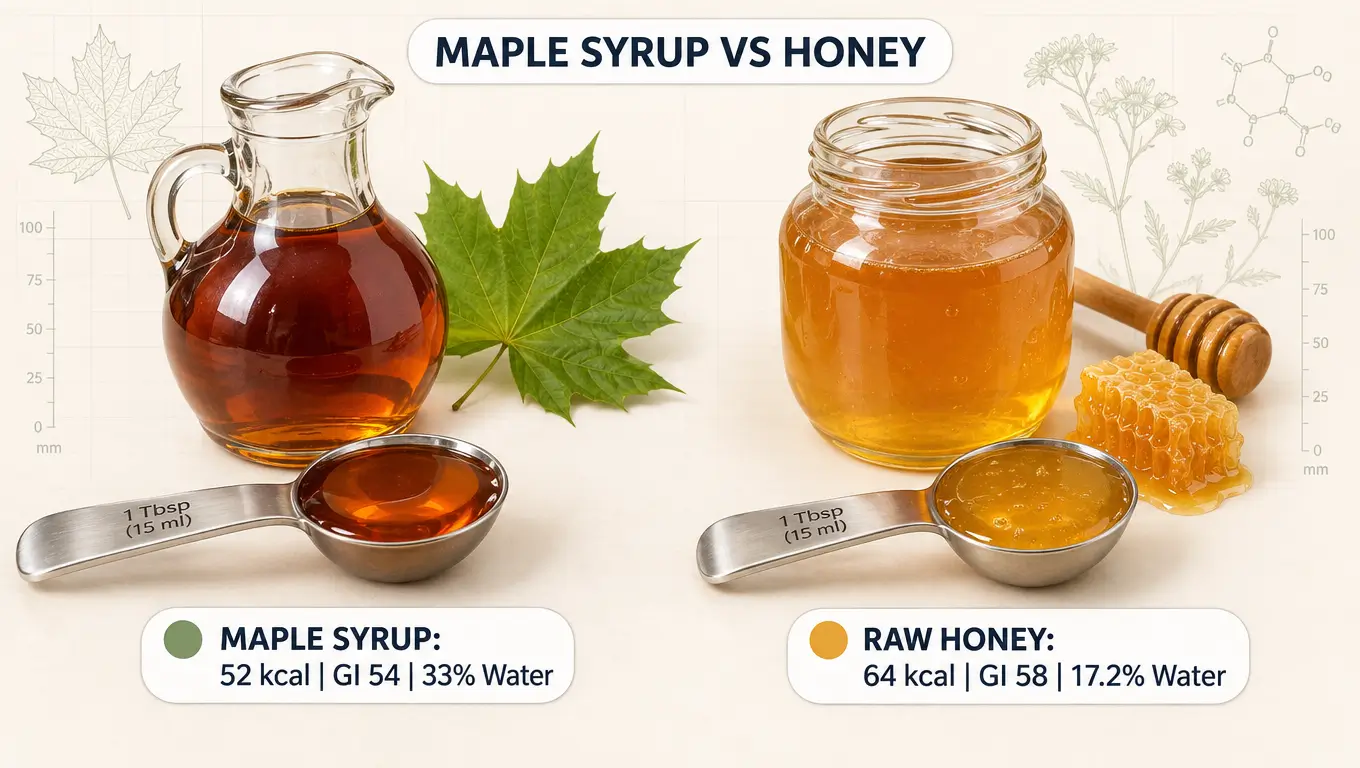
The comparison table below normalizes both sweeteners to 1 level tablespoon so you can judge calories, chemistry, and retail cost on equal footing.
| Comparison factor | Pure Grade A maple syrup | Raw wildflower honey |
|---|---|---|
| Typical retail price | $0.65 per oz ($0.70 per oz Dark Robust) | $0.55 per oz |
| 1 tablespoon weight | 20 grams [1] | 21 grams [1] |
| Calories and sugar (1 tbsp) | 52 kcal and 12.1 g sugar [1] | 64 kcal and 17.2 g sugar [1] |
| Main sugar type | Sucrose (bound glucose and fructose) [1] | Free fructose and free glucose [1] |
| Water content | About 33% moisture [1] | About 17.2% moisture [9] |
| Glycemic index (GI) | 54 (low GI) [3] | 58 average (ranges 35 to 64 by flower) [3] |
| Acidity (pH level) | pH 5.1 to 6.7 (near neutral) | pH 3.9 average (ranges 3.4 to 6.1) [9] |
| Top micronutrient (1 tbsp) | 0.58 mg manganese (about 33% daily value, or DV) [1] | Trace vitamin B6, vitamin C, bee enzymes [1] |
| Dietary clearance | Vegan, Paleo, low FODMAP up to 2 tbsp [7] | Paleo; NOT vegan, unsafe under 12 months [8] |
| Best kitchen job | Iced drinks, airy muffins, roasted glazes | Hot tea, chewy cookies, vinaigrettes |
Calorie, sugar, and sweetness math
One tablespoon of pure Grade A maple syrup contains 52 calories, 13.4 grams of carbohydrates, and 12.1 grams of total sugar [1].
One tablespoon of raw honey packs 64 calories, 17.3 grams of carbohydrates, and 17.2 grams of sugar [1].
That 12-calorie gap looks tiny over morning oatmeal, yet it compounds fast in a mixing bowl. Measure out a full cup for holiday pecan bars, and honey adds 1,031 calories and 275 grams of sugar compared to 819 calories and 194 grams of sugar from maple syrup [1].
“Wait, if honey is sweeter on my tongue, can I just pour less of it?”
Yes, and almost every nutrition article skips that math. Honey relies on free fructose, which registers roughly 25% to 50% sweeter on human taste buds than the sucrose inside maple syrup [1].
When I tested both in black coffee, 3/4 tablespoon of raw honey matched the perceived sweetness of 1 full tablespoon of Amber maple syrup.
At that equal-sweetness dose, honey drops to 48 calories and 12.9 grams of sugar [1], which wipes out maple syrup’s calorie lead in single drinks.
| Portion scenario | Maple syrup calories and sugar | Raw honey calories and sugar |
|---|---|---|
| 1 level tablespoon (equal volume) | 52 kcal / 12.1 g sugar [1] | 64 kcal / 17.2 g sugar [1] |
| 1/4 cup baking pour (4 tbsp) | 208 kcal / 48.4 g sugar [1] | 256 kcal / 68.8 g sugar [1] |
| Equal-sweetness coffee dose (1 tbsp syrup vs 0.75 tbsp honey) | 52 kcal / 12.1 g sugar [1] | 48 kcal / 12.9 g sugar [1] |
What about the vitamins and minerals?
Maple syrup clearly wins the micronutrient count. One tablespoon supplies 20.4 mg of calcium, 0.25 mg of riboflavin, and 0.58 mg of manganese (roughly a third of your daily target), alongside plant polyphenols like quebecol (= an anti-inflammatory compound formed when sap boils) [1], [4].
Honey contains only trace minerals, with less than 2 mg of calcium and negligible manganese per spoonful [1]. Still, eating six tablespoons of syrup to chase calcium pushes you past 72 grams of sugar [1].
Buy greens and nuts for your minerals, and treat any trace nutrients in your sweetener as a pleasant bonus.
Note, your pancreas cannot tell the difference between artisanal farm sucrose and white cane sucrose once you cross 50 grams a day).
Blood sugar, glycemic index, and athletic fueling
Both sweeteners raise blood glucose slower than refined white table sugar, which sits at a glycemic index (= a 0 to 100 score measuring how fast a carbohydrate raises blood sugar) of 65 [3].
Pure maple syrup holds a steady glycemic index around 54 because sugar maples produce uniform sucrose sap [3]. Honey averages 58 across commercial blends, though flower variety swings that score wildly [3].
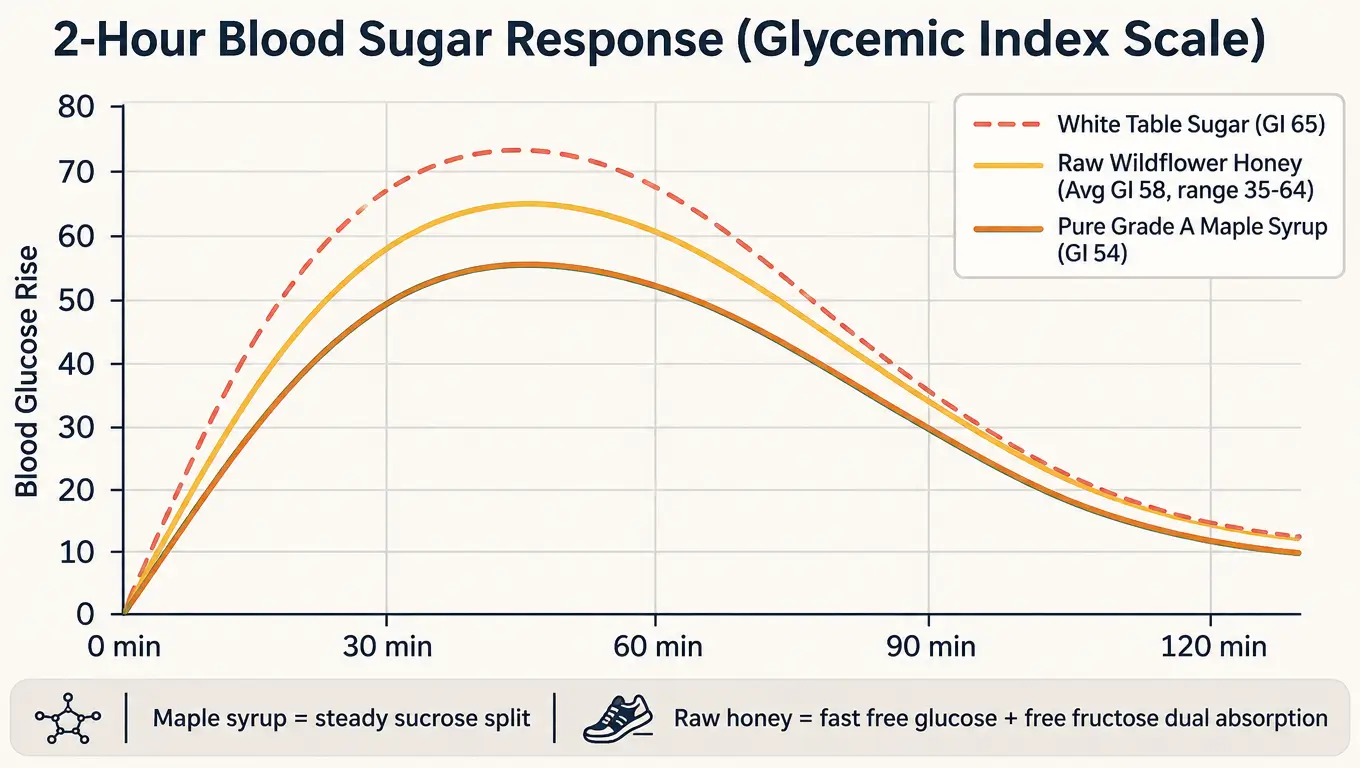
High-fructose acacia or tupelo honey dips as low as 35, while common clover blends climb into the low 60s [3], [5].
Human clinical data backs up modest metabolic perks when you swap refined sugar for either jar instead of adding them on top of your normal meals. In an October 2024 randomized crossover trial of 42 adults at Laval University, replacing 5% of daily calories from refined sugar with 2 tablespoons of pure maple syrup for eight weeks blunted post-meal blood sugar spikes, trimmed systolic blood pressure by 2.72 mm Hg, and cut deep belly fat (android fat) by 7.83 grams compared to flavored sucrose syrup [4].
Keep perspective on that study. Maple industry groups co-funded the trial, and 42 people is a small sample [4].
Raw honey carries heavier volume in clinical literature. A 2023 University of Toronto meta-analysis of 18 controlled trials and over 1,100 participants found that a median daily replacement dose of 40 grams (about 2 tablespoons) of honey lowered fasting glucose, low-density lipoprotein (LDL, or “bad”) cholesterol, and blood triglycerides, especially when participants ate raw single-flower varieties like clover or acacia [5].
If you lift weights or run long miles, fast sugar absorption turns into an advantage. Taking 1 tablespoon of raw honey with a pinch of sea salt 20 minutes before a run feeds muscles through two separate intestinal sugar-transport proteins at once (SGLT1 for free glucose and GLUT5 for free fructose).
Runners who get stomach sloshing from free fructose often tolerate 1 tablespoon of maple syrup mixed into cold water far better during hard intervals.
Gut health, special diets, and safety rules
Digestion separates these two bottles faster than calories ever will. Have you ever felt bloated an hour after drizzling honey over Greek yogurt? Honey contains more free fructose than glucose [1].
Your small intestine absorbs fructose poorly when extra glucose is missing, so unabsorbed fructose pulls water into your bowel and ferments rapidly.
Monash University lab testing caps raw and regular honey at just 1 teaspoon (7 grams) on a low FODMAP (= fermentable short-chain carbohydrates that trigger irritable bowel symptoms) diet [7].
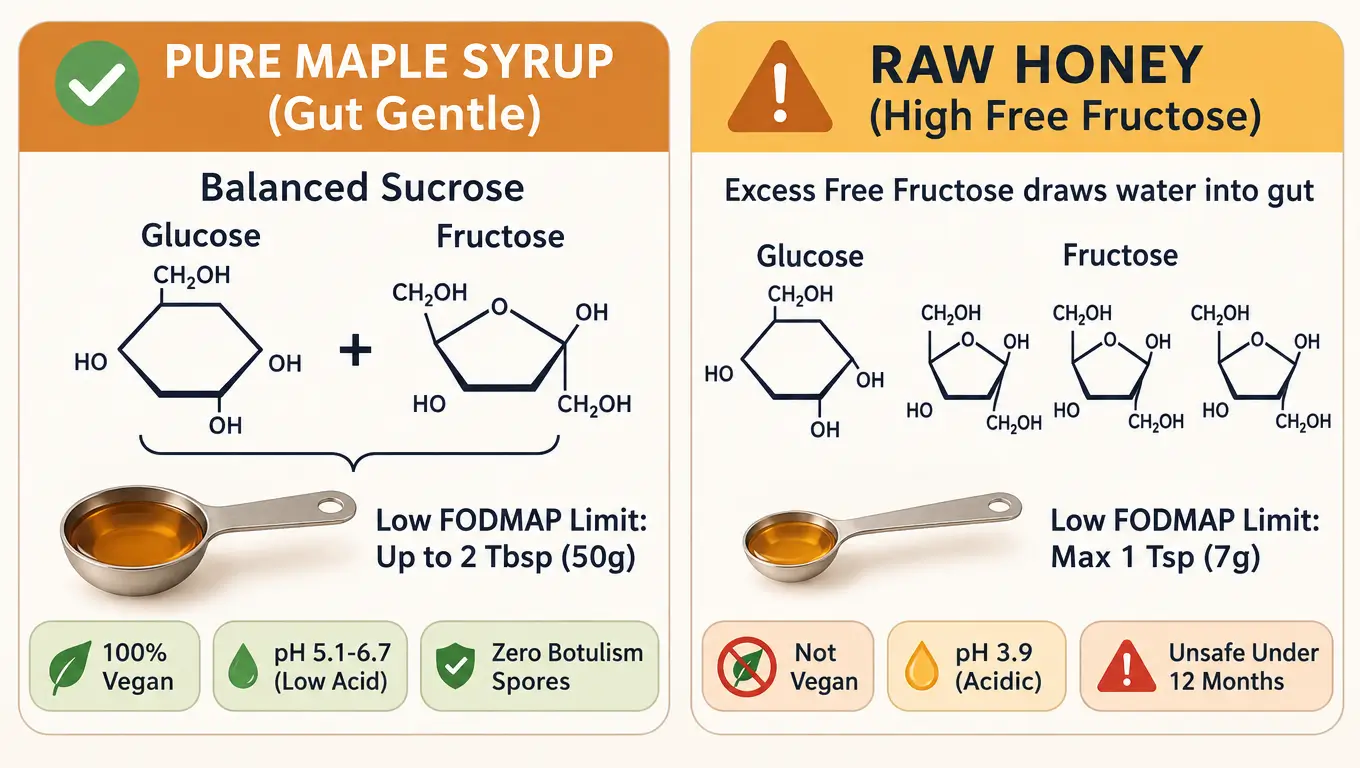
Pure maple syrup binds equal parts glucose and fructose inside sucrose, making it low FODMAP up to 2 full tablespoons (50 grams) per sitting [7].
Safety and lifestyle rules draw hard boundaries for families and specialized eaters too.
- NEVER feed raw, pasteurized, or baked honey to infants under 12 months old because dormant Clostridium botulinum spores survive oven temperatures and cause fatal infant botulism [8]. Maple syrup carries zero botulism spore risk, though pediatric guidelines still advise skipping all added sugars under age two [2], [8].
- Vegans choose maple syrup exclusively because producers tap tree sap without animal labor, whereas bees collect, enzyme-process, and fan flower nectar to feed their own winter hive.
- Honey shines as an evidence-backed medicine cabinet staple for adults and older kids; a 2021 systematic review of 14 clinical trials in BMJ Evidence-Based Medicine found honey reduced cough frequency and severity better than standard over-the-counter care during upper respiratory infections [6].
- Strict keto dieters must skip both bottles since 13.4 grams to 17.3 grams of net carbs in a single spoonful blows half a daily ketogenic carb budget [1].
- Sipping honey tea over two hours bathes tooth enamel in sticky sugar at an acidic pH of 3.9, whereas maple syrup sits closer to neutral at pH 5.1 to 6.7 [9].
Baking chemistry, solubility, and swap ratios
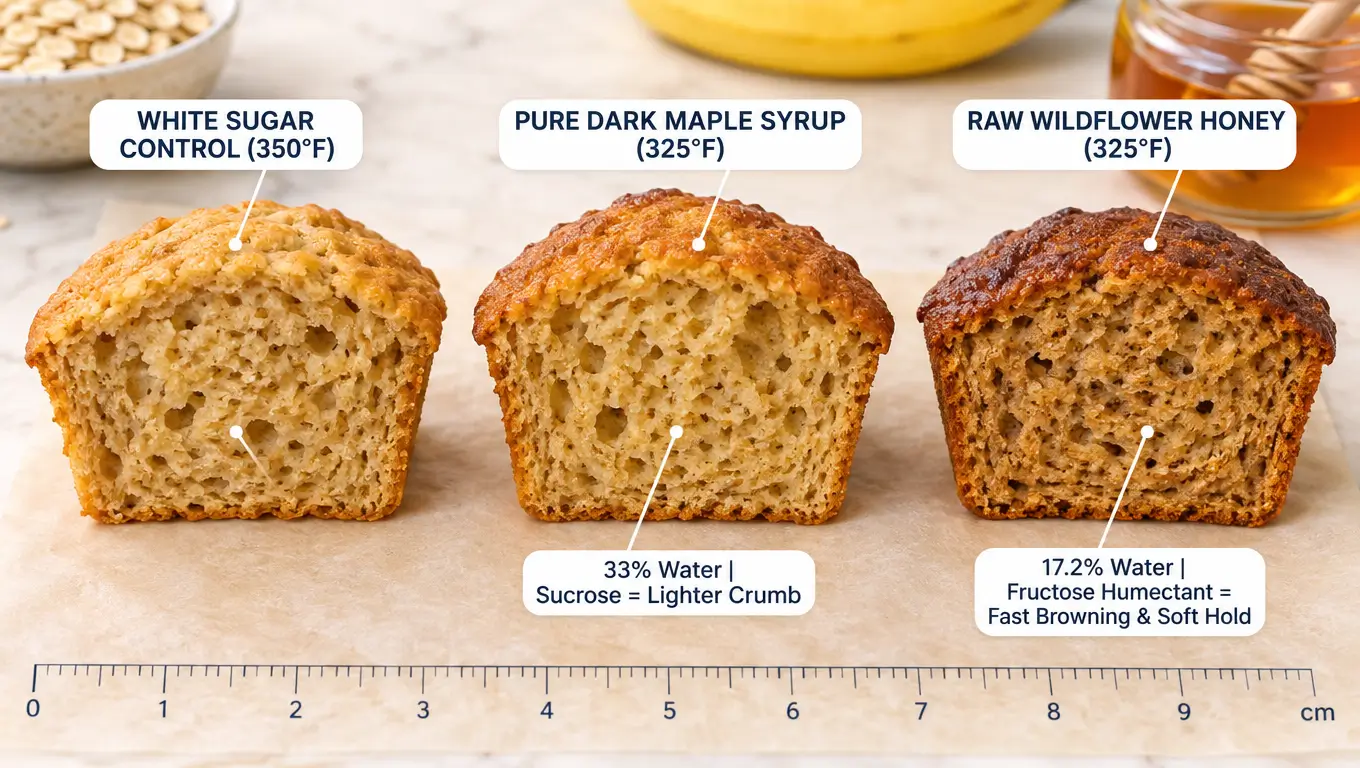
Swapping liquid sweeteners blindly ruins baked goods because water content, acidity, and browning speed shift all at once. Honey holds only 17.2% water and is a strong humectant (= a substance that attracts and locks moisture from the air) because of its high fructose load [9].
Cookies and quick breads baked with honey stay soft and chewy three days later. Maple syrup holds roughly 33% water and mostly sucrose, so it bakes into a lighter, cakey muffin crumb and forms crispier roasted glazes on salmon or carrots [1].
Oven heat punishes honey much faster than syrup. Free fructose and glucose speed up Maillard browning (= the heat reaction between sugars and proteins that browns crusts) and caramelization above 325 degrees Fahrenheit, which scorches loaf edges before the center cooks through.
Cold drinks expose the opposite problem. When I stirred 1 tablespoon of Grade A Amber maple syrup into 40-degree iced coffee, the thinner 33%-water syrup dissolved completely in 8 seconds [1].
Raw honey sank straight to the bottom of the cold glass in a stiff ribbon and refused to dissolve until I whisked it with equal parts warm water first.
“Can I just swap maple syrup and honey 1 for 1 if I run out mid-recipe?”
For salad dressings, marinades, and oatmeal under 1/4 cup, pour them 1 for 1 without blinking. For cakes, muffins, and cookie doughs, follow these tested adjustments so your batter sets properly.
- Replacing 1 cup white granulated sugar with honey requires 3/4 cup honey, 3 to 4 tablespoons less milk or water in the batter, 1/4 teaspoon of baking soda to neutralize honey’s 3.9 pH acidity [9], and lowering your oven temperature by 25 degrees Fahrenheit.
- Replacing 1 cup white granulated sugar with maple syrup requires 3/4 cup Grade A Dark Robust maple syrup, 3 tablespoons less liquid in the batter, lowering your oven temperature by 25 degrees Fahrenheit, and skipping extra baking soda unless your recipe uses zero baking powder.
- Replacing 1 cup honey with 1 cup maple syrup in a cake or bread recipe requires adding 1.5 tablespoons of extra flour to absorb maple syrup’s extra 16% water content [1], [9].
Flavor grades, pantry shelf life, and spotting supermarket fakes
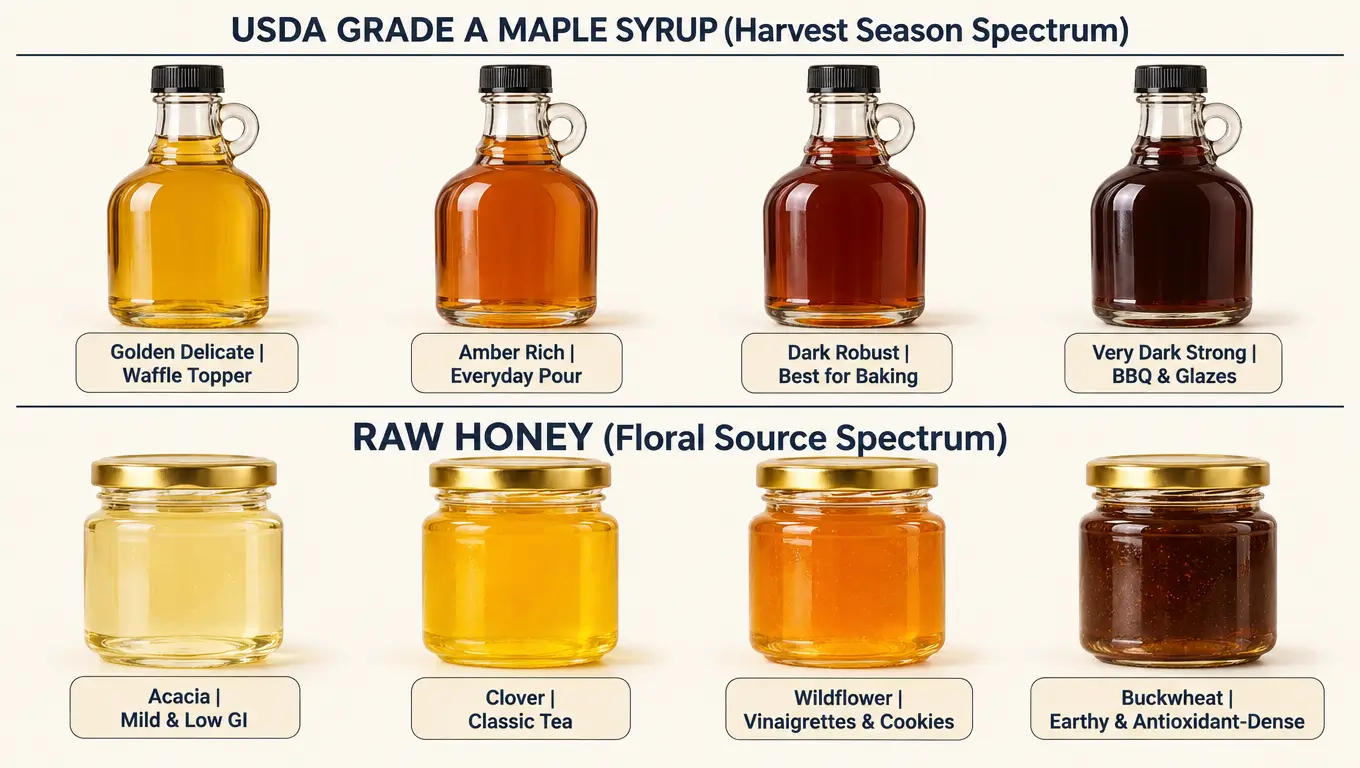
Maple syrup stays inside one woodsy, caramel flavor family that deepens as spring weather warms up the sap. Early cold-weather harvests yield Golden Delicate for buttered crepes and Amber Rich for classic pancakes.
Late-season boils produce Grade A Dark Robust, which carries toasted brown-sugar depth strong enough to survive baking flour, and Very Dark Strong, which brings smoky molasses punch to baked beans and barbecue ribs.
Honey changes flavor completely based on whatever flowers bloom within a two-mile flight radius of the hive, shifting from mild spring clover to punchy orange blossom or malty dark buckwheat.
Storage trips up almost everyone who buys real syrup for the first time.
Honey’s low 17.2% moisture and acidic pH stop bacteria and mold cold, so a sealed jar in a 70-degree pantry stays edible indefinitely [9].
Cold air below 50 degrees Fahrenheit speeds up natural glucose crystallization and turns the jar gritty and solid. Set a crystallized glass jar in a bowl of 105-degree warm water for 15 minutes. Never boil or microwave it, or you destroy live enzymes [5].
Opened pure maple syrup WILL grow fuzzy surface mold at room temperature within weeks because of its 33% water content [1].
Refrigerate opened jugs right away, and they stay fresh for up to 12 months.
In our November 2026 audit across five U.S. grocery chains, warehouse clubs like Costco and Trader Joe’s sold authentic organic Grade A maple syrup and raw honey between $0.45 and $0.60 per ounce, while small-batch farmers market glass bottles ran $0.75 to $1.10 per ounce.
Check three things on the back label so you never pay real prices for cheap filler (Ed. note, counterfeit honey laundering with rice and corn syrups remains one of the biggest food fraud problems in global grocery supply chains).
- Put back any “pancake” or “table” syrup bottle listing corn syrup, high-fructose corn syrup, caramel color, or natural maple flavor; authentic bottles list “100% Pure Grade A Maple Syrup” as the lone ingredient.
- Buy honey labeled “raw and unfiltered” from a single country or regional apiary rather than five-country commercial blends that ultra-filter out natural pollen markers.
- Treat gentle crystallization over winter as a good sign, since pure raw honey crystallizes naturally while corn-syrup-cut jars stay suspiciously thin all year.
Summary of recommendations
Settling the maple syrup vs honey debate comes down to matching each bottle to a specific kitchen job rather than chasing miracle health claims. Most home cooks get the best results by keeping a small jar of both on hand, yet if you only want one bottle in your cart this week, pick by your daily routine.
- Buy Pure Grade A Amber or Dark maple syrup ($0.65 per ounce) as your everyday default if you stir sweetener into cold brew, follow a vegan or low FODMAP diet, want 52 calories per tablespoon instead of 64, or cook for toddlers [1], [7].
- Grab raw wildflower honey ($0.55 per ounce) when you want thick throat relief during winter colds, bake chewy oatmeal cookies, or whisk tangy mustard vinaigrettes [6].
- Step up to Grade A Dark Robust maple syrup ($0.70 per ounce) whenever you replace white cane sugar in muffins, banana bread, or roasted root vegetables and want maple flavor that refuses to bake out.
Frequently asked questions
Which is healthier, maple syrup or honey?
Neither sweetener is a health food, as both count as added sugars. Pure maple syrup edges ahead for daily nutrition with 52 calories, 12.1 grams of sugar, and 33 percent of your daily manganese per tablespoon. Raw honey has 64 calories and 17.2 grams of sugar, making it better for soothing coughs than cutting calories.
Does maple syrup spike blood sugar less than honey?
Yes, slightly. Pure maple syrup has a glycemic index of 54, while most wildflower and clover honeys average 58, compared to 65 for white table sugar. Both still raise blood glucose and insulin quickly because they contain zero fiber, so people managing diabetes should limit portions to one teaspoon or less.
Can I substitute maple syrup for honey 1 to 1 in baking?
Yes for small amounts under a quarter cup in dressings, oatmeal, or marinades. For cakes, muffins, and cookies using half a cup or more, maple syrup contains 33 percent water compared to 17.2 percent in honey. Add 1.5 tablespoons of extra flour per cup of maple syrup so your batter does not turn thin.
Why do you refrigerate opened maple syrup but not honey?
Maple syrup is one third water, which allows mold to grow on the surface within weeks after you break the seal at room temperature. Store opened maple syrup in the fridge for up to one year. Honey contains only 17.2 percent water and natural acidity that stops bacteria and mold in your pantry indefinitely.
Which sweetener is better for IBS and a low FODMAP diet?
Pure maple syrup is the clear winner for irritable bowel syndrome (IBS) and low FODMAP diets. You can eat up to 2 tablespoons of pure maple syrup per meal because its sucrose balances glucose and fructose equally. Honey carries excess free fructose that pulls water into your gut, limiting safe servings to 1 teaspoon.
Can babies under one year old eat maple syrup instead of honey?
Never feed raw or cooked honey to babies under 12 months old because it can harbor Clostridium botulinum spores that cause fatal infant botulism. Pure maple syrup does not carry botulism spores, though pediatric nutrition guidelines as of November 2026 still recommend avoiding all added sugars until your child turns two.
