No chew foods after surgery: 60+ soft foods, meal plans, and recipes
Exactly what to eat at every recovery stage so you heal faster, hit your protein, and skip the pain.
Enjoying this article?Add FoodNourish as a preferred source on Google and see our research-backed guides more often in your search results.
You found this page for one of two reasons.
- You are recovering right now and your mouth hurts, or
- You have surgery coming up and you want to shop before you are too sore to think.
Either way, you need food that heals you without touching the surgical site. This guide covers wisdom teeth, tooth extractions, dental implants, jaw surgery, and bariatric puree stages.
You get a full food list, a day-by-day meal plan, high-protein picks, five recipes, and a shopping list you can print.
QUICK ANSWER
The best no chew foods after surgery are liquids and smooth, soft foods that need zero chewing, like smoothies, yogurt, broth, applesauce, mashed potatoes, scrambled eggs, and blended soups. Start with cool liquids for the first 24 hours. Move to soft foods over the next week. Skip straws, hot food, and anything crunchy so you protect the blood clot and avoid dry socket.
No chew, soft, and liquid are three different things
Most pages use these words like they mean the same thing.
They do not, and mixing them up is how people hurt themselves on day two.
- A liquid diet means anything you can sip or pour. Think broth, milk, thin smoothies, and meal-replacement shakes. Nothing holds its shape.
- A pureed or no-chew diet means blended foods with body but no texture. You can eat them with a spoon, and they need no chewing at all. Mashed potatoes, yogurt, applesauce, and blended soup live here.
- A soft diet means foods you can mash with a fork or your tongue. Scrambled eggs, soft pasta, flaky fish, and ripe banana qualify. You barely chew, and you keep that work away from the wound.
| Stage | Texture | Example foods | When to use |
|---|---|---|---|
| Liquid | Pours or sips, no shape | Broth, milk, thin smoothie, shakes | First 24 hours |
| Pureed / no chew | Spoonable, smooth, no chewing | Yogurt, applesauce, mashed potato, blended soup | Days 1 to 3 |
| Soft | Mashes with a fork | Scrambled eggs, soft pasta, flaky fish | Days 3 to 7+ |
Which stage you stay in, and for how long, depends on your surgery. That is the next thing to sort out.
How long do you have to avoid chewing?
This is where the three audiences split, and where most articles only serve one. Your timeline depends entirely on what was done.
After wisdom teeth removal or a simple tooth extraction, most people return to a near-normal diet within 7 to 10 days, according to oral surgery guidance from Aspen Dental [1] and Somerset Oral Surgery [2].
The first 24 to 48 hours are the strictest. After dental implant surgery, the window runs similar but stretches longer if a bone graft was involved, so follow your surgeon’s exact instructions.
Jaw surgery is a different category. A soft, no-chew diet often runs 6 weeks to let the bone heal, and Dr. Chad Dammling, DDS, MD, told GoodRx that “a soft, no-chew diet for 6 weeks allows for proper bone healing” [3].
He also noted that 15% to 20% of swelling can take 2 to 3 months to fully resolve [3].
Bariatric patients follow a puree phase of roughly 4 weeks before moving to soft foods, based on post-bariatric nutrition guidance [4].
| Surgery type | No-chew duration | Return to normal eating |
|---|---|---|
| Wisdom teeth / extraction | Strict 24 to 48 hrs, soft 7 to 10 days | 7 to 10 days [1][2] |
| Dental implant | Similar, longer with bone graft | Varies, follow surgeon |
| Jaw surgery | Up to 6 weeks no-chew | 6 to 8 weeks [3] |
| Bariatric (puree phase) | ~4 weeks puree | Per program [4] |
Your surgeon’s instructions always beat a general timeline. If they said 6 weeks, they mean 6 weeks. Now for the part you actually came for, the food.
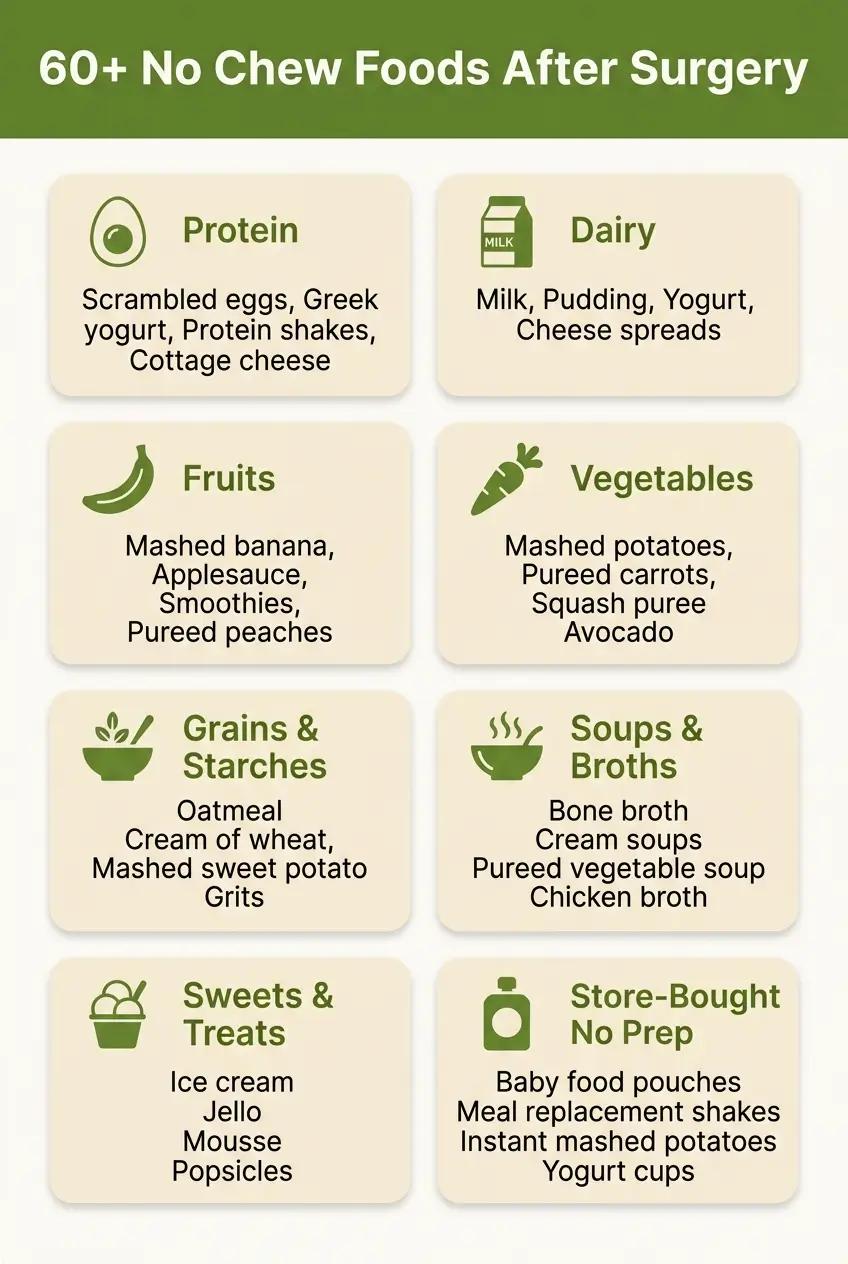
The full no chew food list (60+ foods by category)
I sorted these by category so you can scan straight to what you want and build a grocery list fast. Everything here needs little or no chewing. Save or print this section before you shop.
Protein, the foods that rebuild tissue:
- Scrambled eggs, soft-set
- Greek yogurt, no fruit chunks
- Cottage cheese
- Ricotta
- Silken or soft tofu
- Protein shakes, spoon not straw
- Refried beans
- Hummus
- Finely shredded chicken, moist
- Flaky soft fish like salmon or tilapia
- Smooth peanut or nut butter, blended in
- Lentil puree
- Egg salad, well mashed
- Soft mashed beans
Dairy and dairy-style:
- Milk or fortified plant milk
- Kefir
- Pudding
- Custard and flan
- Cream cheese
- Mascarpone
Fruits, ripe or blended:
- Applesauce
- Mashed banana
- Ripe avocado
- Canned peaches or pears, unsweetened
- Pureed berries, seeds strained
- Ripe mango
- Stewed prunes
- Baked apple, softened
Vegetables, cooked soft or pureed:
- Mashed potatoes
- Mashed sweet potato
- Pureed squash or pumpkin
- Mashed cauliflower
- Steamed soft carrots, mashed
- Creamed corn
- Mashed beets
- Avocado mash
- Soft-cooked spinach, blended
Grains and starches:
- Oatmeal, cooked loose
- Cream of wheat or grits
- Soft pasta or mac and cheese
- Risotto
- Polenta
- Rice pudding
- Soft pancakes, no crunchy edges
- Quinoa, cooked soft
Soups and broths, warm not hot:
- Chicken, beef, or vegetable broth
- Blended vegetable soup
- Cream of tomato
- Butternut squash soup
- Miso soup
- Lentil soup, blended
Sweets and treats:
- Ice cream, no chunks or nuts
- Gelatin
- Sorbet and popsicles, no hard pieces
- Chocolate mousse
- Cheesecake, soft
- Tapioca pudding
Store-bought, no prep needed:
- Baby food pouches, fruit, veg, and meat
- Meal-replacement drinks like Ensure or Boost
- Premade smoothies, no seeds
- Squeeze applesauce
- Single-serve yogurt and pudding cups
A long list helps, but timing matters more in the first day. Here is exactly what to eat right out of surgery.
The first 24 hours: what to eat right after surgery
The first day has one job, protect the blood clot.
After an extraction, your body forms a clot in the empty socket that shields the bone and nerve underneath while new tissue grows. Knock that clot loose and you get dry socket, a painful condition that stalls healing [1].
Two habits cause most clot problems. Heat softens and can dislodge the clot, so keep everything cool or lukewarm on day one. Suction pulls the clot straight out, which is why you skip straws for at least a week [1].
Drink from a cup. Eat smoothies and shakes with a spoon.
Stick to cool liquids and ultra-soft foods for the first 24 hours. Smooth smoothies, broth that has cooled, yogurt, applesauce, pudding, and very loose mashed potatoes all work.
You will not have much appetite, and that is normal. Sip nutrient-dense liquids often instead of forcing a full meal.
What causes dry socket, avoid all of these early
“Can I really not eat anything solid on day one?”
Correct, and it is only one day. By tomorrow your options open up. Here is the full week mapped out.
Day-by-day no chew meal plan for the first week
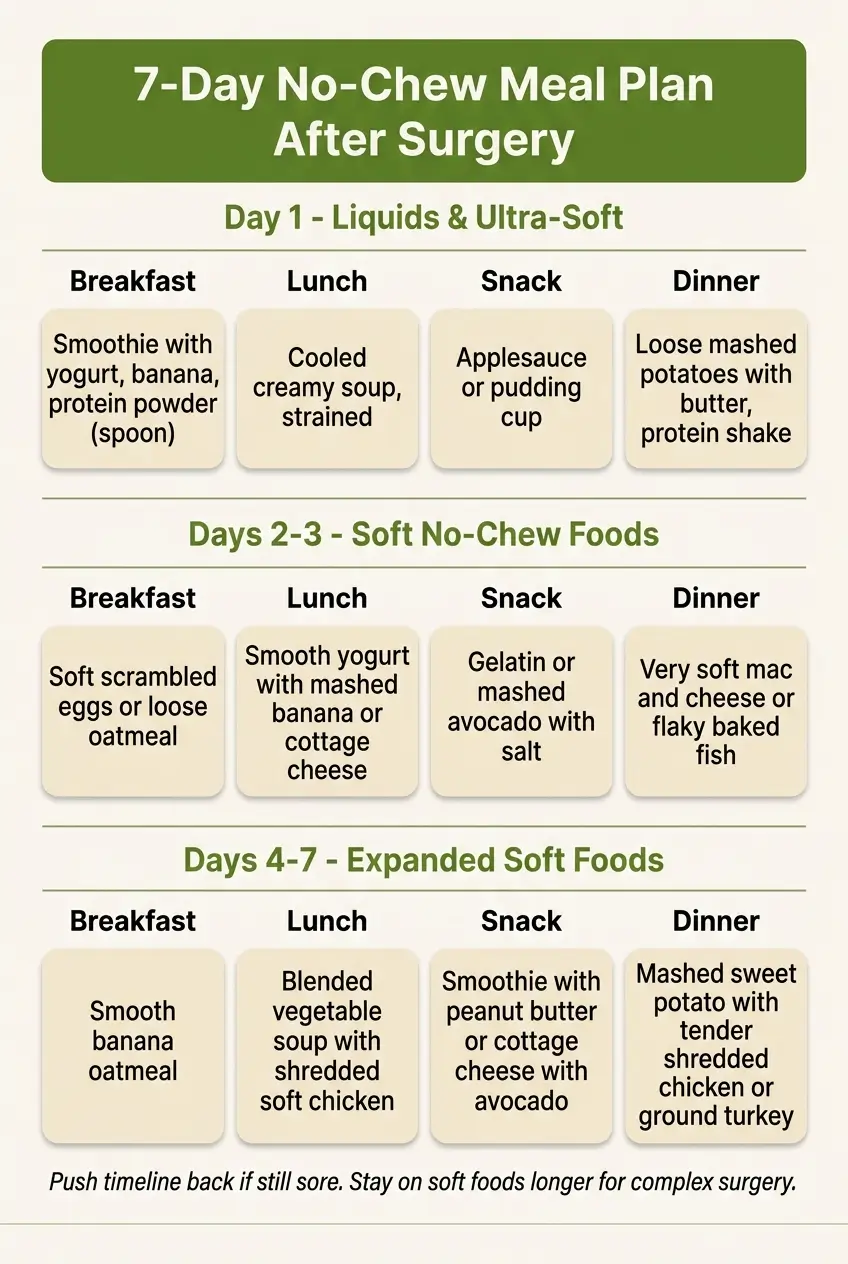
This plan moves you from liquids to soft foods at the pace your mouth can handle. Push the timeline back a day or two if you still feel sore, and stay on soft foods longer if your surgery was complex.
Day 1, liquids and ultra-soft:
- Breakfast: smoothie with yogurt, banana, and a scoop of protein powder, eaten with a spoon
- Lunch: cooled creamy soup, strained of chunks
- Snack: applesauce or a pudding cup
- Dinner: loose mashed potatoes with butter, plus a protein shake
Days 2 to 3, soft no-chew foods:
- Breakfast: soft scrambled eggs, or loose oatmeal
- Lunch: smooth yogurt with mashed banana, or cottage cheese
- Snack: gelatin, or mashed avocado with a pinch of salt
- Dinner: very soft mac and cheese, or flaky baked fish that falls apart
Days 4 to 7, expanded soft foods:
- Breakfast: smooth banana oatmeal (recipe below)
- Lunch: blended vegetable soup with shredded soft chicken
- Snack: smoothie with peanut butter, or cottage cheese with avocado
- Dinner: mashed sweet potato with tender shredded chicken or ground turkey
Eating soft does not mean eating less, and that is where a lot of people slip up. Your body needs MORE fuel while it heals, not less. Here is how to hit it.
How to get enough protein and calories without chewing
Protein is the nutrient that rebuilds the tissue your surgery disturbed, and it speeds recovery and energy [3].
The problem is obvious.
Most high-protein foods, like steak, chicken breast, and nuts, demand exactly the chewing you cannot do. So you have to get smart about soft protein.
A simple way to track it, count your protein in 20 to 30 gram blocks across the day and aim for three to four blocks.
You hit a block with one cup of Greek yogurt, two to three scrambled eggs, a scoop of protein powder in milk, or a half cup of cottage cheese. Stack a few of those and you are covered without chewing once.
High-protein no-chew foods, ranked by protein per serving:
| Food | Serving | Protein (approx) |
|---|---|---|
| Protein shake | 1 scoop in milk | 25 to 30 g |
| Greek yogurt | 1 cup | 15 to 20 g |
| Cottage cheese | 1/2 cup | 12 to 14 g |
| Scrambled eggs | 2 eggs | 12 g |
| Refried beans | 1/2 cup | 7 g |
| Silken tofu | 1/2 cup | 6 to 8 g |
High-protein no chew foods, grams per serving
Approximate values per typical serving. Actual grams vary by brand and portion.
Losing weight during recovery signals you are short on calories, and that slows healing [5].
To pack in more calories without more volume, use whole milk instead of water in shakes and oatmeal, stir in a tablespoon of nut butter or olive oil, add skim milk powder to soups and drinks, and eat five or six small meals instead of three big ones [5].
Liquids fill you up fast, so save water, tea, and broth for the end of a meal rather than the start [5].
Tracking grams is one thing. Eating the same yogurt four times a day gets old by Wednesday. These five recipes give you variety.
5 easy no chew recipes
Each recipe stays smooth or fork-soft, and I added approximate protein and calories so you can fit them into your day. Serve everything warm, never hot.
1. Smooth banana oatmeal
- Cook 1/2 cup quick oats in 1 cup whole milk until very loose.
- Mash 1 ripe banana and stir it in.
- Add a pinch of cinnamon.
- Thin with extra milk if it feels thick. The banana sweetens it and adds potassium.
Per serving: about 9 g protein, 320 calories.
2. Protein scrambled eggs
- Whisk 2 eggs with 2 tablespoons milk.
- Cook slow on low in butter, stirring, until just set and still soft. Overcooked eggs turn rubbery, which defeats the point.
- Stir in a little shredded cheese at the end.
Per serving: about 16 g protein, 240 calories.
3. Creamy mashed sweet potatoes
- Boil 2 peeled, cubed sweet potatoes until a fork slides through.
- Drain, then mash with 2 tablespoons butter, a splash of milk, and a pinch of salt until smooth.
- Blend it if you want it silkier.
High in vitamin A, which supports healing.
Per serving: about 4 g protein, 280 calories.
4. Blended chicken and vegetable soup
- Simmer 2 chopped carrots, 1 potato, and 1 zucchini in 4 cups broth with 1 cup shredded cooked chicken until everything is very soft.
- Blend with an immersion blender to the smoothness you can handle.
One of the easiest ways to get protein and vegetables in one bowl.
Per serving: about 18 g protein, 220 calories.
5. Avocado and cottage cheese blend
- Mash 1 ripe avocado with 1/2 cup cottage cheese and a small drizzle of olive oil.
- Season lightly.
Soft enough to swallow with almost no effort, and loaded with healthy fat and protein.
Per serving: about 14 g protein, 300 calories.
Foods to avoid after surgery, and why
Each food below carries a specific risk, so I paired the item with the reason. Skip these for at least a week, or longer if your surgeon says so [1][2].
- Hard and crunchy foods like chips, nuts, popcorn, and crusty bread. They scrape the site, and small pieces lodge in the socket and invite infection [1].
- Sticky and chewy foods like caramel, toffee, and gum. They tug at stitches and can pull the clot loose when you open your mouth [6].
- Spicy foods like hot sauce and chili. They sting raw tissue and trigger pain [1].
- Acidic foods like citrus, lemonade, and tomato-heavy sauces. They irritate and inflame the wound [6].
- Very hot food and drinks. Heat can dissolve or dislodge the clot and restart bleeding [6].
- Carbonated and alcoholic drinks. Carbonation disturbs the site, and alcohol slows healing and reacts badly with pain medication [6].
- Seeds and small particles like strawberry seeds, chia, and sesame. They get trapped in the socket [7].
Even when you do everything right, a few annoying problems show up mid-recovery. Most have easy fixes.
Common recovery problems and easy fixes
Nobody warns you about these, and they are the complaints I see most.
- No appetite. Surgery and pain medication kill hunger. Force nothing. Sip a protein shake or smoothie every couple of hours instead of facing a plate. Small and frequent beats large and overwhelming.
- Soft-food boredom. By day three, plain yogurt feels like punishment. Rotate flavors, blend different fruit into smoothies, swap savory for sweet, and lean on the five recipes above. Variety is the only fix here.
- Constipation. A soft, low-fiber diet plus pain medication backs you up, and almost no recovery guide mentions it. Add gentle fiber as you heal with blended prunes or prune juice once a day, blended baked beans, and split-pea soup [5]. Increase fiber slowly over a few days, not all at once, and drink plenty of water [5].
- Mouth fatigue. Even soft chewing tires a healing jaw. Chew on the side away from the surgery, take small bites, and stop when it aches. There is no prize for finishing fast.
Once these problems fade and the soreness lifts, you can start easing back to real food.
When and how to return to normal eating
Wait for the signs before you rush this. Soreness should be gone, swelling down, and soft chewing should feel comfortable with no pain at the site. For extractions that is usually around days 7 to 10 [1][2].
For jaw surgery it is closer to 6 to 8 weeks, and Dr. Dammling noted the move to harder foods "should be a gradual transition," with most people sore for the first week of it [3].
Reintroduce textures in steps.
- Start with soft solids like cooked pasta and tender chicken before anything tough.
- Chew on the side opposite the surgery.
- Add one firmer food at a time so you can tell what your mouth tolerates.
- If a food hurts, back off to soft foods for another day or two and try again.
- Hold off on the hardest items, like raw vegetables, steak, and nuts, until you feel fully healed.
If you are reading this before surgery, the smartest thing you can do is shop now.
Print this shopping list before surgery
Buy these before your surgery date so you are not driving to the store sore and groggy. Stock the fridge and freezer ahead, and make a couple of smoothies or soups in advance to freeze.
- Greek yogurt, cottage cheese, pudding cups
- Eggs, milk or fortified plant milk
- Protein powder and a few meal-replacement drinks
- Applesauce, ripe bananas, ripe avocados, canned peaches
- Instant oats, cream of wheat
- Mashed-potato makings, sweet potatoes, canned pumpkin
- Broth, a few cans of blendable soup
- Soft pasta, mac and cheese
- Ice cream with no chunks, gelatin, popsicles
- Baby food pouches for zero-prep days
- A blender or immersion blender if you do not own one
That list, plus the meal plan above, covers your whole first week.
FAQ
How we researched this
I built this guide from oral and maxillofacial surgery patient instructions, hospital no-chew diet resources, and registered dietitian guidance published by dental and surgical practices.
I prioritized sources tied to surgical or hospital practices over general blogs, and I cross-checked recovery timelines across multiple sources before stating them.
The main limitation is that recovery varies by person and procedure. Numbers here are typical ranges, not guarantees. This article gives general information and does not replace your surgeon's or dietitian's instructions.
If you are managing a complex recovery or a medical condition, that personal guidance comes first. If you notice severe pain, bleeding past 24 hours, fever, or pus from the site, call your surgeon right away [1].
Citations
- [1] Aspen Dental - "Tooth Extraction Aftercare: 50 Soft Foods to Eat" - https://www.aspendental.com/dental-care-resources/tooth-extraction-aftercare-50-soft-foods/
- [2] Somerset Oral Surgery - "Wisdom Teeth Extraction: Essential Foods for Faster Recovery" - 2025 - https://somersetoms.com/2025/10/05/wisdom-teeth-extraction-essential-foods/
- [3] GoodRx - "On a 'No Chew' Diet After Jaw Surgery? Here's What To Eat" - https://www.goodrx.com/conditions/dental-care/eating-after-jaw-surgery
- [4] North Tees and Hartlepool NHS - "Puree meal ideas following bariatric surgery" - https://www.nth.nhs.uk/resources/puree-meal-ideas-following-bariatric-surgery/
- [5] Facial & Oral Surgery - "Jaw Surgery Diet" - https://www.facialoralsurg.com/procedures/jaw-surgery/jaw-surgery-diet/
- [6] Hermitage Oral Surgery - "Best Foods to Eat After Oral Surgery: Soft Food Meal Plan" - https://www.hermitageos.com/blog/foods-after-oral-surgery/
- [7] Boston Children's Hospital - "No-Chew Diet Cook Book" - 2025 - https://www.childrenshospital.org/sites/default/files/2025-05/oral-and-maxillofacial-surgery-non-chewing-cookbook.pdf