
Peptides for Women: What the Science Actually Supports in 2026
An evidence-graded guide to what is legal, what works, what it costs, and what to skip.
Enjoying this article?Add FoodNourish as a preferred source on Google and see our research-backed guides more often in your search results.
What peptides actually are, and the three types women confuse
Peptides are short chains of amino acids that act as chemical messengers. They tell your cells to repair tissue, release hormones, manage blood sugar, or build collagen. Your body makes thousands of them without any help.
None of this is new. Researchers isolated insulin in 1921 and treated the first diabetic patient a year later [1].
Insulin is a peptide. So is semaglutide. So is every GLP-1 medication your friends keep talking about.
The confusion starts because one word covers three completely different products.
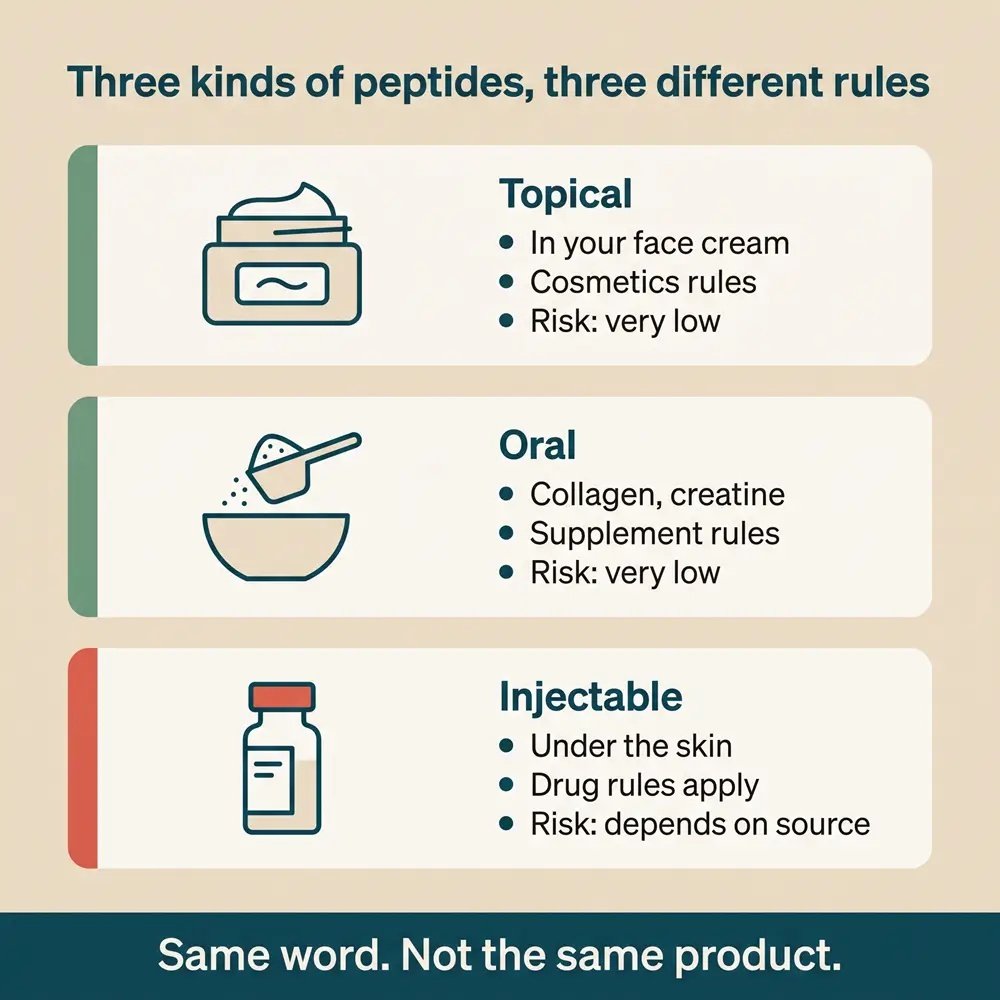
- Topical peptides sit in your face cream. Cosmetics rules cover them, they work on the skin surface, and the risk is close to zero.
- Oral peptides include collagen powder and creatine. You swallow these, food and supplement rules apply, and several carry solid human trials.
- Then there are injectable peptides, which go under your skin with a needle. A few hold FDA approval. Most of the ones filling your feed are neither approved nor legally sold for human use.
“Isn’t my face cream a peptide too?” – It is. And it shares a category name with a vial of BPC-157 and nothing else. Which brings up the question most women ask second, right after “what are these.”
Why women respond differently, and why most peptide research ignored them
Estrogen drives collagen synthesis, connective tissue repair, fat distribution, and how fast muscle rebuilds after you train. When estrogen drops during perimenopause, all four shift at once.
Skin thins, recovery slows, and weight redistributes toward the midsection even when your habits have not changed.
That collision explains why peptide marketing targets women in their forties so hard. The symptoms are real, they arrive together, and standard advice often falls flat.
The research base bothers me for one specific reason.
Early human trials for several of these compounds enrolled men only, and the dosing guidance carried over to women without anyone testing whether it should.
Women metabolize many drugs differently, carry different body composition, and move through hormonal states men do not have.
So where did the number on your protocol sheet come from? Ask. Often the honest answer is a small male cohort or a veterinary study.
The legal reality right now, updated after the July 2026 FDA vote
The FDA sorts substances for compounding into three categories.
Compounding means a licensed pharmacy mixes a drug to order for an individual patient.
- Category 1 substances can be compounded.
- Category 2 substances raise significant safety risks and cannot.
- Category 3 means the agency has not finished its review.
BPC-157, CJC-1295, ipamorelin, AOD-9604 and others sit in Category 2, which is why your dermatologist cannot simply write a script [2].
On July 23 and 24, 2026, the FDA’s Pharmacy Compounding Advisory Committee reviewed seven of these compounds [3].
The panel voted 8 to 6 in favor of BPC-157, KPV and TB-500, with one abstention, and 7 to 5 for MOTS-c with two abstentions [4].
The next day it backed semax and recommended epitalon by 7 to 5 with one abstention, then rejected emideltide by a 6 to 7 vote [5][6].
Six of seven recommended. Social media read that as legalization. It is not.
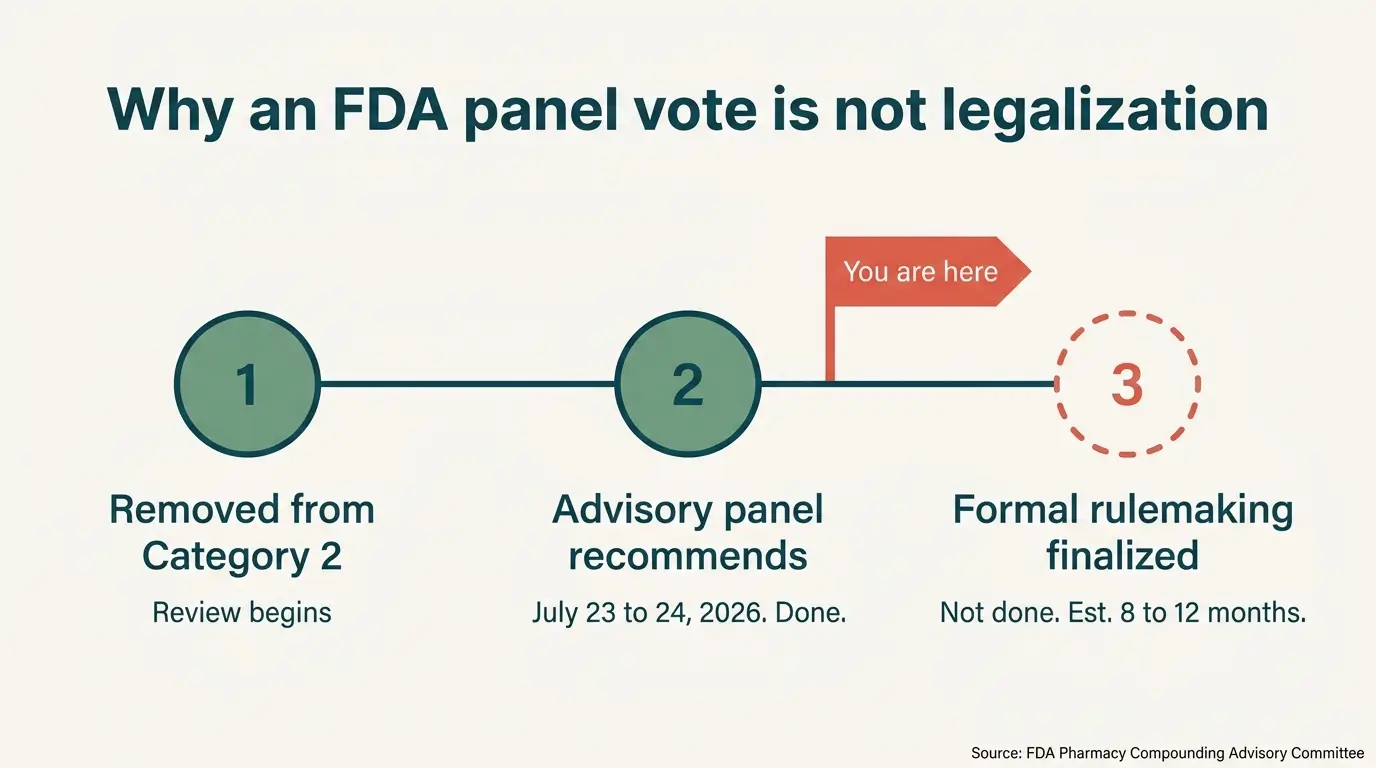
Three separate legal events keep collapsing into one.
- Removal from Category 2 is the first.
- An advisory committee recommendation is the second.
- Actual placement on the compoundable list is the third, and it requires notice-and-comment rulemaking, where the agency publishes a draft rule, collects public comment, and finalizes it.
Attorney Dustin Robinson, who tracks this area, put the realistic timeline for that last step at eight to twelve months [4].
Current legal status
Last verified
A licensed clinician still cannot legally prescribe BPC-157, TB-500, KPV or MOTS-c through a compounding pharmacy.
Source: FDA Pharmacy Compounding Advisory Committee, July 2026.
Two details deserve your attention.
- FDA career scientists objected to the votes, saying they lacked the evidence to judge safety or effectiveness, and one agency official told the panel the compounds lack universally accepted chemical formulas [4].
- Reuters reported that six of the eight members recently appointed to the committee work for or operate clinics selling peptide treatments [4][7].
Panel member Josh Mailman, who voted no, said it plainly. “I’m voting on something here, but I don’t know what that something is. It’s kind of like a black box to me” [4].
So which of these actually have data behind them?
The evidence scorecard
We graded each compound on published human trials, whether women were included, and current legal status.
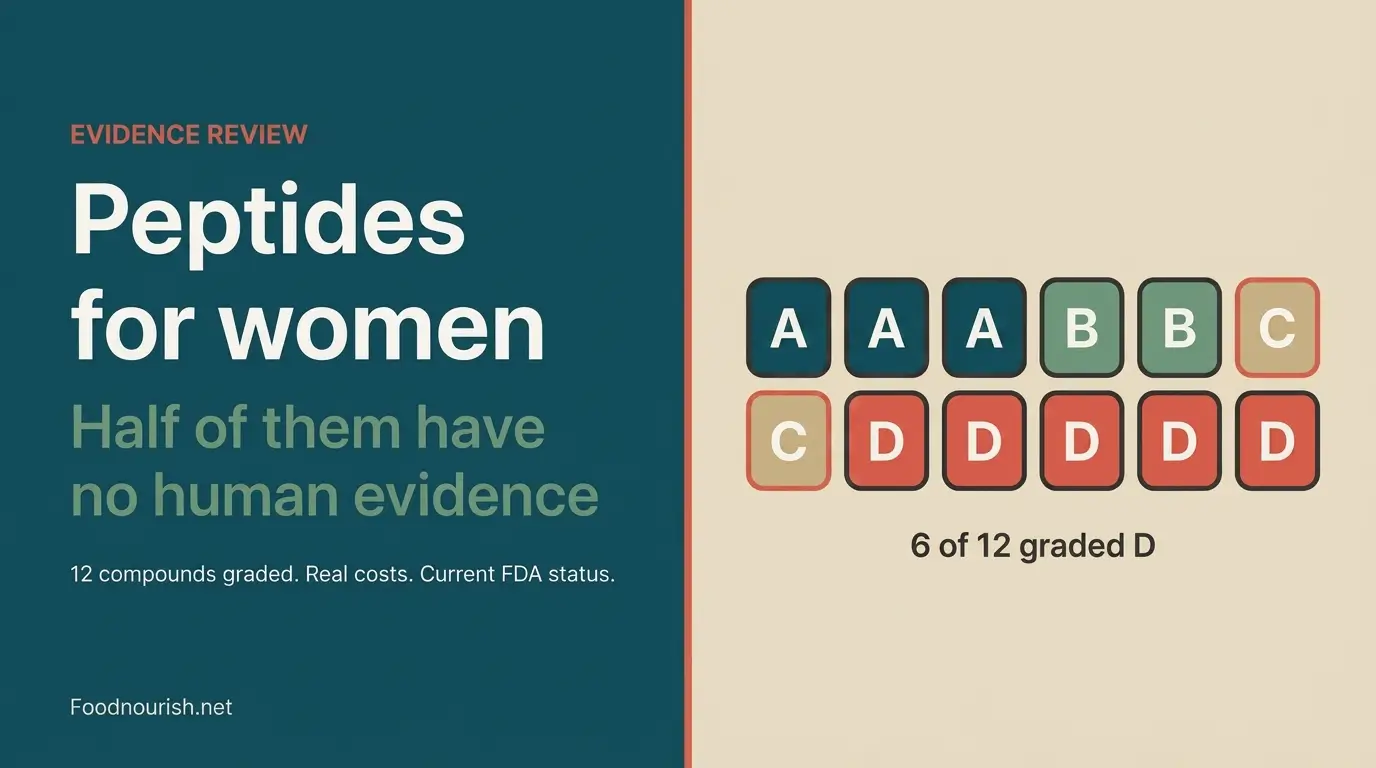
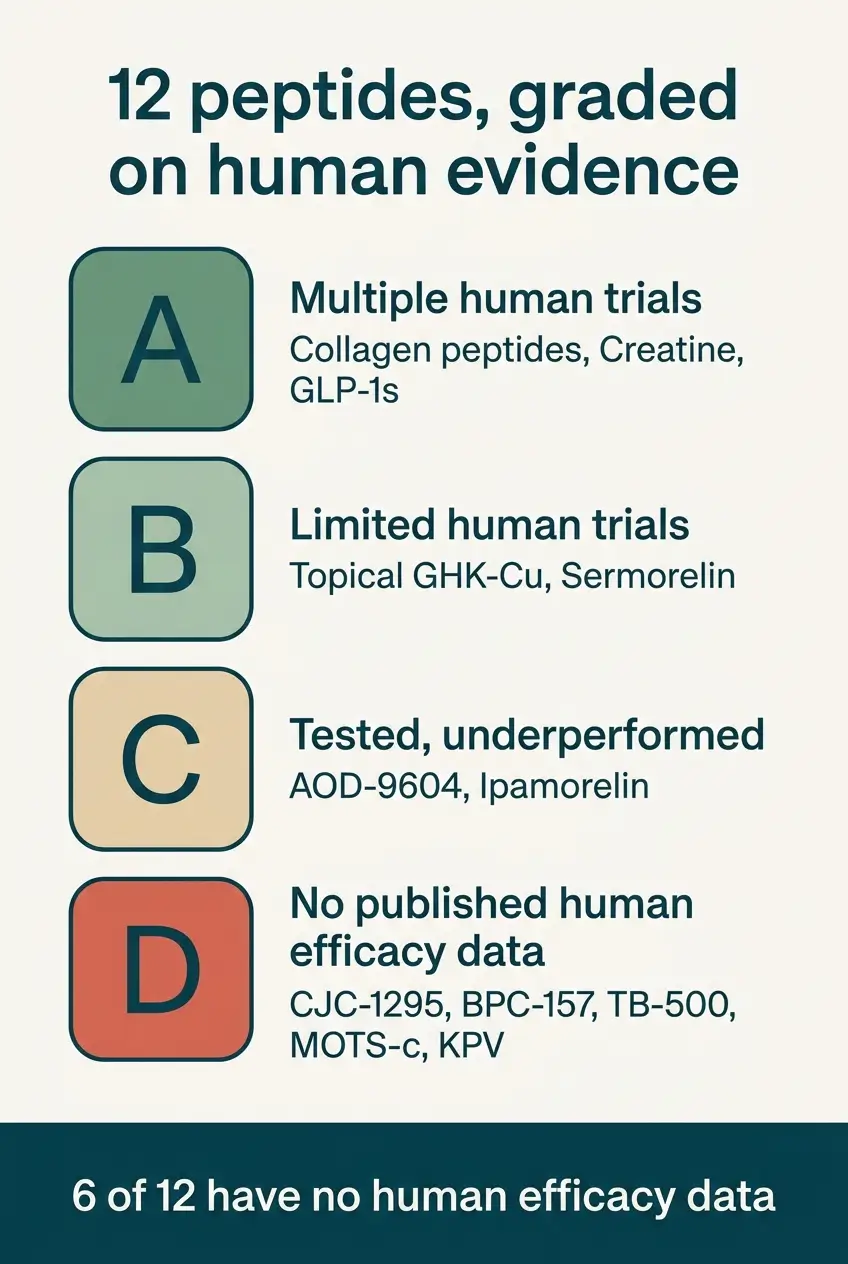
Grade A means multiple human randomized controlled trials. B means limited human trials. C means human data exists but the compound underperformed. D means no published human efficacy data.
| Peptide | Marketed for | Human evidence | Legal status now | Grade |
|---|---|---|---|---|
| Collagen peptides | Skin, joints | 23 randomized trials pooled, 2025 meta-analysis | Food supplement, unrestricted | A |
| Creatine monohydrate | Muscle, bone, cognition | Extensive, includes postmenopausal cohorts | Supplement, unrestricted | A |
| GLP-1s | Weight, metabolic health | Large phase 3 programs, thousands enrolled | FDA approved, prescription | A |
| Topical GHK-Cu | Skin firmness, wrinkles | 12-week trial, 71 women with sun-damaged skin | Cosmetic ingredient | B |
| Sermorelin | Growth hormone support | Approved 1997 as Geref, later discontinued | Compoundable, prescription | B |
| AOD-9604 | Fat loss | 12-week trial, 2.6 kg lost vs 0.8 kg placebo | Category 2, not compoundable | C |
| Ipamorelin | Muscle, recovery, sleep | 117 patients, no significant benefit vs placebo | Category 2, not compoundable | C |
| CJC-1295 | Growth hormone support | No published efficacy trials in healthy adults | Category 2, not compoundable | D |
| BPC-157 | Gut, injury recovery | Animal models, minimal human data | Recommended, rulemaking pending | D |
| TB-500 | Tissue repair | No human interventional studies identified | Recommended, rulemaking pending | D |
| MOTS-c | Energy, metabolism | Early human work only | Recommended, rulemaking pending | D |
| KPV | Inflammation, wound healing | Minimal human data | Recommended, rulemaking pending | D |
Two rows in that table changed how I think about this category.
Ipamorelin went into a proper randomized trial with 117 bowel resection patients. It was well tolerated, and it produced no significant difference from placebo on the outcome measured [15].
That is not a peptide waiting for research. That is a peptide that got research and did not clear the bar.
TB-500 is worse. A 2026 review searching for human interventional studies of TB-500 in tendon, ligament, muscle, bone or cartilage found none [16]. Zero. It sells at scale anyway.
Six of the twelve compounds here earn a D. Now compare that to what you can already buy.
Peptides by goal, and what actually works for each
Nobody wakes up wanting GHK-Cu. You wake up noticing your skin looks thinner. So we sorted by goal.
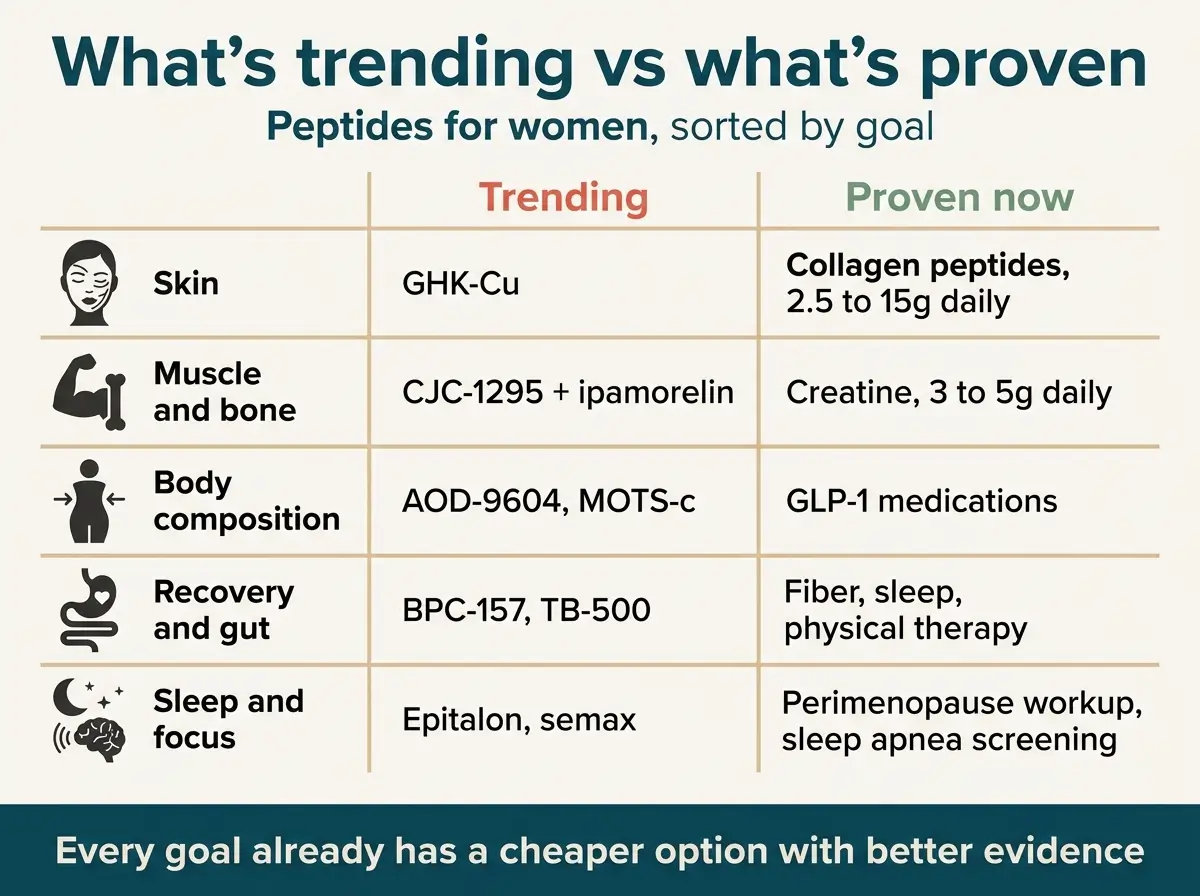
“If the evidence is that thin, why does everyone say these work?” Because most people start peptides alongside better sleep, more protein and a new training block, and something in that combination delivers. Notice the pattern across all five goals. A cheaper option with better evidence already exists. Which makes the price of the alternative worth examining closely.
What peptide therapy actually costs, the number nobody publishes
Not one page ranking on the first search page for this topic tells you the price. Clinics quote after a consultation. That is a sales technique, and it is not a clinical necessity.
Compounded peptides through a licensed pharmacy typically run $200 to $600 per month depending on the compound, dose and delivery format [19].
Across telehealth providers, med spas and pharmacies, the full range runs $150 to $800 and higher [20].
BPC-157 through telehealth channels gets quoted between $100 and $425 monthly [21].
Those figures cover the vial. They usually exclude the initial consultation at $100 to $300, baseline lab work at $150 to $400, follow-up visits, syringes, alcohol swabs, sharps disposal, bacteriostatic water (the sterile liquid used to mix powdered peptides), and cold-chain shipping.
So what does a year of peptide therapy actually cost you? Do the arithmetic. A $300 monthly quote commonly becomes $4,500 to $5,500 in year one, and most protocols cycle on and off across many months rather than ending after one round.
Set that against collagen peptides at $25 to $45 monthly and creatine at $10 to $20 monthly. Both carry Grade A evidence. Neither needs a prescription.
Pricing red flags
If a provider does any of the following, slow down before you hand over a card.
“But I found the same peptide online for forty dollars.” Yes. And that gap deserves its own section.
The sourcing problem, with actual numbers
A 2025 evaluation of research-grade peptides marketed directly to consumers tested purity, measured abundance and endotoxin burden. Depending on which quality model the authors applied, between 41.6% and 71.1% of samples failed basic quality criteria, and measurable endotoxin contamination showed up in the batch [22].
Endotoxin = fragments of dead bacteria. Sterile filtering does not remove it. Inject enough and you get fever, chills and a systemic inflammatory response.
Read the label on any of these products and you will find the phrase “for laboratory research use only, not for human consumption.”
That sentence is not packaging boilerplate. It is the seller telling federal regulators the product was never intended for a human body, which moves the legal liability onto you.
Why research-use peptides cost so much less
Three prices exist for the same molecule.
- A licensed compounding pharmacy charges $200 to $600 a month.
- Telehealth quotes BPC-157 at $100 to $425.
- A research-chemical vial runs $30 to $80.
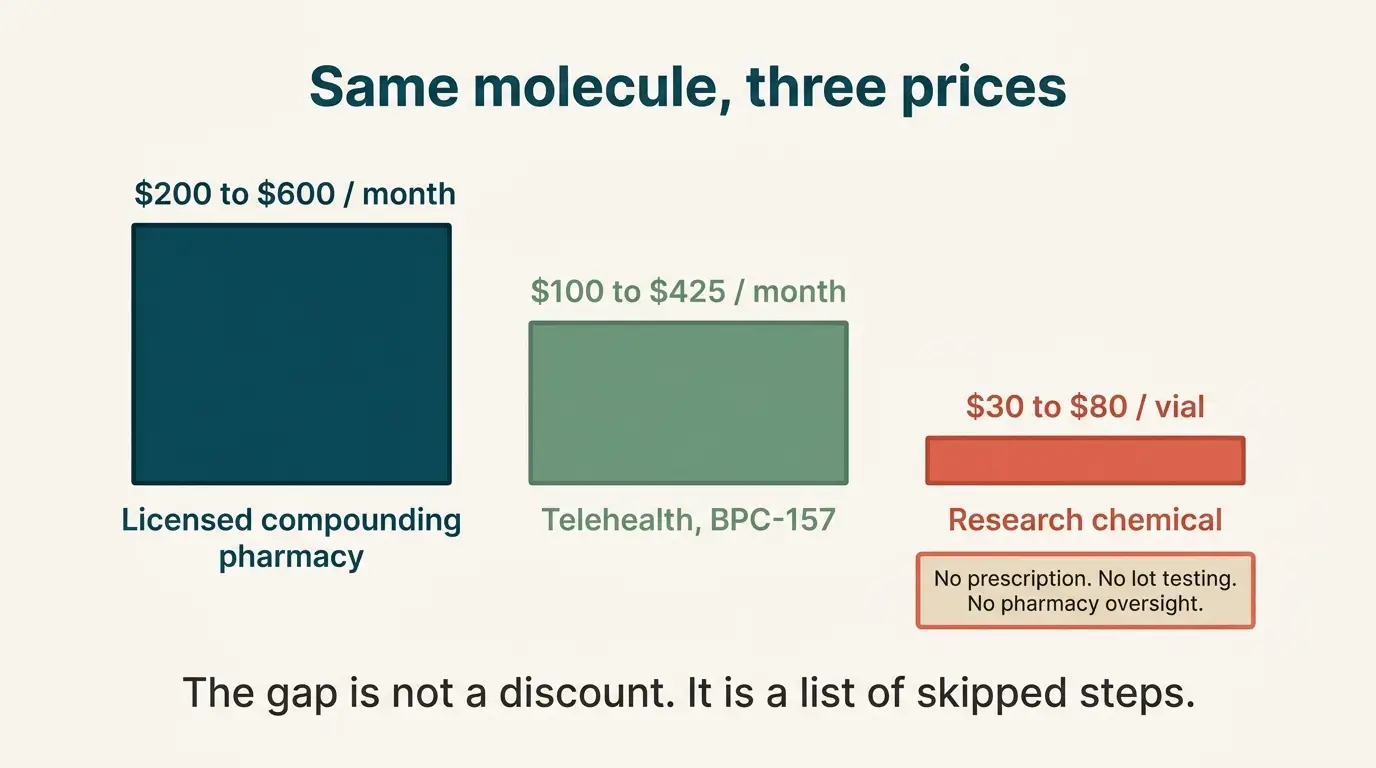
That gap is not a discount. It is a list of steps somebody skipped.
The prescription costs money because a clinician has to evaluate you first. Research-chemical sellers require nothing.
No intake, no labs, no screening for contraindications, nobody checking your cancer history or your thyroid medication before you inject.
Sterility and endotoxin testing cost money. Pharmacies operating under sections 503A and 503B of federal drug law, the rules governing licensed compounding, test each lot and document the result. In the research-chemical channel, testing is optional and the seller reports it.
Pharmacy oversight costs money. Licensed facilities get inspected, carry recall obligations and answer to a state board. A reseller shipping from a warehouse answers to nobody.
The honest way to read a $40 vial is this. You are paying for the molecule and nothing else.
What the price difference actually buys
| Attribute | Compounding pharmacy | Telehealth program | Research-use vial |
|---|---|---|---|
| Typical monthly cost | $200 to $600 | $100 to $425 | $30 to $80 |
| Prescription required | Yes | Yes | No |
| Lot-specific certificate of analysis | Yes | Usually | Seller reported |
| Sterility and endotoxin testing | Required | Required | Optional |
| Clinician evaluates you first | Yes | Yes | No |
| Recall obligation | Yes | Yes | None |
| Legal intended use | Human patient | Human patient | Laboratory research only |
Cost aside, the safety questions get sharper for women specifically.
Side effects, contraindications, and who should not touch these
Reported effects across injectable peptides include injection-site irritation, fatigue, headache, nausea, diarrhea, water retention, facial flushing, heart palpitations, insomnia and allergic reactions [23].
Harvard Health notes that sparse evidence means we have very little reliable side effect data at all, which is its own kind of answer.
The FDA cited published literature identifying serious adverse events, including death, when ipamorelin was given intravenously for gastric motility [2].
ProPublica reported in 2026 that FDA documentation linked adverse events, including deaths, to several peptides including ipamorelin, CJC-1295, AOD-9604 and melanotan II, without establishing that the drugs caused them [24].
The intravenous route also differs from subcutaneous injection. It still belongs in your decision.
The concern I take most seriously involves growth. Peptides that raise IGF-1, which is insulin-like growth factor 1, a hormone that signals cells to grow, or that promote new blood vessel formation, carry a theoretical risk of feeding tumors nobody has detected yet. For a 48-year-old woman with a family history of breast cancer, that theoretical risk is not academic.
DO NOT START if you are pregnant, breastfeeding, have an active or prior hormone-sensitive cancer, have untreated sleep apnea, have unmanaged diabetes, or have significant cardiovascular disease.
Nobody has studied how these compounds interact with hormone replacement therapy, thyroid medication, GLP-1s or hormonal birth control. If you take any of those, you are the experiment.
Competitive and masters athletes, check your governing body’s banned list before you order anything. Several of these compounds trigger positive tests.
Dr. Pieter Cohen of Harvard Medical School stated his position without hedging. “As a clinician, I do not recommend injecting yourself with peptides” [23].
How to have this conversation with your doctor
Bring these seven questions:
- Which FDA category does this compound fall into today?
- Which pharmacy dispenses it, and what is its license number?
- What baseline labs do you want before I start?
- What are the stop criteria if something goes wrong?
- What does monitoring look like, and how often?
- What is my total first-year cost, including labs and supplies?
- What happens when I stop?
Reasonable baseline labs include IGF-1, fasting glucose, HbA1c (your three-month average blood sugar), a lipid panel, thyroid function and a hormone panel.
A legitimate peptide therapy protocol includes lab work, a named pharmacy, a defined endpoint and a clinician willing to tell you no. A sales script includes a bundled stack, a subscription and a price you only hear after you hand over a card.
Where the evidence on peptides for women actually lands
Start today with confidence. Collagen peptides at 2.5 to 15 grams daily, creatine monohydrate at 3 to 5 grams daily, adequate dietary protein, and food-derived bioactive peptides from whey, casein, eggs and fish. All cheap, all studied in humans, all available without a prescription.
Discuss with a clinician. Sermorelin, GLP-1 medications and topical GHK-Cu. Real evidence, real oversight, real prescriptions.
Wait. BPC-157, TB-500, KPV, MOTS-c, semax, epitalon, CJC-1295, ipamorelin and AOD-9604. Rulemaking on several is underway, and this verdict changes the day the FDA finalizes a rule and a licensed pharmacy can legally dispense them with lot testing attached.
That day may arrive within a year. It has not arrived yet.
If you do one thing this week, book the perimenopause workup you have been putting off. The question of peptides for women gets much easier to answer once you know your actual labs.
Frequently asked questions
How we researched this
We reviewed FDA Pharmacy Compounding Advisory Committee materials from the July 23 and 24, 2026 meeting, the agency’s Category 2 bulk substances list, peer-reviewed trials and meta-analyses indexed in PubMed and PMC, expert commentary published by Harvard Health and the American Medical Association, reporting from Reuters, Time, ProPublica and the Regulatory Affairs Professionals Society, and a published purity and endotoxin analysis of consumer-marketed research peptides.
We prioritized human trials over animal models and randomized controlled trials over observational work, and we recorded whether trials enrolled women wherever investigators reported it.
Pricing came from published provider rates across telehealth, med spa and compounding pharmacy channels. Providers self-report those prices, and they vary by region, dose and delivery format.
Limitations matter here. Most trending peptides have no published human efficacy trials at all, which means absence of evidence rather than evidence of harm. Regulatory status is changing actively, and we will update this guide as the FDA moves through rulemaking.
Citations
- National Center for Biotechnology Information – “The Discovery of Insulin” – 2018
- U.S. Food and Drug Administration – “Certain Bulk Drug Substances for Use in Compounding May Present Significant Safety Risks”
- U.S. Food and Drug Administration – “July 23-24, 2026 Meeting of the Pharmacy Compounding Advisory Committee” – July 2026
- Pharmaceutical Executive – “FDA Panel Votes to Loosen Restrictions for Four Peptides” – July 2026
- Regulatory Affairs Professionals Society – “FDA advisory committee backs two more peptides, rejects one for compounding list” – July 2026
- Time – “An FDA Committee Just Voted in Favor of Peptides” – July 23, 2026
- Reuters – “FDA advisers back first four of seven unapproved peptides under review for looser rules” – July 23, 2026
- Myung SK, et al., The American Journal of Medicine – “Effects of Collagen Supplements on Skin Aging” – 2025
- Smith-Ryan AE, et al., Nutrients – “Creatine Supplementation in Women’s Health: A Lifespan Perspective” – 2021
- Smith-Ryan AE, et al., Journal of the International Society of Sports Nutrition – “Creatine in women’s health: bridging the gap” – 2025
- Pickart L, et al., BioMed Research International – “GHK Peptide as a Natural Modulator of Multiple Cellular Pathways in Skin Regeneration” – 2015
- Pickart L, Margolina A, International Journal of Molecular Sciences – “Regenerative and Protective Actions of the GHK-Cu Peptide” – 2018
- GoodRx – “Geref (sermorelin): Drug Basics and Frequently Asked Questions”
- Adan RA, et al. – “Obesity Pharmacotherapy: Current Perspectives and Future Directions” – 2013
- Beck DE, et al., International Journal of Colorectal Disease – “Prospective, randomized, controlled, proof-of-concept study of the ghrelin mimetic ipamorelin for the management of postoperative ileus in bowel resection patients” – 2014
- McGuire F, et al., Applied Sciences – “Thymosin Beta-4 and TB-500 in Tissue Healing” – 2026
- American Medical Association – “What doctors want patients to know about injectable peptides” – April 29, 2026
- Quagliani D, Felt-Gunderson P, American Journal of Lifestyle Medicine – “Closing America’s Fiber Intake Gap” – 2017
- Preston’s Pharmacy – “How Much Do Compounded Peptides Cost?”
- FormBlends – “Peptide Therapy Near Me Cost: What You Actually Pay in 2026” – 2026
- Perfect B – “How Much Does Peptide Therapy Cost? A Complete 2026 Guide” – 2026
- ResearchGate – “Evaluation of Research Grade Peptides Marketed Directly to Consumers Reveals Extensive Variability in Purity and Measured Abundance” – 2025
- Harvard Health Publishing – “Peptides: what they are, potential benefits, and safety concerns” – 2026
- ProPublica – “An FDA Reversal on Peptides Could Open the Market to Unproven Drugs” – 2026
