
The Best Zucchini Bread Recipe (Moist, Two Loaves, Never Gummy)
Skip the squeezing, bake to 205°F, and get a perfect crumb on your first loaf instead of your fourth.
Enjoying this article?Add FoodNourish as a preferred source on Google and see our research-backed guides more often in your search results.
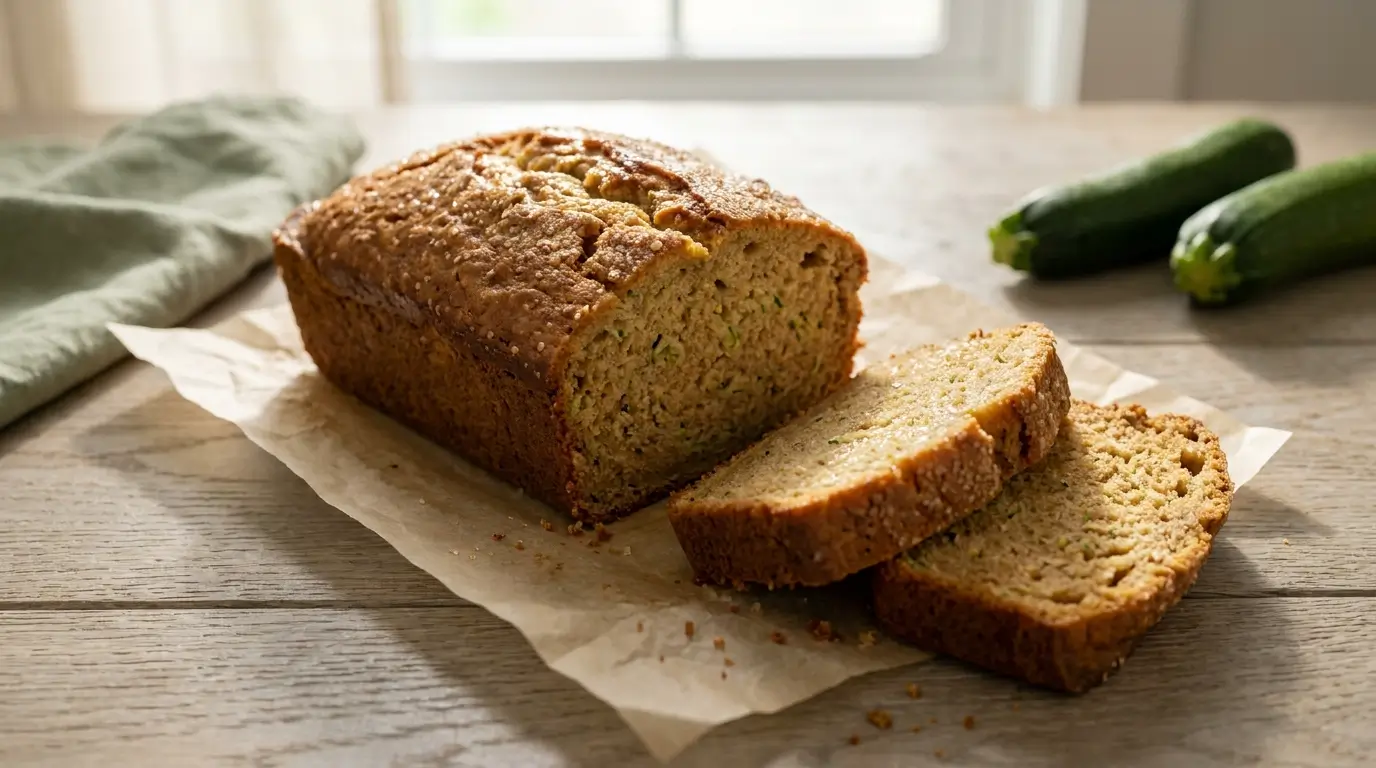
This is the best zucchini bread recipe for anyone staring down a counter full of summer squash. It makes two 8×4-inch loaves from one pound of grated zucchini, uses oil and sour cream so the crumb stays soft through day five, and finishes with a doneness temperature instead of a toothpick guess.
Fifteen minutes of hands-on work, one whisk, two bowls, no mixer. One loaf now, one in the freezer.
20 slices · about $3.25 per loaf · 15 minutes hands-on · freezes for 3 months
Most gummy zucchini bread fails at one specific decision, and it happens before the batter ever hits the pan.
Why This Is the Best Zucchini Bread Recipe
- The recipe yields two 8×4 loaves from 1 pound of zucchini, so the garden surplus goes somewhere useful and the second loaf goes straight to the freezer.
- It uses oil plus sour cream rather than butter, because butter is solid at room temperature and firms the crumb as the loaf cools, while oil stays liquid and keeps the texture soft for days.
- Brown sugar carries a caramel note that white-sugar-only recipes never reach, which is exactly the flaw a Kitchn side-by-side taste test flagged in one of the most-reviewed zucchini bread recipes online [1].
- You skip the squeezing and the peeling entirely.
- You pull the loaves at 200°F to 205°F internal, the published doneness range for quick breads [2].
- And a scatter of turbinado sugar on top bakes into a thin crackly lid.
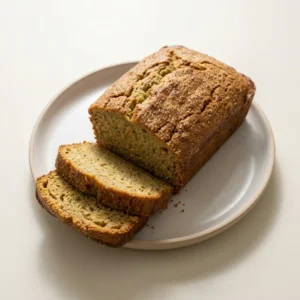
The Best Zucchini Bread (Two Loaves)

Equipment
- 2 8×4-inch metal loaf pans Light aluminized steel. Glass pans need 325°F and 5 to 10 extra minutes. Dark nonstick over-browns the crust.
- 1 Box Grater Use the large holes. A food processor shredding disc is faster for 2 lb or more
- 1 Digital Kitchen Scale Used for both the flour and the zucchini. The single most useful tool in this recipe
- 1 Instant-read digital thermometer Finished loaves read 200°F to 205°F in the center
- 1 Large mixing bowl 4-quart or larger, for the dry ingredients.
- 1 Medium mixing bowl 2-quart, for the wet ingredients
- 1 Balloon whisk Replaces sifting and replaces a mixer
- 1 Flexible silicone spatula For folding, so you do not overmix
- 2 Sheets parchment paper Cut into slings with a 2-inch overhang on the long sides
- 1 Wire cooling rack Airflow underneath prevents a soggy base
- 1 Dry measuring cup set Only if you are not weighing. Spoon and level.
- 1 Measuring spoon set For the spices, leaveners, salt, and vanilla
- 1 Serrated bread knife Saws clean slices without compressing the crumb.
- 1 Vegetable peeler Optional, only for oversized garden zucchini with a tough rind.
Ingredients
Dry ingredients
- 3 cups all-purpose flour spooned and leveled (360 g)
- 2 tsp ground cinnamon
- ½ tsp ground nutmeg freshly grated if possible
- 1 ½ tsp baking powder check the date, replace after 6 months
- 1 tsp baking soda
- 1 tsp fine sea salt not optional in a sweet loaf
Wet ingredients
- 3 large eggs
- 1 cup light brown sugar packed (200
- ½ cup granulated sugar (100 g)
- ¾ cup extra-virgin olive oil (180 ml)
- ¼ cup ull-fat sour cream or plain Greek yogurt (60 g)
- 1 tbsp pure vanilla extract
Zucchini and add-ins
- 3 cups grated zucchini loosely measured, unpeeled, unsqueezed, from about 1 lb or 2 medium zucchini (390 g)
- 1 cup chopped walnuts or pecans optional (120 g)
- 2 tbsp turbinado sugar optional, for the tops
Instructions
Prep
- Heat the oven to 350°F (177°C) with a rack in the center position.
- Grease two 8×4-inch metal loaf pans, then line each with a parchment sling that overhangs the long sides by 2 inches.
- Trim the ends off the zucchini. Grate on the large holes of a box grater, skin on.

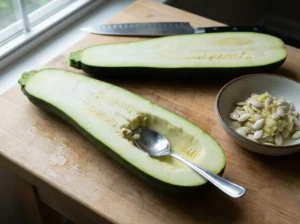
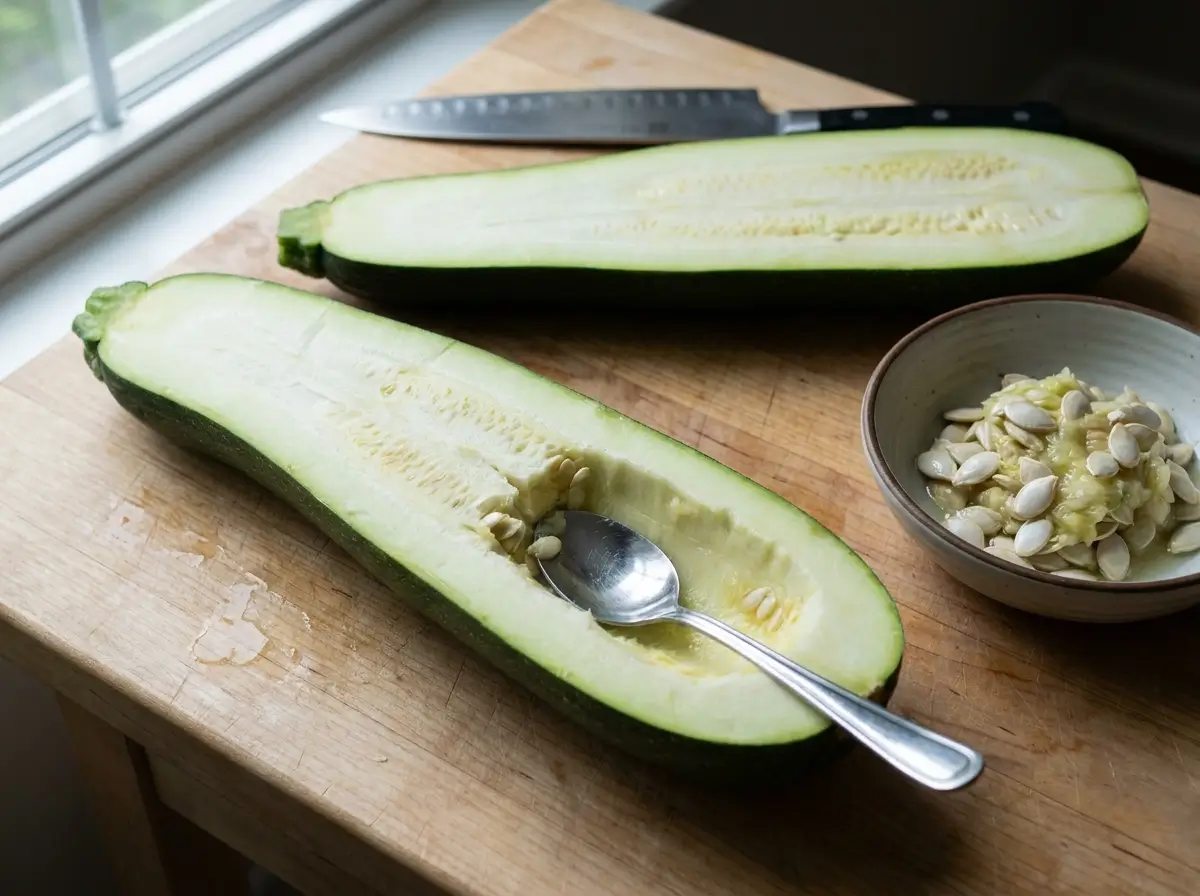
- Spoon the shreds loosely into a measuring cup without pressing, or weigh out 390 g. Do not drain, blot, or squeeze. For an oversized garden zucchini, halve it lengthwise, scrape out the seedy core with a spoon, then grate and reweigh.
Mix
- In the large bowl, whisk the flour, cinnamon, nutmeg, baking powder, baking soda, and salt for a full 20 seconds until the color is uniform. Whisking here does the job of sifting.
- In the medium bowl, whisk the eggs, brown sugar, and granulated sugar for 45 seconds until slightly lightened.
- Whisk in the oil, sour cream, and vanilla until smooth, with no white streaks of sour cream remaining.
- Pour the wet mixture into the dry. Fold with the spatula about 12 strokes, until only a few dry streaks remain. Add the zucchini and the nuts, if using.
- Fold 8 to 10 more strokes, just until no dry flour is visible. The batter looks far too thick for the first few strokes, then loosens within seconds as the zucchini releases its water. Stop the moment the flour disappears, because every stroke past that builds gluten and turns the crumb dense and tunneled.
Bake
- Divide the batter evenly between the pans, roughly 700 g per pan, and smooth the tops. Sprinkle each with 1 tablespoon turbinado sugar, if using.
- Bake 50 to 60 minutes. At the 35-minute mark, tent each loaf loosely with foil if the tops are browning fast.
- Start checking at 50 minutes. The loaves are done when an instant-read thermometer inserted into the center reads 200°F to 205°F and the top springs back when pressed. A toothpick alone is unreliable in a batter this wet.
Cool
- Cool in the pans on a wire rack for 15 minutes. Lift the loaves out by the parchment slings and cool directly on the rack for at least 45 minutes more.
- Slice with a serrated knife using a sawing motion, never downward pressure.
Notes
- Weigh the flour. A densely packed cup holds up to 160 g against a correct 120 g, so three scooped cups can add 120 g of extra flour and dry the loaf out completely. Without a scale, fluff the flour, spoon it into the cup, and level with a knife.
- Do not squeeze fresh zucchini. At roughly 94.8 percent water, the 390 g in this recipe supplies about 370 g of liquid, and the ingredient list has no milk or water to replace it. Thawed frozen zucchini is the one exception, and it should be drained in a sieve and lightly pressed before measuring.
- Use 8×4 pans for height. A 9×5 pan holds noticeably more, so the same batter spreads wider and flatter. If a 9×5 is what you own, start checking at 40 minutes.
- Temperature beats the toothpick. Zucchini bread holds enough moisture to leave a pick damp when the loaf is fully baked, which is why so many people overbake chasing a clean toothpick. Pull at 200°F to 205°F in the center.
- Cool a full hour before slicing. Steam is still redistributing through the crumb, and cutting early is the most common reason a properly baked loaf tastes gummy.
- Keep total add-ins at or under 1 1/2 cups. Nuts, chips, and dried fruit beyond that weigh down the crumb and sink the center.
- To make one loaf, halve everything, use 2 eggs, reduce the oil by 1 tablespoon, and bake in a single 8×4 pan for 50 to 58 minutes.
- Storage runs 3 days airtight at room temperature, 7 days refrigerated, and 3 months frozen. Freeze slices with parchment squares between them so you can thaw one at a time.
- Above 3,500 feet, cut each sugar by 1 tablespoon, drop the baking powder to 1 teaspoon, add 2 tablespoons flour, and raise the oven to 365°F.
- Do not mix the batter ahead. The leaveners start reacting the moment they meet the zucchini’s liquid, and a rested batter will not rise.
- Taste a raw shred of any zucchini over 10 inches. Bitterness signals high cucurbitacin, and a bitter squash belongs in the compost.
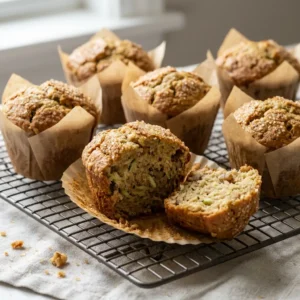
Zucchini Bread Muffins
Equipment
- 2 12-cup standard muffin pans Light metal. Fill any unused cups with water so the pan heats evenly and does not warp
- 24 Paper muffin liners Or grease the cups directly with butter and flour.
- 1 #16 portion scoop 1/4 cup capacity, gives even fills and clean liner edges.
- 1 Box Grater Use the large holes
- 1 Digital Kitchen Scale For the flour and the zucchini
- 1 Instant-read digital thermometer Centers read 200°F to 205°F.
- 1 Large mixing bowl 4-quart, for the dry ingredients
- 1 Medium mixing bowl 2-quart, for the wet ingredients
- 1 Balloon whisk No mixer needed
- 1 Flexible silicone spatula For folding
- 1 Wire cooling rack For cooling out of the pan
- 1 Measuring spoon set For spices, leaveners, salt, and vanilla.
Ingredients
Dry ingredients
- 3 cups all-purpose flour spooned and leveled (360 g)
- 2 tsp ground cinnamon
- ½ tsp ground nutmeg freshly grated if possible
- 1 1/2 tsp baking powder
- 1 tsp baking soda
- 1 tsp fine sea salt
Wet ingredients
- 3 large eggs room temperature
- 1 cup light brown sugar packed (200 g)
- ½ cup granulated sugar, (100 g)
- ¾ cup extra virgin olive oil (180 ml)
- ¼ cup full-fat sour cream, or plain Greek yogurt (60 g)
- 1 tbsp pure vanilla extract
Zucchini and add-ins
- 3 cups grated zucchini loosely measured, unpeeled, unsqueezed (390 g)
- 1 cup chopped walnuts optional (120 g)
- 2 tbsp turbinado sugar optional, skip if glazing
Instructions
Prep
- Heat the oven to 425°F (218°C) with a rack in the center position. Line 24 standard muffin cups with paper liners.
- Trim and grate the zucchini on the large holes of a box grater, skin on. Measure 390 g, spooned loosely rather than packed. Do not drain or squeeze.
Mix
- In the large bowl, whisk the flour, cinnamon, nutmeg, baking powder, baking soda, and salt for 20 seconds until uniform.
- In the medium bowl, whisk the eggs, brown sugar, and granulated sugar for 45 seconds, then whisk in the oil, sour cream, and vanilla until smooth. Pour the wet into the dry and fold about 12 strokes. Add the zucchini and the nuts, if using, then fold 8 to 10 more strokes until no dry flour shows.
Bake
- Scoop the batter all the way to the top of each liner. Filling to the rim is what creates the dome. Sprinkle with turbinado sugar, if using.
- Bake 5 minutes at 425°F. Reduce the oven to 350°F (177°C) without opening the door and bake 13 to 16 minutes more. Total oven time runs 18 to 21 minutes.
- Check that a thermometer inserted into the center of a middle muffin reads 200°F to 205°F.
Cool
- Cool 5 minutes in the pan, then transfer to a wire rack. Wait another 10 minutes before peeling any liner.
Notes
- Wait 10 minutes before peeling a liner. Pull too early and half the muffin comes away with the paper.
- The 425°F opening blast sets the outer wall fast so the interior pushes upward. Skip it and you get flat tops.
- Do not open the oven door when you drop the temperature. The rush of cool air collapses the rise you just built.
- Fill any unused muffin cups with water so the pan heats evenly and does not warp.
- Freeze in a zip-top bag for 3 months and microwave 20 seconds straight from frozen.
- Skip the turbinado sugar if you plan to glaze, because the two together read as gritty.
- Mini muffins bake 11 to 14 minutes total at a steady 350°F and yield about 48.
- Loaf timing does not transfer. Muffins finish in roughly a third of the time and will be dry and cracked at 50 minutes.
Why Squeezing the Zucchini Dries Out Your Loaf
Nearly every popular recipe tells you not to squeeze the grated zucchini. One or two tell you to wring it dry. Almost nobody explains what the water is actually doing.
USDA data puts raw zucchini at 94.8 percent water by weight, with 117.5 grams of water in a 124-gram cup [3].
Run that against the 390 grams this recipe calls for and your zucchini delivers roughly 370 grams of water to the batter. That is about a cup and a half of liquid, and it functions as the primary liquid in the recipe.
Read the ingredient list again. There is no milk, no buttermilk, no water anywhere on it, because the squash is doing that job.
Wring the zucchini out and you have removed most of the recipe’s hydration without replacing it. The flour has less water to absorb, the starches gelatinize less fully, and the loaf that comes out is pale, tight, and crumbly.
Most people blame the oven for that. The oven had nothing to do with it.
“So there’s never a reason to drain it?” One. Frozen zucchini that you have thawed releases a large volume of free liquid on its own, because ice crystals rupture the cell walls during freezing and that water is no longer held inside the shreds. Drain thawed zucchini in a sieve, press it lightly, then measure. Fresh zucchini goes in wet.
With the water settled, the next question is how much squash you actually need, and published recipes disagree wildly.
How Much Zucchini You Actually Need
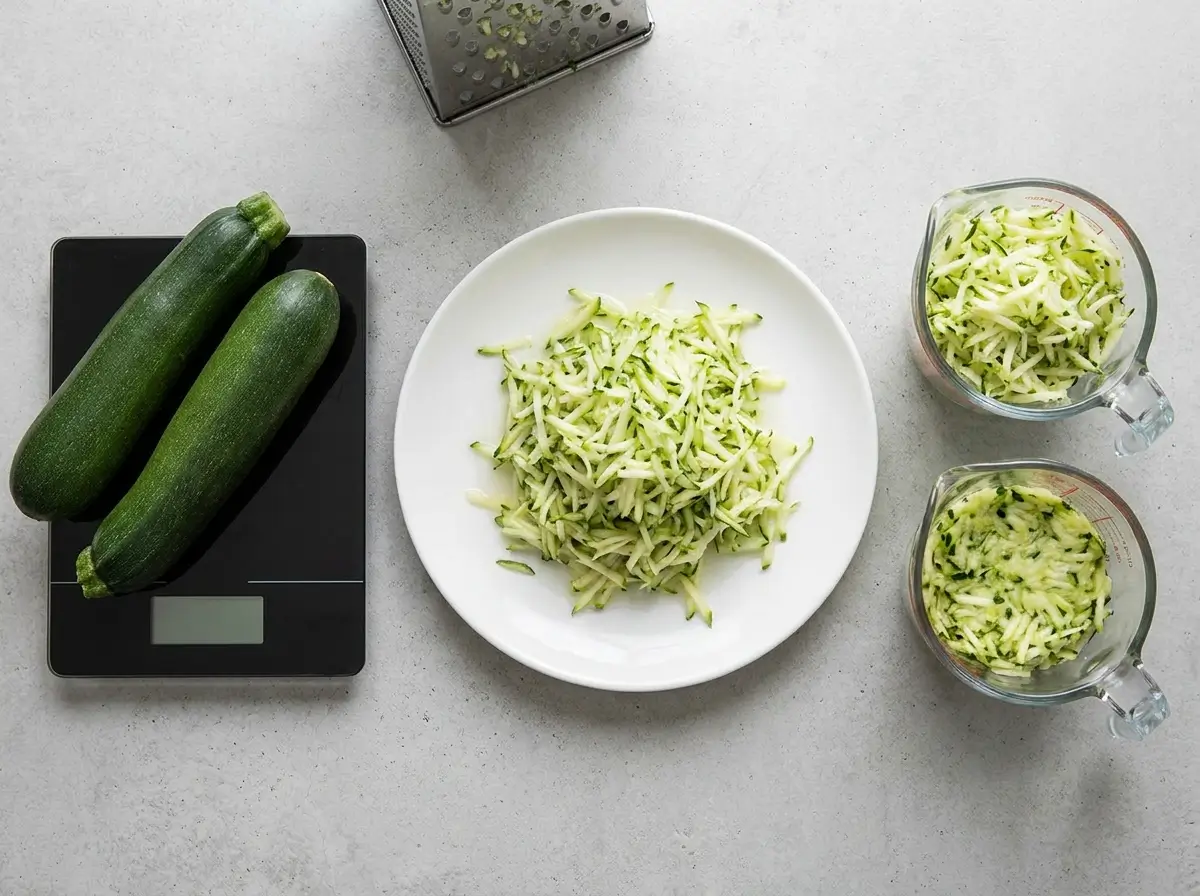
Popular recipes call for anywhere from 1.5 cups to 4 cups of grated zucchini while all claiming the same title. That range is more than double, and volume measuring is why.
Grated zucchini is loose, wet, and compressible. Press it into the cup and you fit substantially more than someone who spooned it in. Two bakers following the same recipe end up with meaningfully different batters. A scale removes the problem in four seconds.
This recipe wants 3 cups loosely measured, 390 grams, from roughly 1 pound or 2 medium zucchini.
Do not peel them. The skin is thin enough to disappear during baking, and it supplies every green fleck in the finished slice.
Grate on the large holes of a box grater, or use the shredding disc of a food processor once you are working through more than 2 pounds.
Do not chop or dice. Larger pieces steam inside the crumb instead of dissolving into it, and they leave wet pockets behind.
Got a baseball-bat zucchini from a neighbor? Halve it lengthwise, scrape the seedy center out with a spoon, then grate and weigh again. Expect to lose roughly a quarter of the starting weight to that core.
One more rule for the giants. If a raw shred tastes bitter, throw the whole squash out. Bitterness signals high cucurbitacin content, and French poison control centers logged 353 cases of non-edible squash exposure over five years, with 57.8 percent of patients presenting with diarrhea, vomiting, or abdominal pain [4].
Bitter squash goes in the compost, not the batter.
Once the zucchini is measured, the pantry ingredients decide the texture.
Substitutions that actually work
| Swap | How to do it | What changes |
|---|---|---|
| Gluten-free | 1:1 GF blend with xanthan gum, equal weight | Slightly denser, add 5 min bake time |
| Whole wheat | Replace half the flour, add 2 tbsp milk | Nuttier, tighter crumb |
| Dairy-free | Unsweetened applesauce for the sour cream | Marginally less rich |
| Less sugar | Cut to 1 cup total, no lower | Paler crust, one day less shelf life |
| Butter | 1 cup melted, for the 3/4 cup oil | Better day one, drier by day three |
Other Ways to Bake This Batter
| Format | Pan | Oven | Time | Pull temp |
|---|---|---|---|---|
| Two standard loaves | 2 × 8×4 | 350°F | 50 to 60 min | 200 to 205°F |
| Two wide loaves | 2 × 9×5 | 350°F | 40 to 50 min | 200 to 205°F |
| Mini loaves | 6 × 5.75×3 | 350°F | 30 to 38 min | 200 to 205°F |
| Muffins | 24 standard | 425°F then 350°F | 18 to 21 min | 200 to 205°F |
| Sheet cake | 9×13 | 350°F | 35 to 42 min | 200 to 205°F |
| Bundt | 10-cup | 350°F | 45 to 55 min | 200 to 205°F |
Flavor Variations Worth Making
- Chocolate chip. 1 1/2 cups semi-sweet, tossed in 1 tbsp of the measured flour first so they suspend instead of sinking to the bottom.
- Cinnamon streusel top. 1/2 cup flour, 1/3 cup brown sugar, 1 tsp cinnamon, and 4 tbsp cold cubed butter worked to coarse crumbs. Tent with foil at 35 minutes.
- Lemon zucchini. 2 tbsp lemon zest rubbed into the sugar with your fingers to release the oils, then a glaze of 1 cup powdered sugar and 2 tbsp lemon juice.
- Cream cheese swirl. Beat 8 oz cream cheese with 1/4 cup sugar and 1 egg. Layer half the batter, spoon the filling over, top with the rest, and drag a knife through twice.
Why Your Last Loaf Failed
| Problem | Most likely cause | Fix next time |
|---|---|---|
| Gummy or wet center | Pulled early, or sliced hot | Bake to 205°F, cool 60 minutes |
| Sunken middle | Overmixed, too many add-ins, door opened early | Fold to 20 strokes, cap add-ins at 1 1/2 cups |
| Dry and crumbly | Too much flour, or squeezed zucchini | Weigh 360 g flour, skip the squeeze |
| Dense, barely rose | Dead leaveners or overmixing | Replace soda and powder after 6 months |
| Burnt top, raw center | Oven runs hot, or dark pan | Tent at 35 minutes, use light metal, check with an oven thermometer |
| Tunnels and holes | Overmixed batter | Stop folding when the flour just vanishes |
| Stuck to the pan | No parchment sling | Grease and line every time |
| Bitter flavor | Overgrown squash, high cucurbitacin [4] | Use zucchini under 10 inches |
Frequently Asked Questions
Storing and Freezing
At room temperature, wrap the cooled loaf airtight with a paper towel above and below the bread. The towels absorb condensation that would otherwise make the crust tacky by morning. Three days.
In the refrigerator, wrap tightly and keep 7 days. Cold dulls the flavor, so warm a slice 10 seconds in the microwave before serving.
In the freezer, double-wrap a whole cooled loaf in plastic and then foil, or freeze individual slices with parchment squares between them so you can pull one at a time.
Three months. Thaw a whole loaf 2 hours at room temperature, or drop a frozen slice straight into the toaster. A day-four slice comes back with 8 seconds in the microwave.
What to Serve With Zucchini Bread
Honey butter melts into a warm slice better than plain butter does. Whip 4 tbsp softened butter with 1 tbsp honey and a pinch of salt. Salted cultured butter works on the same principle with less effort.
Cream cheese and a drizzle of maple push a slice toward breakfast.
Toasted in a dry skillet for 90 seconds a side, the cut faces caramelize and the crumb firms up enough to hold its own next to black coffee.
A bowl of macerated summer berries cuts the sweetness if you are serving it as dessert.
Sources
- [1] The Kitchn, “We Tested 4 Famous Zucchini Bread Recipes and Found a Clear Winner”, July 16, 2020
- [2] ThermoWorks, “Baked Goods Doneness Temps”, Martin Earl
- [3] USDA FoodData Central, “Squash, summer, green, zucchini, includes skin, raw”, FDC ID 169291
- [4] Le Roux G. et al., “Poisoning by non-edible squash: retrospective series of 353 patients from French Poison Control Centers”, Clinical Toxicology, August 2018, 56(8):790-794, https://doi.org/10.1080/15563650.2018.1424891
- [5] King Arthur Baking, “How to measure flour the right way”, Rossi Anastopoulo, October 13, 2023
- [6] King Arthur Baking, “Why it’s important to choose the right bread pan”, PJ Hamel, February 12, 2016