25 debloating foods that beat belly bloat fast (dietitian-backed)
What to eat for water bloat, gas, and period puffiness, plus how fast each food works.
Enjoying this article?Add FoodNourish as a preferred source on Google and see our research-backed guides more often in your search results.
Quick answer
The best debloating foods are water-rich produce like cucumber and watermelon, potassium-rich foods like banana, avocado, and sweet potato, fermented foods like yogurt, kefir, and kimchi, and soothing herbs like ginger, peppermint, and fennel. Some debloating foods work within a few hours by calming gas or flushing water. Others, like fiber and fermented foods, work over several days by improving how your gut moves food.
Top picks at a glance
- Ginger is best for fast gas relief. It speeds up stomach emptying and often eases pressure within 1 to 2 hours [3].
- Cucumber is best for water bloat. It is about 95% water, which supports hydration and helps your body let go of retained fluid [2].
- Yogurt is best for daily gut health. Live probiotics in yogurt reduce bloating and abdominal distension in people with irritable bowel syndrome (IBS) [1].
- Banana is best for salt bloat. One medium banana packs 422 mg of potassium, which helps balance sodium and cut water retention [9].
- Peppermint tea is best for cramping bloat. Peppermint oil relaxes the muscles in your gut and reduces IBS symptoms like bloating [4].
[ELEMENT OPPORTUNITY: pinnable vertical summary graphic, 1000x1500px, listing the 5 top picks with a one-line “best for” tag each, branded for Pinterest saves]
How we picked
I evaluated more than 40 foods and drinks that show up in bloating research and dietitian guidance, then narrowed the list to 25 with the strongest case behind them. Three filters did the work.
- First, the food needed a clear mechanism, meaning a real reason it helps, whether that is potassium balancing sodium, water content fighting fluid retention, probiotics improving gut bacteria, or enzymes speeding digestion.
- Second, the food needed support from peer-reviewed studies or major medical institutions, not just marketing claims.
- Third, the food needed to be easy to find at a normal grocery store. I pulled sources from PubMed studies, Healthline, GoodRx, and Harvard Health, all reviewed in 2023 to 2025.
I also grouped each food by the type of bloat it targets, because what helps salt bloat is different from what helps gas.
Why your stomach feels like a balloon
Nearly one in seven Americans reported bloating over a single week, according to a 2023 study published in Clinical Gastroenterology and Hepatology [5].
So if your jeans felt fine this morning and feel tight by 3 p.m., you are not imagining it and you are far from alone. The fix is often sitting in your kitchen.
The right debloating foods can ease that tight, puffy feeling, sometimes within hours.
The catch is that bloat has more than one cause, and the food that fixes one type does little for another. Matching the food to your type of bloat is the whole game, so start there.
First, why are you bloated?
Bloating happens for three main reasons, and knowing yours tells you what to eat.
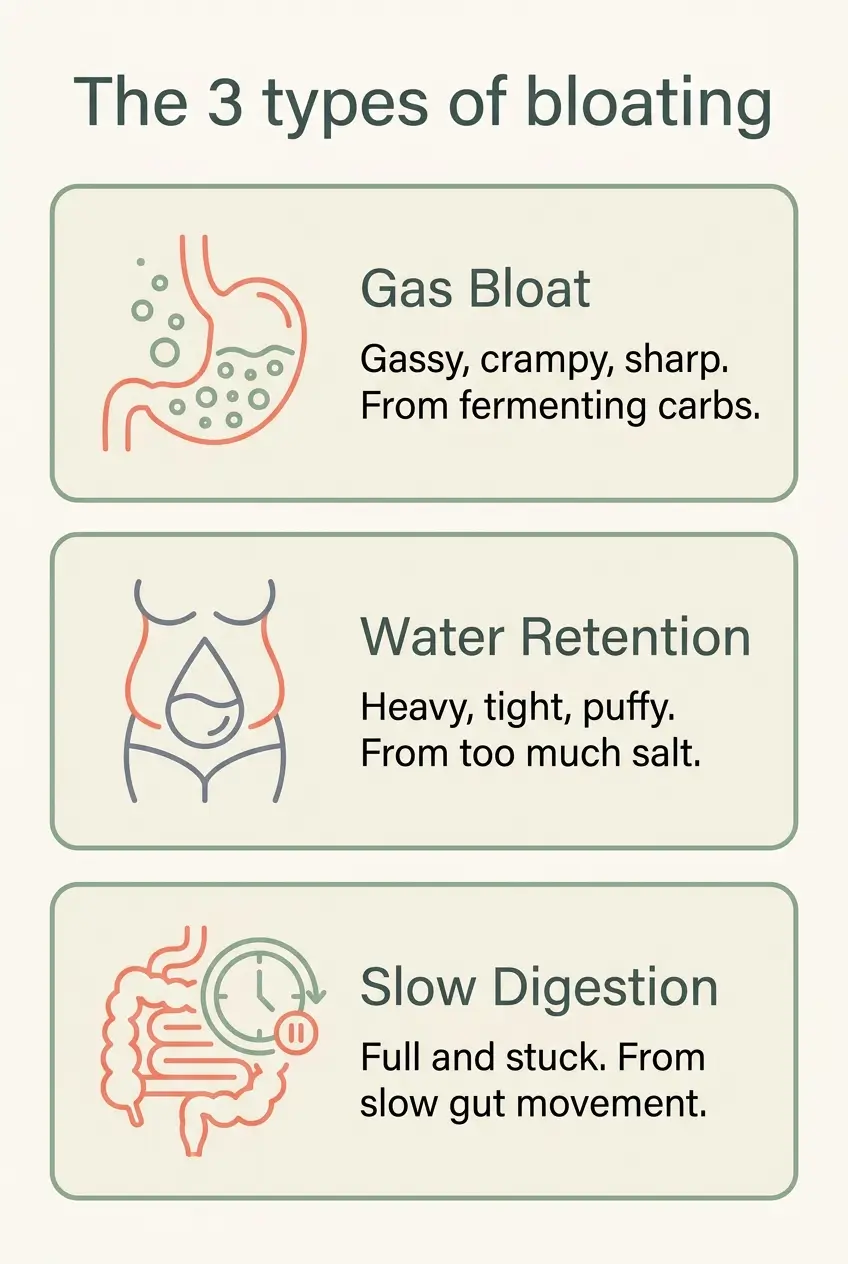
- Trapped gas is the most common driver. Your gut bacteria ferment certain carbohydrates in your colon and release gas as a byproduct [11]. Beans, cruciferous vegetables, and fizzy drinks are frequent culprits. This bloat feels gassy, crampy, and sometimes sharp.
- Water retention is the second driver. When you eat a lot of salt, your body holds onto water to balance the sodium, and that extra fluid shows up as puffiness [9]. This bloat feels heavy and tight rather than gassy, and it often hits after takeout, restaurant meals, or processed snacks.
- Slow digestion and constipation make up the third. When food and stool move through your gut too slowly, gas and pressure build up behind them [3]. This bloat feels full and stuck, and it usually comes with fewer or harder bowel movements.
Each type responds to different foods, so the next three sections sort your options by the problem they solve.
Debloating foods for water retention
These foods work through two levers, high water content and high potassium. Potassium tells your kidneys to release sodium and the water that clings to it [9].
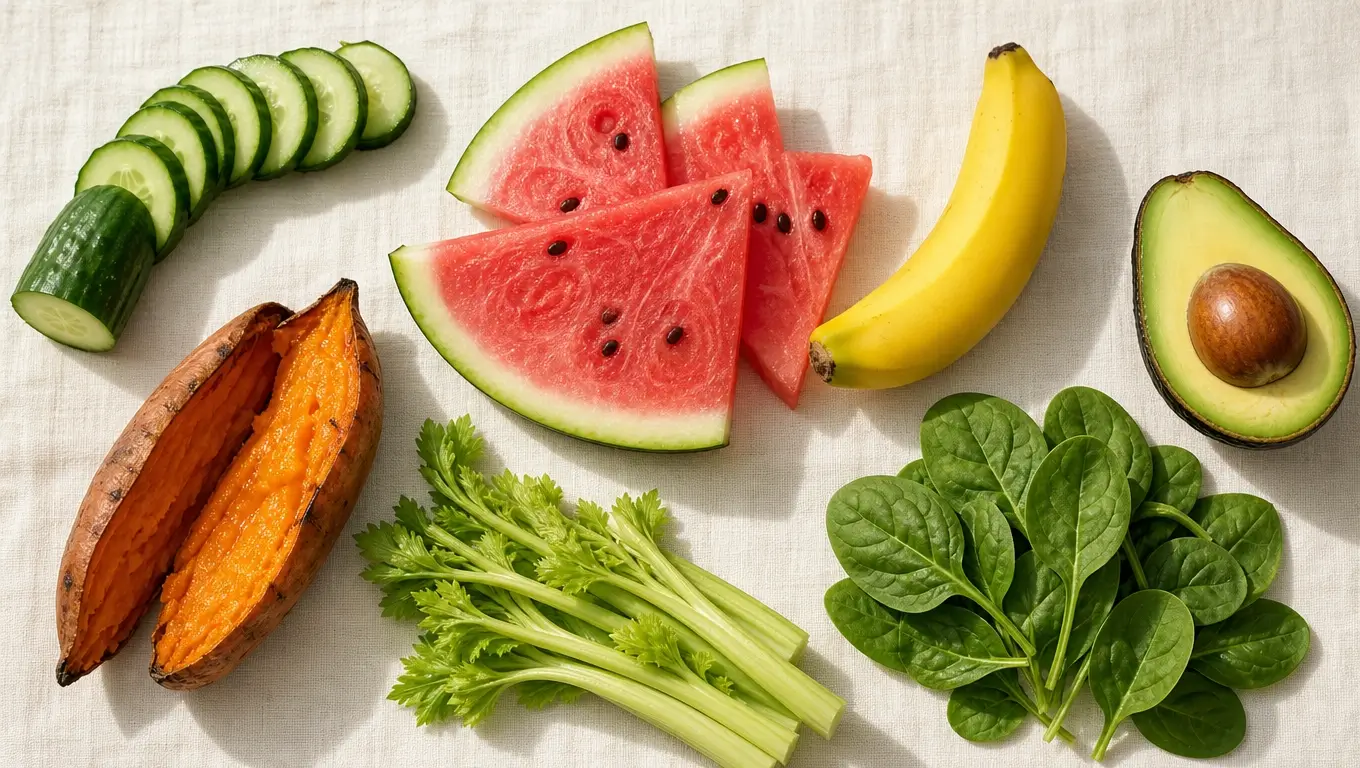
Most of these act within hours, which makes them your go-to after a salty meal.
- Cucumber is about 95% water [2]. Eating water-rich food helps you stay hydrated, and good hydration helps your body release retained fluid instead of hoarding it. Slice a whole cucumber into water or a salad when you feel puffy.
- Watermelon runs around 91% water and adds potassium on top of the hydration. A few cups make an easy afternoon snack that pushes fluid out rather than in.
- Cantaloupe works like watermelon, mostly water with potassium and fiber. Swap it in when watermelon is out of season.
- Celery acts as a natural diuretic, meaning it increases urine output to clear excess water and sodium [2]. It also contains mannitol, which pulls water into your gut and softens stool, so it helps constipation-type bloat too.
- Asparagus contains the amino acid asparagine, which acts as a natural diuretic and flushes extra fluid and salt. It also delivers nearly 3 g of fiber per cup [2].
- One medium banana carries 422 mg of potassium, plus 3 g of fiber [9]. The potassium directly counters salt bloat, which makes a banana one of the simplest fixes after a salty dinner. Slightly green bananas also carry resistant starch, a fiber that feeds good gut bacteria.
- Half an avocado brings about 485 mg of potassium, and a whole one adds 9 to 10 g of fiber [8]. Pair it with salty food to blunt the sodium hit.
- Sweet potato holds 538 mg of potassium in one medium spud [8]. It works as a filling dinner base that fights water retention while keeping you satisfied.
- Spinach is rich in magnesium, which reduces fluid retention and helps relax gut muscles to move things along. A couple of cups blend easily into a smoothie.
- Potassium does the heavy lifting in this group, so here is how the top sources stack up. Spinach and cantaloupe values are general USDA FoodData Central reference figures.
| Food | Potassium per serving |
|---|---|
| Spinach (1 cup cooked) | ~840 mg |
| Sweet potato (1 medium) | 538 mg [8] |
| Avocado (1/2 fruit) | 485 mg [8] |
| Cantaloupe (1 cup) | ~430 mg |
| Banana (1 medium) | 422 mg [9] |
Debloating foods for gas and cramping
This group calms your gut muscles, speeds up digestion, or breaks down food faster so less of it ferments. These are your fastest options, with several working inside an hour or two.
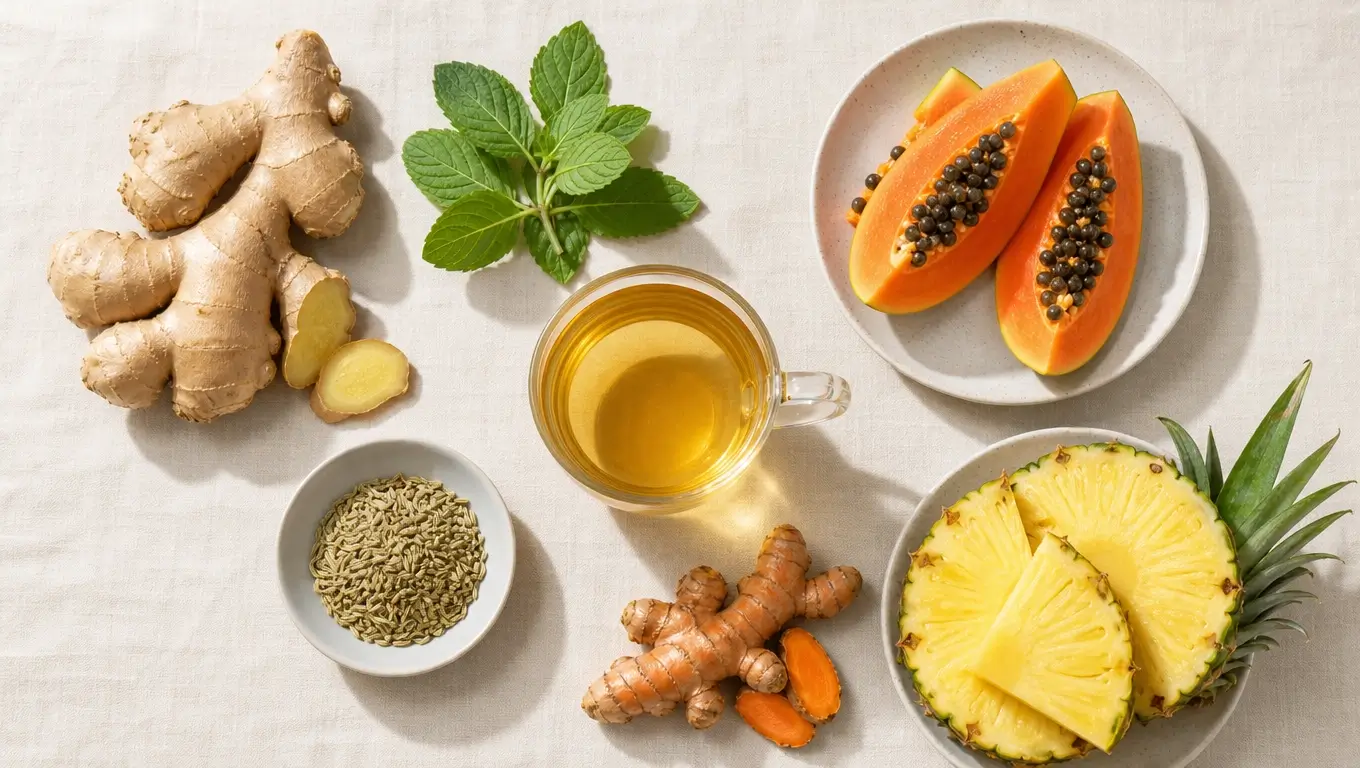
- Ginger speeds up stomach emptying, which prevents the backup that causes gas and fullness. It also relaxes digestive muscles. Grate fresh ginger into hot water for a quick tea when pressure builds. GoodRx notes the exact debloat dose is not pinned down, but ginger root in a cup or two of tea is a safe way to use it [3].
- Peppermint relaxes the muscles in your stomach and intestines, which eases cramping and lets trapped gas pass [4]. Peppermint oil reduces IBS symptoms including bloating, and the recommended dose for IBS symptoms is 0.2 mL of peppermint oil two to three times daily [3]. Peppermint tea is a gentler everyday option.
- Fennel relaxes intestinal muscles and helps you pass gas more easily. One study found fennel and turmeric taken together cut IBS symptoms like gas and bloating [3]. Chew the seeds after a meal or steep them as tea.
- Papaya contains papain, an enzyme that breaks down protein and supports digestion. People with IBS who took 20 mL of concentrated papaya enzyme daily for 40 days reported less bloating and constipation [3]. The whole fruit is worth eating too.
- Pineapple contains bromelain, an enzyme used traditionally to ease indigestion, heartburn, and bloating [1]. A few fresh chunks after dinner can help.
- Kiwi contains actinidin, an enzyme that speeds up stomach emptying and helps digest protein from foods like cheese [1]. Two kiwis a day is a common amount in digestion research.
- Turmeric contains curcumin, which lowers inflammation and reduces IBS symptoms like gas and bloating. Research generally treats 500 mg to 2,000 mg of turmeric daily as safe [3]. A curry or a turmeric latte both count.
“Does the tea actually do anything, or is it the warm water?” Warm liquid alone stimulates gut movement, and the ginger or peppermint adds a real muscle-calming effect on top [3][4]. You get both at once.
Debloating foods for gut health and regularity
These foods play a longer game. They feed good bacteria, add fiber, and improve how often and how easily you go. Do not expect a result in an hour. Eat them regularly and your baseline bloat drops over days and weeks.
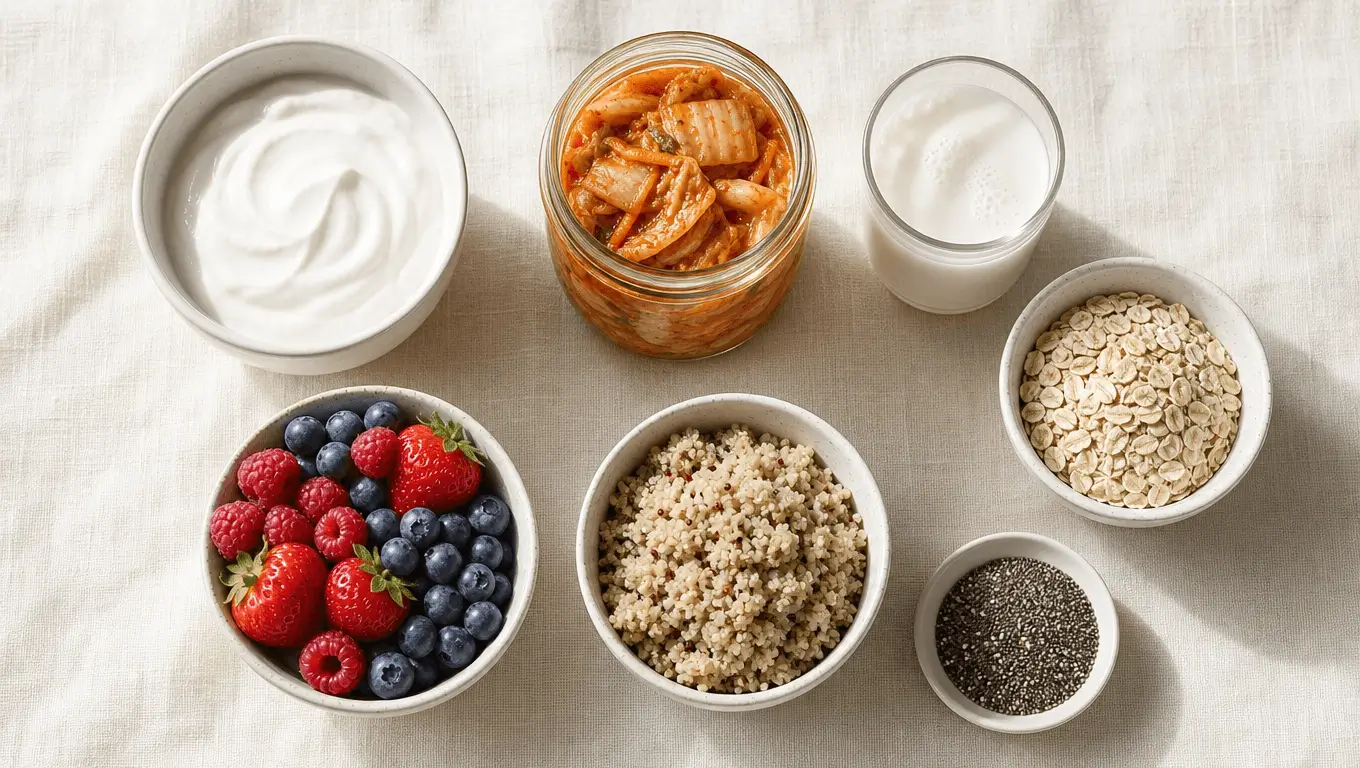
- Probiotics in yogurt reduce bloating and abdominal distension in people with IBS, and they improve stool frequency and consistency [1]. Skip it if you are lactose intolerant.
- Kefir is a fermented milk drink with even more probiotics than yogurt. People with inflammatory bowel disease (IBD) who drank 400 mL of kefir daily for four weeks had significantly less bloating [1].
- Kimchi is fermented cabbage loaded with live microbes that settle into your gut and build a more balanced microbiome (= the community of bacteria living in your gut). Regular small servings work better than one big plate.
- Sauerkraut works like kimchi, fermented cabbage with live bacteria. A forkful alongside a meal adds probiotics without much effort.
- Kombucha is fermented tea rich in probiotics. In a 2023 study of 40 women, drinking 220 mL of a kombucha-based beverage improved constipation and bloating after 10 days compared to water. One warning. Kombucha is carbonated, and too much can cause the bloating you are trying to fix, so keep it modest and pick low-sugar versions [1].
- Oats deliver soluble fiber, which reduces gas production and regulates bowel movements. A half-cup serving has 4 g of fiber [1]. Choose plain steel-cut oats over sugary instant packets.
- Berries like strawberries, blueberries, and blackberries are high in fiber and polyphenols that support gut bacteria, and they are low in fructose, so they cause less gas than apples or pears [3].
- Quinoa is a gluten-free grain with fiber and antioxidants that may help bloating, especially if wheat-based foods like pasta and bread set you off [1].
- Chia and flax seeds add soluble fiber that pulls water into your stool and keeps things moving. Start with 1 tablespoon and drink water with it, since too much fiber too fast can backfire.
One honest caveat. Adding fiber too quickly can increase gas before it helps. Ramp up slowly over a week or two and your gut adjusts.
How fast does each food work?
Most articles skip this, and it is the question you actually care about when your stomach is tight before dinner with friends. Here is the realistic timeline.
- Within a few hours, you can expect relief from ginger, peppermint, fennel, cucumber, watermelon, celery, and banana. These act fast because they calm gut muscles, flush water, or supply quick potassium [3][4][9].
- Over several days to weeks, the slow-but-steady group does its work. Yogurt, kefir, kimchi, kombucha, oats, berries, and seeds improve your gut bacteria and regularity, and that payoff builds with consistency rather than arriving in one sitting [1].
So for a same-day fix, lean on the fast group. For fewer bloated days overall, make the slow group a daily habit.
| Speed | Foods | What they target |
|---|---|---|
| A few hours | Ginger, peppermint, fennel, cucumber, watermelon, banana, celery | Gas, water retention |
| Several days | Yogurt, kefir, kimchi, kombucha, oats, berries, seeds | Gut bacteria, regularity |
A 1-day debloat menu
Want to see it in action? Here is a full day built only from foods on this list, balanced across all three bloat types.
- Breakfast is plain steel-cut oats topped with blueberries and 1 tablespoon of ground flax, with ginger tea on the side. You get soluble fiber, polyphenols, and fast gas relief in one sitting.
- A mid-morning snack is one banana for potassium and a small handful of berries.
- Lunch is a spinach and cucumber salad with half an avocado, grilled chicken or chickpeas, and a squeeze of lemon. This loads up potassium and water while keeping the meal light.
- An afternoon snack is plain yogurt or kefir with a few pineapple chunks. Probiotics meet a digestive enzyme.
- Dinner is baked sweet potato with sauteed asparagus and a side of kimchi. Potassium, fiber, and live bacteria close out the day.
NOTE: Sip peppermint or fennel tea after dinner if you still feel tight.
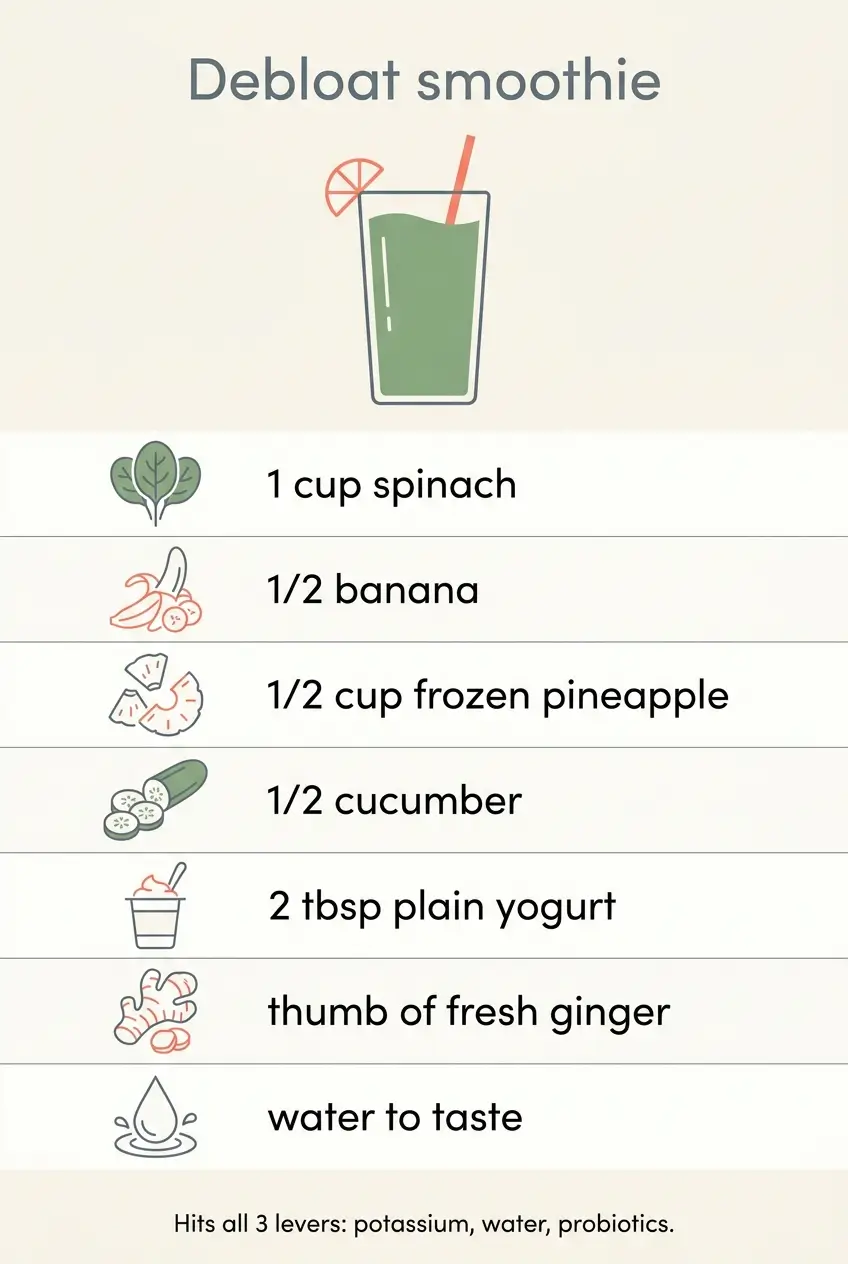
Debloat smoothie recipe
Blend 1 cup spinach, half a banana, half a cup of frozen pineapple, half a cucumber, 2 tablespoons plain yogurt, a thumb of fresh ginger, and water to your liking. This single glass hits all three levers, potassium, water, probiotics, and a digestive enzyme. Drink it in the morning or after a salty meal.
Targeted fixes for common bloat scenarios
Match your bloat to the fix
Period bloat
Banana, avocado, sweet potato, and spinach to counter water retention, plus ginger and turmeric to ease cramping.
After a salty meal
Banana, cucumber, watermelon, and celery for potassium, plus plenty of water to flush the sodium.
Before a trip or event
Cucumber, banana, ginger tea, and plain yogurt. Skip beans, cruciferous veg, and fizzy drinks the day before.
- Period bloat responds to potassium-rich and anti-inflammatory foods. Hormone shifts make your body retain water before your period, so reach for banana, avocado, sweet potato, and spinach to counter the fluid, plus ginger and turmeric to ease cramping inflammation [9][3].
- After a salty meal, your body holds water to dilute the sodium. Drink water and load up on potassium from banana, cucumber, watermelon, and celery to help your kidneys release the excess [9][2]. This is the fastest scenario to fix, often within a day.
- Before a trip or an event, eat light and lean on fast-acting, low-FODMAP foods. FODMAPs (= certain hard-to-digest carbs that ferment and cause gas) are worth avoiding here [11]. Stick with cucumber, banana, ginger tea, and plain yogurt, and skip beans, cruciferous veg, and fizzy drinks the day before.
Foods to skip when you’re bloated
Some foods make the problem worse even though many are healthy. Cut these back when you feel puffy. [3][5][9]
- Carbonated drinks like soda and beer pump gas straight into your gut .
- Beans, lentils, and legumes ferment in your colon and release gas.
- Cruciferous vegetables like broccoli, cabbage, Brussels sprouts, and cauliflower contain raffinose, a carb your body cannot break down until bacteria in your colon feed on it and release gas .
- High-fructose fruits like apples and pears can trigger gas and bloating.
- Sugar alcohols in sugar-free gum and candy ferment and cause bloating.
- Dairy, if you are lactose intolerant, leads to bloating after milk or cheese.
- Ultra-processed salty foods drive water retention through their sodium load .
You do not have to ban these forever. Pull back only while you are actively bloated, then reintroduce them.
Habits that help beyond food
What you do matters almost as much as what you eat.
- Walk for 10 to 15 minutes after meals. People who took a short post-meal walk reported less bloating, according to a 2021 study [6]. Exercise also eases IBS symptoms, including bloating, per a 2023 review in the Journal of Rehabilitation Medicine [5].
- Eat slowly and chew thoroughly. When you rush, you swallow extra air and tend to overeat, and both bloat you [5]. Put your fork down between bites and make the meal last 20 minutes.
- Drink enough water. Staying hydrated helps your body release retained fluid instead of clinging to it [2].
When bloating means see a doctor
Most bloating clears within a day or two. Some does not, and that is worth taking seriously. See a healthcare professional if your bloating lasts beyond one or two days or keeps getting worse, or if it comes with any of these warning signs.
- Unexplained weight loss
- Severe abdominal pain
- Vomiting, especially with blood
- Blood in your stool
- Diarrhea lasting more than three days
- Inability to pass gas or no bowel movement for several days
Persistent bloating can point to IBS, small intestinal bacterial overgrowth (SIBO), celiac disease, or inflammatory bowel disease. In rare cases, ongoing bloating with these red flags signals something more serious, including ovarian cancer [3]. Food fixes are for everyday bloat. Anything stubborn or alarming belongs in front of a doctor.
Frequently asked questions
The bottom line
Match the food to your bloat. Reach for ginger, peppermint, cucumber, and banana when you need relief today, and build yogurt, kefir, oats, and fiber into your routine for fewer bloated days overall.
These debloating foods are cheap, easy to find, and backed by real research.
Start with the smoothie tomorrow morning, and if your bloating sticks around past a day or two or comes with pain, weight loss, or blood, call your doctor.
Citations
- Healthline – “20 Foods and Drinks That Help with Bloating” – 2024 – https://www.healthline.com/nutrition/foods-that-help-with-bloating
- Healthline – “20 Foods and Drinks That Help with Bloating” (cucumber, celery, asparagus, hydration data) – 2024 – https://www.healthline.com/nutrition/foods-that-help-with-bloating
- GoodRx – “9 Foods That Reduce Bloating and Gas” – 2024 – https://www.goodrx.com/well-being/gut-health/foods-that-help-reduce-bloating
- GoodRx – “9 Foods That Reduce Bloating and Gas” (peppermint oil dosing) – 2024 – https://www.goodrx.com/well-being/gut-health/foods-that-help-reduce-bloating
- Harvard Health – “How to get rid of bloating: Tips for relief” – 2024 – https://www.health.harvard.edu/healthy-aging-and-longevity/how-to-get-rid-of-bloating-tips-for-relief
- Harvard Health – “How to get rid of bloating: Tips for relief” (2021 post-meal walk study) – 2024 – https://www.health.harvard.edu/healthy-aging-and-longevity/how-to-get-rid-of-bloating-tips-for-relief
- mindbodygreen via Naturopathic.org – “18 Foods To Add To Your Diet When You Start Feeling Bloated” (potassium values for avocado, sweet potato) – 2025 – https://naturopathic.org/news/692843/18-Foods-To-Add-To-Your-Diet-When-You-Start-Feeling-Bloated-.htm
- mindbodygreen via Naturopathic.org – “18 Foods To Add To Your Diet When You Start Feeling Bloated” (banana potassium, sodium balance) – 2025 – https://naturopathic.org/news/692843/18-Foods-To-Add-To-Your-Diet-When-You-Start-Feeling-Bloated-.htm
- Harvard Health – “How to get rid of bloating: Tips for relief” (raffinose, FODMAP, gas mechanism) – 2024 – https://www.health.harvard.edu/healthy-aging-and-longevity/how-to-get-rid-of-bloating-tips-for-relief