Best Emergency Food: Tested Picks, Real Calories, and Brands to Avoid
Skip the calorie-padded buckets. Find kits that actually feed you for the price, by tested cost per day.
Enjoying this article?Add FoodNourish as a preferred source on Google and see our research-backed guides more often in your search results.
The best emergency food overall is Mountain House, which earns its spot on a 30-year taste guarantee and meals that taste fine straight from the pouch [1]. Augason Farms wins on budget at under $4 per meal [2]. Peak Refuel wins on calories and protein if your wallet can handle it [1]. Skip any kit that hides a low daily calorie count behind a big serving number, because that is where most buyers overpay.
Top picks at a glance
- Mountain House Just in Case 3-Day Kit. Best overall. Around $8 per meal, 30-year shelf life, just add water [1].
- Augason Farms 72-Hour 1-Person Kit. Best budget. $33.99 for 18 servings, about $1.89 per serving, 25-year shelf life [2].
- Peak Refuel Basecamp 3.0. Best calories and protein. Around $14 per meal, 2,545 calories and 120g protein per day, 10-year shelf life [1][3].
- ReadyWise Grab Bag. Best for a bug-out bag. Lightweight, water-resistant pouches you can eat from directly [4].
- My Patriot Supply 30-Day. Best bulk value. Around $250 for a month at over 2,000 calories per day [5].
How we picked
I evaluated the major emergency food brands sold at Costco, Walmart, REI, and direct from manufacturers, then cross-checked my notes against the Wirecutter taste panel of five testers and the Forbes Vetted review [1][6].
I ranked each kit on five things, real calories per day, cost per 2,000 calories, certified shelf life, prep method, and protein per serving, with taste as the tiebreaker.
I leaned on published nutrition labels for the hard numbers because serving counts mislead, and on hands-on tasting notes for flavor. These prices reflect June 2026; emergency food goes on sale constantly, so verify the live price before you buy.
You came here for a shortlist, so let me give you the math behind it before the picks.
Why most people buy the wrong emergency food
Demand for an emergency food supply spiked after 2020 and never fully cooled, and suppliers know they are selling into a nervous market [7].
That pressure produces a specific trap. Buyers compare the number on the front of the bucket, “120 servings” or “30-day supply,” and assume more servings means more food. A serving of one kit can hold 200 calories while a serving of another holds 600 [7].
The serving count tells you almost nothing.
You need calories, protein, and a shelf life you can trust, at a price that does not punish you for stocking up. The rest of this guide ranks the best emergency food by what actually keeps you fed, names the brands worth your money, and flags the ones that pad their numbers.
First, the side-by-side that no top-ranking review currently gives you.
Emergency food comparison, by real cost and calories
Every number below comes from the manufacturer’s published nutrition data or the Wirecutter taste panel [1][2][3].
The last column matters most, because it shows what a full day of eating actually costs.
| Kit | Price per meal | Calories per day | Protein per day | Shelf life | Prep method |
|---|---|---|---|---|---|
| Mountain House Just in Case 3-Day | ~$7.78 | 1,706 | 75g | 30 years | Just add water [1] |
| Augason Farms 72-Hour 1-Person | ~$3.78 | 1,580 | 58g | 25 years | Stovetop simmer [1][2] |
| Peak Refuel Basecamp 3.0 | ~$13.83 | 2,545 | 120g | 10 years | Just add hot water [1][3] |
| ReadyWise Emergency Bucket | varies | ~1,800 | moderate | 25 years | Add hot or cold water [6] |
| My Patriot Supply 30-Day | varies | 2,000+ | moderate | 25 years | Stovetop simmer [5] |
Calories per day by kit
Dashed target line marks 2,000 calories per adult. Higher is more filling.
Source: NYT Wirecutter taste panel and manufacturer nutrition labels, 2026.
Two things jump out. Peak Refuel delivers nearly 1,000 more calories per day than Mountain House and more than double the protein, which is why backpackers swear by it [1][3].
Augason Farms costs less than half what Peak Refuel does per meal, and that gap widens fast when you are buying one kit per family member [1].
Now, how many of those calories do you actually need?
How many calories you actually need per day
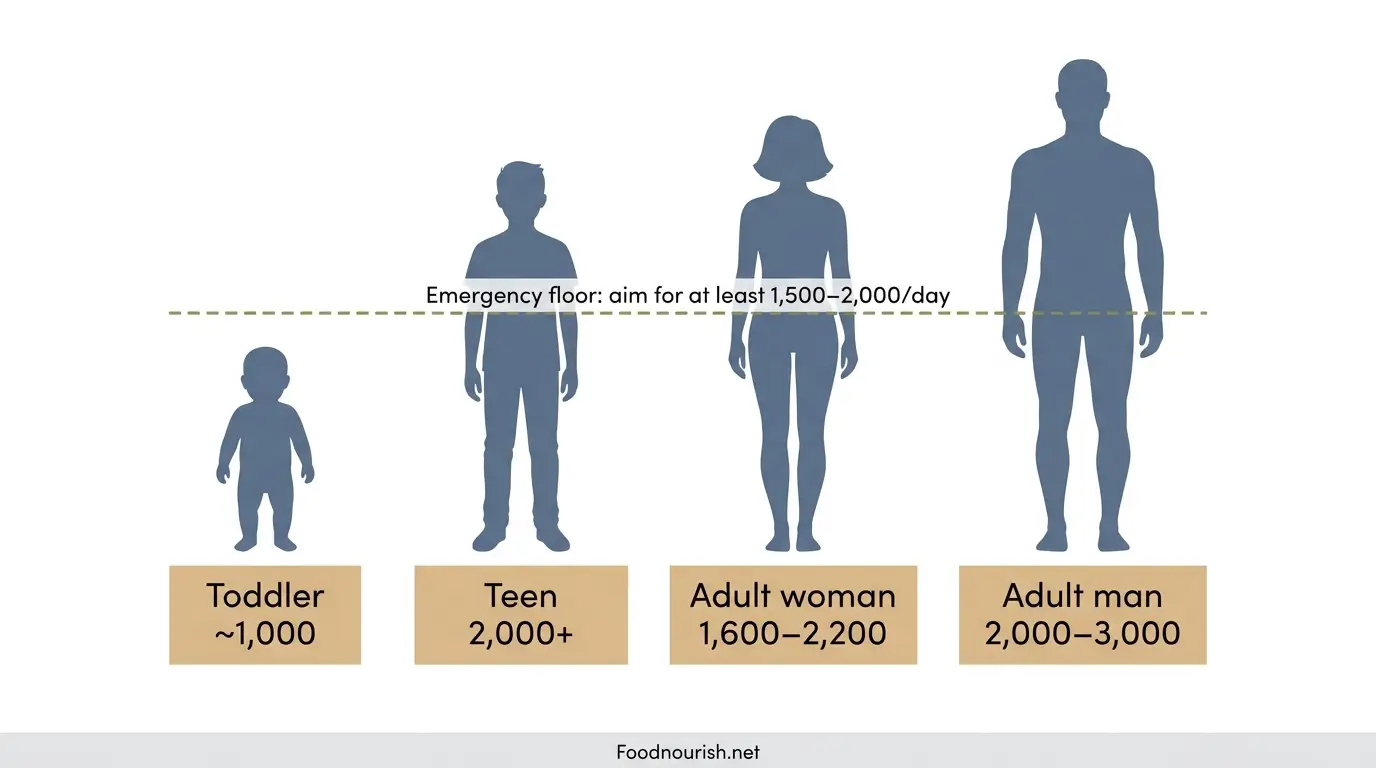
An adult needs roughly 1,600 to 3,000 calories per day depending on age, sex, and activity [1].
In a short emergency you will not hit your normal intake, and that is fine. Aim to cover at least half your daily needs to hold your energy and mood, and treat 1,500 to 2,000 calories per day as a realistic floor for an adult [6].
Children change the math. A toddler needs around 1,000 calories per day, and a teenager needs over 2,000 [6]. If you are feeding a family, add it up per person rather than trusting a kit’s “feeds a family of four” claim.
FEMA recommends keeping at least a three-day food and water supply per person, and many preppers build toward two weeks or a month [1].
Whatever your target, the number that matters is total calories per day, not the serving count on the label. Hold onto that, because it exposes the single most common scam in this category.
The calorie-padding trap, and the brands that use it
Here is the trick. A kit advertises “120 servings” and calls itself a one-month supply.
You divide 120 by 30 and assume four meals a day.
Then you read the individual nutrition labels and find each serving holds about 200 calories, which works out to roughly 600 to 800 calories per day [7].
That is a starvation ration sold at a premium.
Practical Self Reliance documented this pattern with Wise Food Storage, now rebranded as ReadyWise, whose older “one-month” kits delivered about 600 calories per day per person [7].
The company has since raised calories slightly and dropped the worst claims, but the cost per real calorie still runs two to three times higher than reputable competitors [7].
Reddit’s r/preppers community gives the same blunt advice, treat any brand built around the words “patriot,” “emergency,” or “sos” with caution, because those names tend to target scared buyers rather than informed ones [8].
So how do you protect yourself?
Ignore the serving count. Find the calories per serving on the nutrition label, multiply by the servings per day the kit assumes, and confirm you land near 2,000. If a brand makes that math hard to do, that is your answer.
The table below shows how far advertised servings can drift from real daily calories.
| What the label says | What it can actually mean |
|---|---|
| “120 servings, 1-month supply” | ~600 to 800 calories per day [7] |
| “252 servings” | depends entirely on calories per serving |
| “18 servings, 72-hour kit” | ~1,580 calories per day, honest math [2] |
With the math sorted, here are the kits worth your money, starting with the one most people should buy.
Best emergency food overall: Mountain House
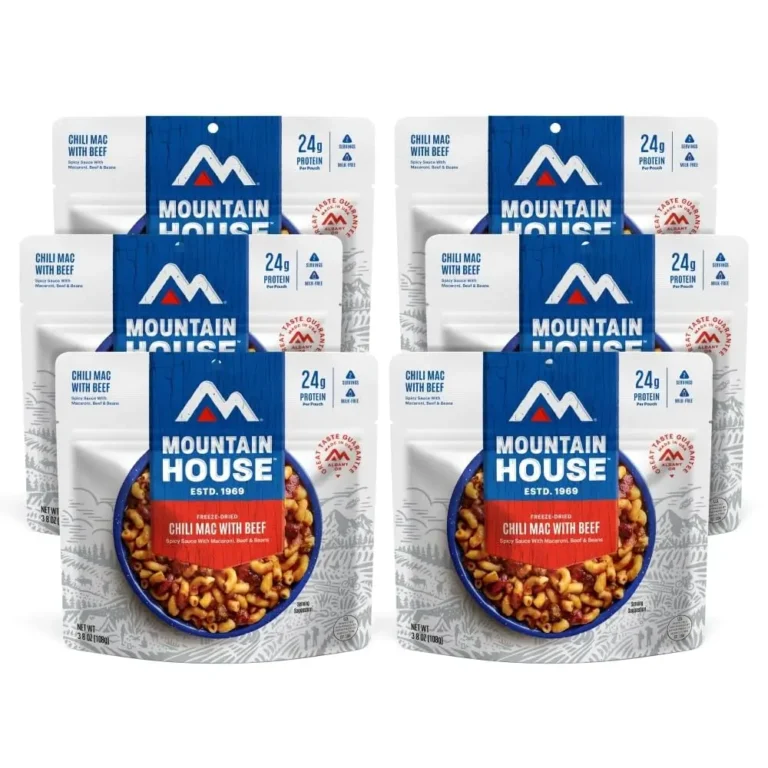
Mountain House is the safe, sensible default, and I do not say that as a knock. The brand has made freeze-dried food since spinning off from military ration work during the Vietnam War, and it backs every meal with a 30-year taste guarantee that the company says it has lab-verified through accelerated testing [1].
Freeze-dried = food with nearly all its water removed, which stops bacteria from growing and gives it that long shelf life.
In the Wirecutter taste panel of five testers, Mountain House landed in the comfortable middle, with the fried rice and beef stroganoff drawing favorable comparisons to Hamburger Helper [1].
Not gourmet, but food you will actually eat. The Just in Case 3-Day Kit holds nine pouches, rehydrates in under 10 minutes with only hot water, and averages 1,706 calories and 75g of protein per day [1].
The flaws are real but minor. The pouches sit in a cardboard box that turns soggy if it gets wet, so move them into a sealed bucket. Some meals need more salt. The price runs around $8 per meal, which beats Peak Refuel but loses to Augason Farms [1].
If you want one brand you can stash and forget, this is it. If that price stings, the next pick costs less than half as much.
Best budget emergency food: Augason Farms
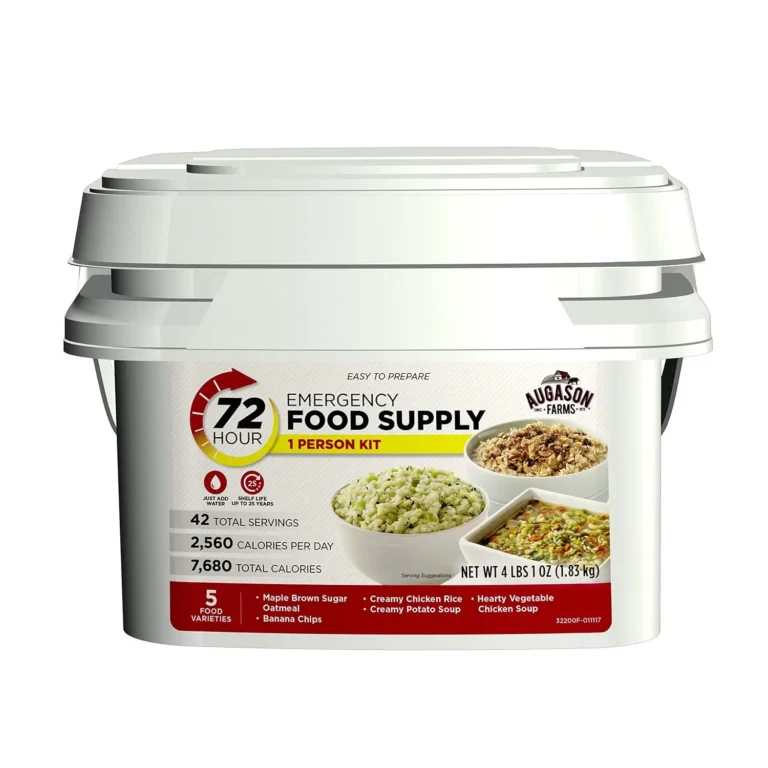
Augason Farms surprised me, and it surprised the Wirecutter panel too, where its 72-hour kit won the overall taste test despite the dullest-looking menu of the bunch [1].
Potato soup, pasta marinara, chicken-flavored rice. It tastes like the canned soup of childhood, familiar and hearty, which counts for a lot when you are stressed and feeding nervous kids [1].
The 72-Hour 1-Person Kit runs $33.99 for 18 servings, about 1,580 calories and 58g of protein per day, with a 25-year shelf life [2].
That is the lowest barrier to entry in emergency food, the “why not” purchase that gets people started.
The catch is preparation. Most Augason Farms meals need a stove and 15 to 20 minutes of simmering, and a working stove is no guarantee in a blackout or after an earthquake cuts the gas [1].
You will need a camp stove and fuel ready to go. The pouches also hold multiple servings and do not reseal, so you waste food unless you have a way to store leftovers [1].
For a tight budget and a deep pantry, those trade-offs are worth it.
Best for calories and protein: Peak Refuel
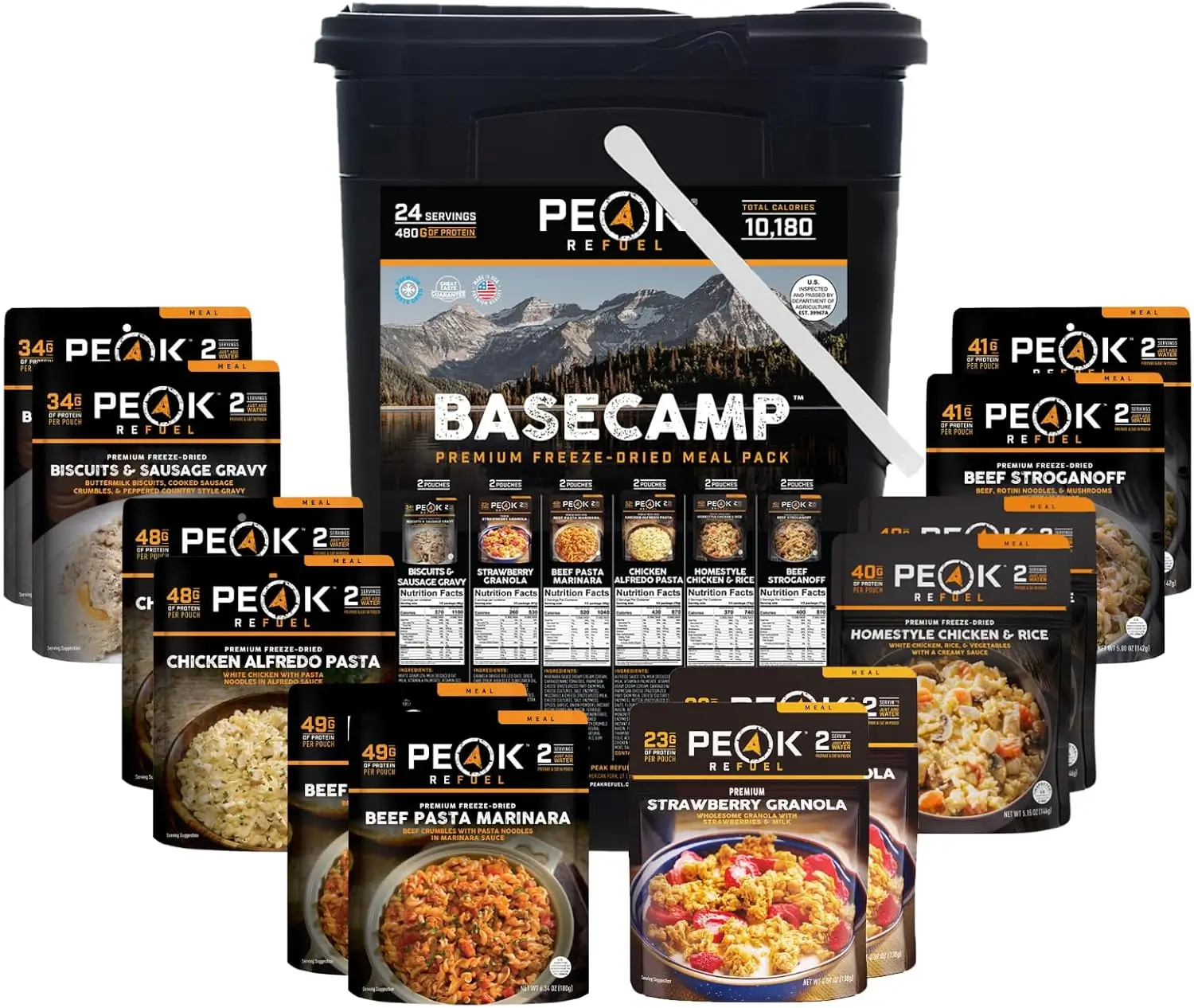
Peak Refuel markets to backpackers, not preppers, but it uses the same freeze-drying as Mountain House and feeds you far better [1].
The Basecamp 3.0 bucket delivers about 2,545 calories and 120g of protein per day, the highest of any kit I looked at, and the chicken alfredo and beef stroganoff were two of the top-scoring meals in the Wirecutter panel [1][3].
The meals use real USDA-inspected meat, which is why the protein numbers run so high [3].
You pay for that quality. Each meal costs around $14, and the shelf life is 10 years rather than 30, so you will rotate stock more often [1][3].
The food ships in a sturdy plastic bucket instead of a cardboard box, which I prefer for keeping moisture and rodents out [1].
Ask yourself one question. Is your priority bare survival or staying comfortable through a hard stretch? If a warm, genuinely good meal would steady your family’s morale during a week without power, Peak Refuel earns its premium. If you just need calories in the closet, you can do it cheaper.
Some emergencies do not let you cook at all, which changes the calculation entirely.
Best for a bug-out bag, car, or evacuation
A bug-out bag = a packed bag you grab and go in an evacuation. For that bag, weight and water-resistance beat everything.
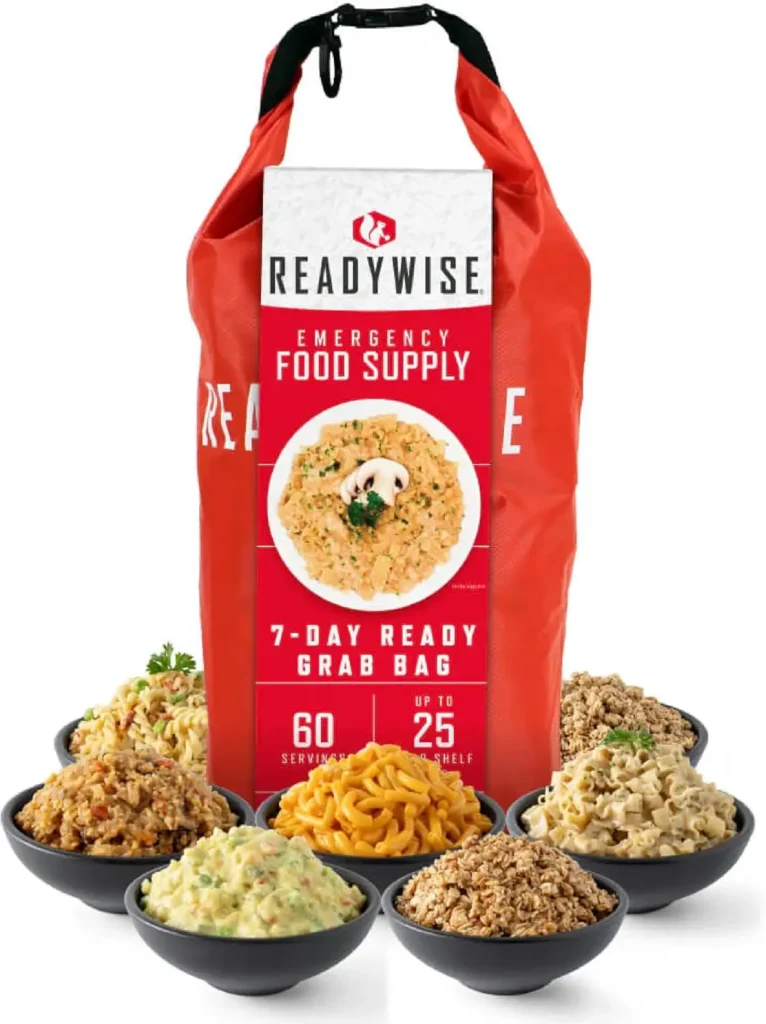
The ReadyWise grab bag holds about a week of food in lightweight, water-resistant pouches with gusseted bottoms you can eat from directly, so all you carry is a spoon [4][6].
Just-add-water pouches like Mountain House work well here too, since they pack flat and need no cookware [1].
Your car needs different food. A vehicle can hit 120°F in summer, and heat wrecks most kits long before their printed shelf life [8].
For the car, calorie-dense ration bars survive temperature swings far better than freeze-dried meals, and several r/preppers users keep bars plus rotating snacks instead [8].
Best no-cook emergency food
What if the power is out, the gas is shut off, and you have no stove? You need food that requires zero heat. Three options cover it.
- Ration bars give you 2,400 to 3,600 calories in a single brick with a long shelf life.
- MREs (Meals Ready to Eat) come with their own flameless heaters, so they need no water or fire, which is why several preppers keep a case in their kit [8].
- Shelf-stable ready-to-eat pouches like Tasty Bite or flavored tuna round it out, eaten cold straight from the package [8].
None of these last 25 years, so rotate them.
Best emergency food for vegan, vegetarian, gluten-free, and low-sodium diets
Most emergency food leans on meat, dairy, and heavy sodium, so restricted diets take more searching.
- Good To-Go makes one of the few genuinely vegan kits, plant-based and gluten-free, with meals like a carrot-ginger power bowl you can prepare with cold water. The trade-off is a short shelf life of about two years, because clean ingredients without preservatives do not last [6].
- Backpacker’s Pantry covers vegetarians with meat-free lasagna, pad thai, and chana masala, plus 463g of protein across a seven-day kit, though some pouches last only three to ten years depending on the meal [6].
- For lower sodium, r/preppers users point to Valley Food Storage, which sells single sample packs so you can test before committing [8].
One rule holds across every diet. Calorie density matters more than the label, so confirm each meal carries enough calories to satiate you on fewer servings [6].
That covers pre-built kits. For longer timelines, building your own often wins.
Emergency food kit vs building your own pantry
Here is the debate that splits experienced preppers. A pre-built survival food kit gives you ready meals you can prepare with water and a spoon, no planning, no cooking skill. That convenience is worth real money during a crisis, and it is why kits dominate the market.
The counterargument is cost. Rice, beans, and oats bought in 50-pound bags from Costco or Sam’s Club, then sealed in Mylar bags with oxygen absorbers, cost a fraction of what kits charge per calorie [8].
Multiple r/preppers users run this math and conclude that the “patriot” and “emergency” kits are mostly cheap starch sold at a markup [8].
A deep pantry of food you already eat, rotated normally, handles most short emergencies for almost nothing extra [8].
So which should you buy? Use both, by timeline. Kits and a deep pantry cover short events like hurricanes, blackouts, and trucking strikes, when you want zero effort and you can still cook.
For anything past a month, raw staples in Mylar give you far more calories per dollar, if you have the storage space and the skill to cook from scratch [8].
| Approach | Rough cost, 1 month, 1 person | Effort |
|---|---|---|
| Pre-built kit (My Patriot Supply) | ~$250 [5] | Low, just add water or simmer |
| DIY rice, beans, oats in Mylar | well under $100 [8] | High, you cook everything |
Whichever you choose, the shelf-life promise is only as good as your storage.
How long emergency food really lasts
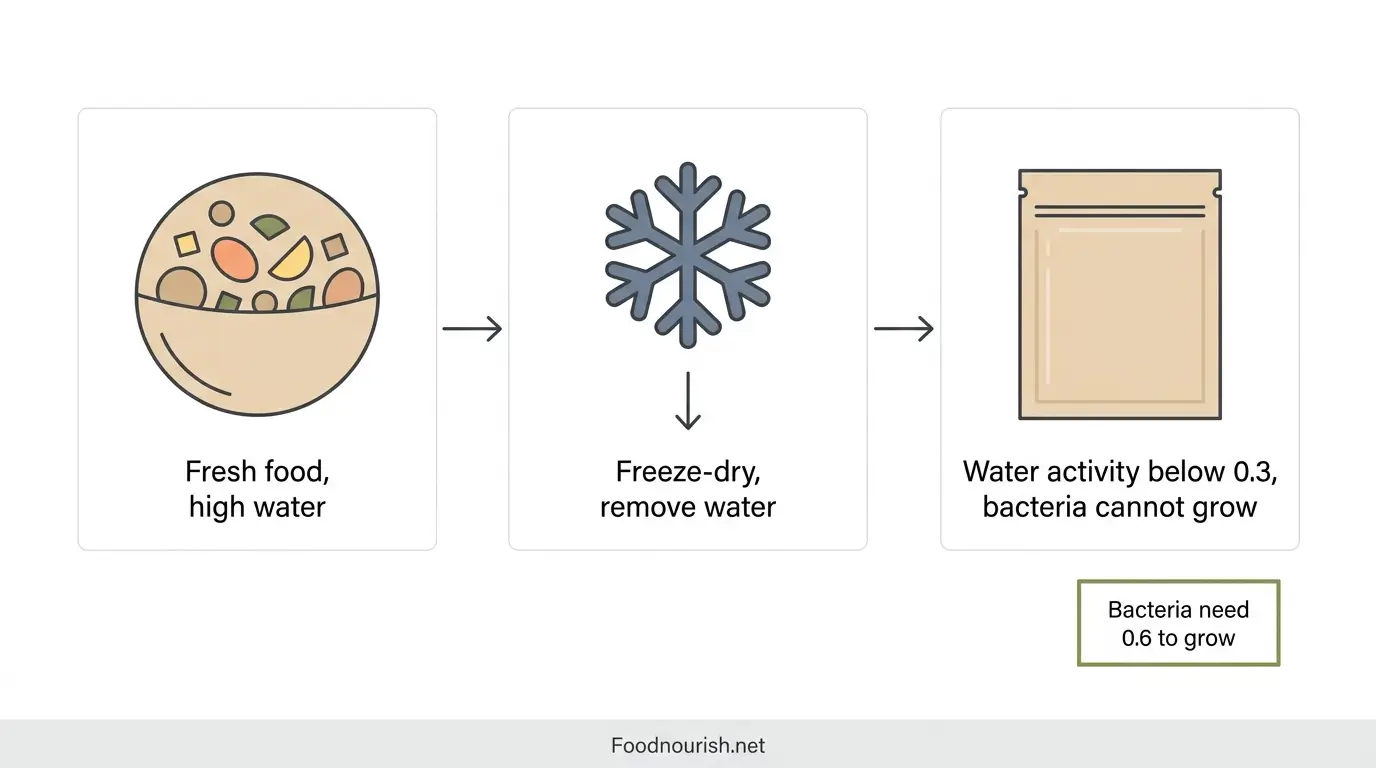
Freeze-drying removes almost all the water from food, and that is the whole secret. Xulei Wu, Space Food Systems manager at NASA, explained it plainly to Wirecutter, the method does not kill bacteria, it removes the water bacteria need to multiply [1].
Water activity for freeze-dried food sits at 0.3 or below, while bacteria need 0.6 to grow, so the food stays safe as long as the packaging holds [1].
Those 25-year and 30-year numbers come from accelerated lab testing, not real time. Leanne Blommaert of NSF told Wirecutter that labs subject the food to high heat to speed bacterial growth about 7.5 times, so confirming a 30-year claim takes roughly four years of testing [1].
Those figures assume ideal storage. A bucket baking in your garage for years will not last as advertised [1].
Store your emergency food supply in a cool, dry, dark place, and trust your senses over the printed date. As Blommaert put it, when in doubt, throw it out, because shelf life ends when either flavor degrades or microbes grow, whichever comes first [1].
One more requirement gets overlooked until it is too late.
Do you need water to prepare it?
Almost every emergency food kit needs water to rehydrate, and water is often the scarcer resource in a disaster. This catches people off guard. You stockpile food, then realize you cannot prepare any of it without clean water you did not store.
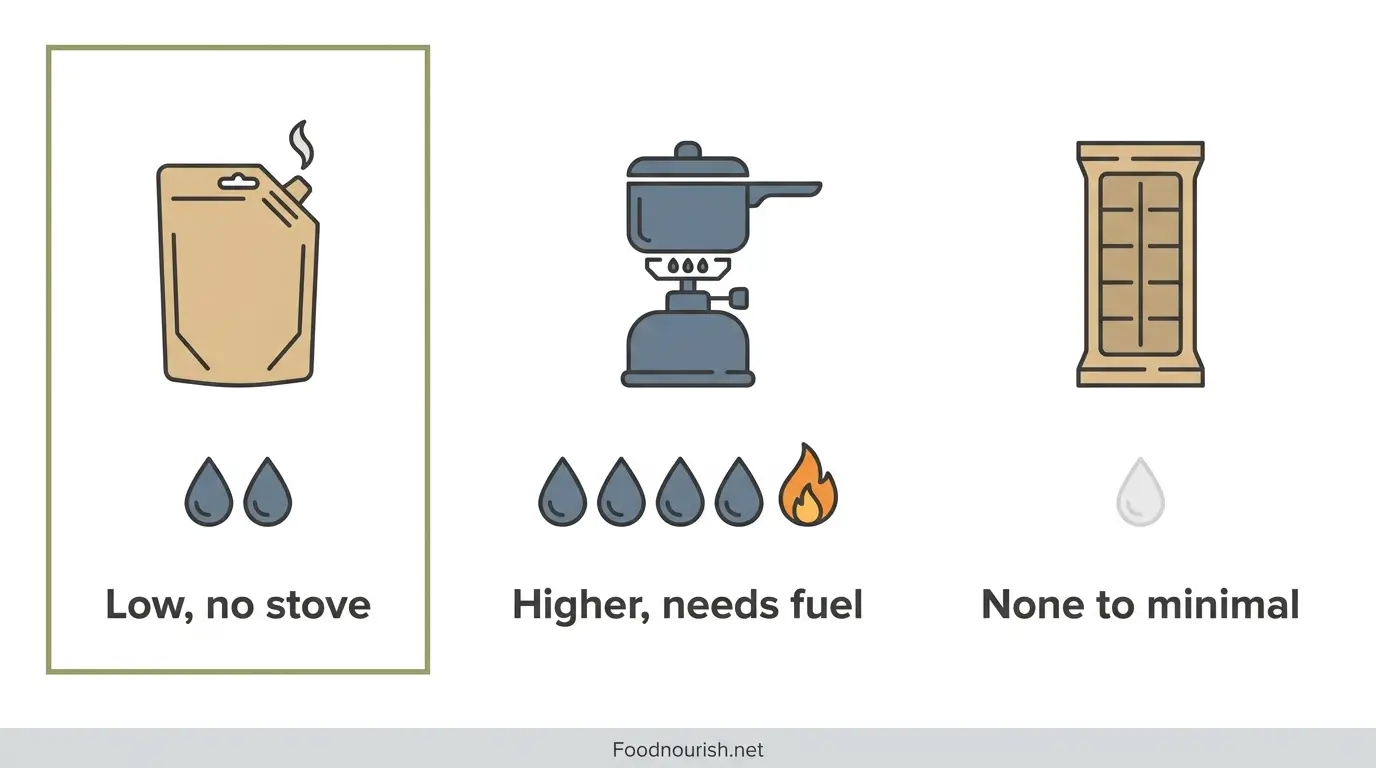
Prep method drives how much you need. Just-add-water pouches like Mountain House and Peak Refuel rehydrate in the bag with a cup or two of hot water and leave no dishes [1].
Stovetop kits like Augason Farms and My Patriot Supply need more water for cooking plus fuel to simmer for 15 to 20 minutes [1].
The CDC recommends storing a separate water supply and replacing stored water every six months, or buying canned water that lasts longer [1].
| Kit type | Water and fuel demand |
|---|---|
| Just-add-water pouch | Low, ~1 to 2 cups hot water per meal, no stove |
| Stovetop kit | Higher, more water plus a fuel source [1] |
| No-cook bars or MREs | None to minimal |
Plan your water storage alongside your food, not after it. Now, what do real buyers say once the marketing wears off?
What real users say
The r/preppers community is refreshingly blunt about this category, so I read through a long thread of owner reports [8].
A few patterns held up.
Mountain House and Peak Refuel come out on top almost every time, praised for taste, easy prep, and in Mountain House’s case the long shelf life that lets you “stash it and forget it” [8].
One user liked that Mountain House lets you filter meals by allergen, a small thing that saves real time [8].
The most common complaint targets kit composition, with several users calling the cheaper buckets “basically cheap starch,” heavy on pasta, white rice, and instant oatmeal that you can buy elsewhere for less [8].
Another recurring caution, paid YouTube taste tests, so users trust firsthand forum reports over sponsored video reviews [8].
The takeaway. Most owners are happy with the premium freeze-dried brands and skeptical of the budget buckets and the heavily advertised “patriot” names, though plenty still keep an Augason Farms or Costco kit around as an affordable backstop [8].
That leaves one question, how much do you actually need to store?
How much to store per person and per family
Start with the FEMA minimum of three days of food and water per person, then build from there [1].
A practical progression looks like three days first, then two weeks, then a month as budget allows. Do the math per person, not per kit. A “feeds a family of four for a week” claim only holds if its real daily calories clear roughly 2,000 per adult [6].
A quick example. A family of four targeting two weeks at 2,000 calories per adult per day needs roughly 112,000 calories total, adjusted down for kids.
Compare that target against the calories-per-day figures in the comparison table above, and you will know how many kits to buy instead of guessing from serving counts.
Frequently asked questions
My recommendation
- Buy the Mountain House Just in Case 3-Day Kit if you want one reliable choice you can ignore for decades.
- Buy Augason Farms if you are starting on a budget, and add a camp stove and fuel to use it.
- Buy Peak Refuel if calories, protein, and morale matter more than price.
Then store water beside it, because the best emergency food does you no good if you cannot prepare it.
Citations
- NYT Wirecutter, “The 3 Best Emergency Food Kits of 2026”, 2026
- Augason Farms, “72-Hour 1-Person Emergency Food Supply Kit, 18 Servings”, 2026
- Peak Refuel / Amazon, “Peak Refuel Beef Pasta Marinara product data”, 2026
- Forbes Vetted, “ReadyWise grab bag listing”, 2026
- My Patriot Supply, “Long-Term Food Storage”, 2026
- Forbes Vetted, “Best Emergency Food Supplies 2026”, 2026
- Practical Self Reliance, “Best (and Worst) Emergency Food Suppliers”, 2025
- r/preppers, “What emergency food kits do you prefer/favor, and why?”, 2025