
Pumpkin Cinnamon Rolls Recipe With Maple Cream Cheese Frosting
Soft, gooey rolls with clear rise cues, make-ahead steps, and no dry or underbaked centers.
Enjoying this article?Add FoodNourish as a preferred source on Google and see our research-backed guides more often in your search results.
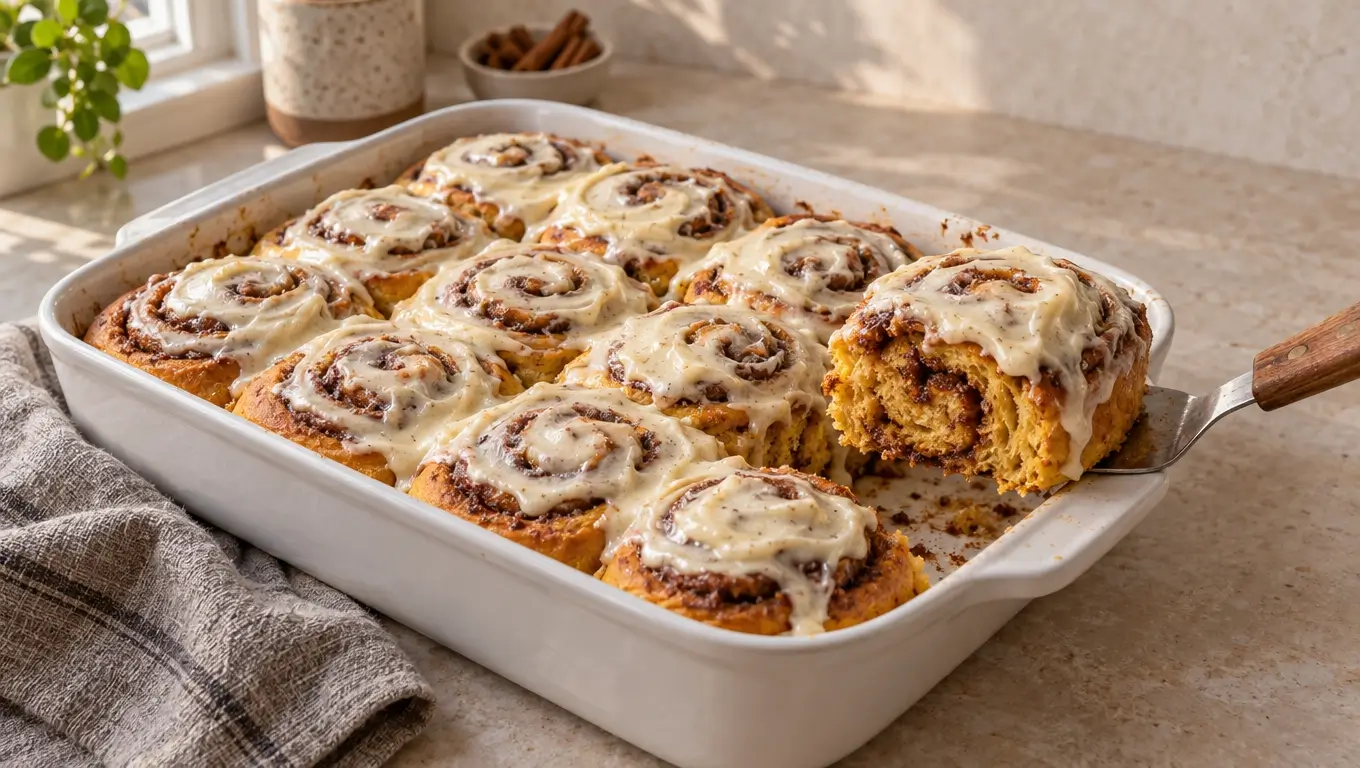
This pumpkin cinnamon rolls recipe puts real pumpkin puree in the yeast dough, where it adds moisture, color, and a mild pumpkin flavor. Brown sugar, cinnamon, and pumpkin pie spice form the filling. Maple cream cheese frosting finishes each warm roll.
You can make all 12 rolls in one morning or refrigerate the shaped rolls overnight. The instructions give you weight measurements, visual rise cues, and an internal-temperature target, so you do not have to rely on the clock alone.
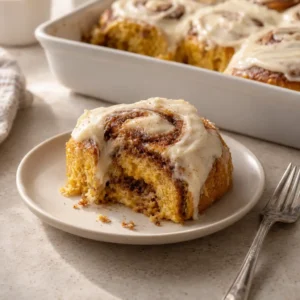
Pumpkin Cinnamon Rolls With Maple Cream Cheese Frosting
Equipment
- 1 Digital Kitchen Scale Use it to weigh the flour, pumpkin puree, butter, sugar, cream cheese, and other ingredients.
- 1 Instant-read thermometer Use it to check the milk temperature and the center of the baked rolls.
- 1 Stand Mixer Optional. Fit it with a dough hook for kneading.
- 1 Large mixing bowl Use a bowl with at least a 4-quart capacity.
- 1 Small Saucepan Use it to warm the milk gently.
- 1 Glass measuring jug A microwave-safe jug can replace the saucepan.
- 1 Silicone spatula Use it to combine the wet and dry ingredients and scrape the bowl.
- 1 Sturdy wooden spoon Use it if you mix the dough by hand.
- 1 Dough scraper Helpful for handling tacky dough and cleaning the counter.
- 1 Rolling Pin Use it to roll the dough into an even rectangle.
- 1 Ruler or measuring tape Use it to check the dough dimensions and divide the log evenly.
- 1 Small mixing bowl Use it to prepare the cinnamon-spice filling.
- 1 Medium mixing bowl Use it to prepare the maple cream cheese frosting.
- 1 Offset spatula Use it to spread the filling and frosting evenly.
- 1 12-inch piece of unflavored dental floss Use it to cut the dough without crushing the spirals.
- 1 Sharp serrated knife Use it if dental floss is unavailable.
- 1 9 by 13-inch baking dish Use a light-colored metal, ceramic, or oven-safe glass dish.
- 1 Parchment paper Leave an overhang on two sides for easier removal.
- 1 Pastry brush Use it to grease exposed areas of the baking dish.
- 1 Clean kitchen towel or reusable bowl cover Use it to cover the dough during rising.
- 1 Plastic wrap or fitted pan cover Use it for overnight refrigeration.
- 1 Wire cooling rack Place the baking dish on it after baking.
- 1 Electric hand mixer Optional. Use it to make smooth frosting.
Ingredients
Pumpkin Dough
- ½ cup Whole milk 120 milliliters. Warm it to 105°F to 110°F.
- 2¼ teaspoons Instant yeast 7 grams. Active dry yeast also works.
- ¼ cup Granulated sugar 50 grams. Reserve 1 teaspoon if you bloom active dry yeast.
- 1 scant cup Pure pumpkin puree 225 grams. Use plain pumpkin puree, not pumpkin pie filling.
- 1 large Egg About 50 grams without the shell. Bring it to room temperature.
- ¼ cup Unsalted butter 57 grams. Melt it, then let it cool until warm.
- 1 teaspoon Pure vanilla extract 5 milliliters.
- 4 cups Bread flour 480 grams. Hold back ¼ cup, or 30 grams, until you check the dough consistency.
- 1 teaspoon Pumpkin pie spice About 2 grams.
- 1 teaspoon Fine salt About 6 grams.
Cinnamon-Spice Filling
- 6 tablespoons Unsalted butter 85 grams. Soften it without melting it.
- ¾ cup Dark brown sugar 150 grams. Pack it lightly.
- 1½ tablespoons Ground cinnamon About 12 grams.
- 2 teaspoons Pumpkin pie spice About 4 grams.
- ⅛ teaspoon Fine salt About 1 gram.
Maple Cream Cheese Frosting
- 4 ounces Full-fat block cream cheese 113 grams. Soften it to room temperature.
- 2 tablespoons Unsalted butter 28 grams. Soften it to room temperature.
- 1 cup Powdered sugar 120 grams. Sift it if it contains hard lumps.
- 2 tablespoons Pure maple syrup 30 milliliters.
- ½ teaspoon Pure vanilla extract 2.5 milliliters.
- 1 pinch Fine salt Adjust it to taste.
- 1 to 2 teaspoons Whole milk 5 to 10 milliliters. Add it only when you want thinner frosting.
Instructions
Prepare the Baking Dish
- Line the baking dish, Fit parchment paper inside a 9 by 13-inch baking dish, leaving an overhang on two opposite sides.
- Grease the dish, Lightly grease the parchment paper and exposed sides of the baking dish.
- Set aside, Keep the prepared baking dish nearby while you make the dough.
Warm the Milk and Prepare the Yeast
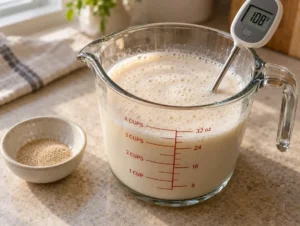
- Warm the milk, Heat the whole milk in a small saucepan or microwave-safe jug until it reaches 105°F to 110°F.

- Prepare active dry yeast, If using active dry yeast, stir it into the warm milk with 1 teaspoon of the measured granulated sugar.
- Check the yeast, Let the mixture stand for 5 to 10 minutes. The surface should look creamy or foamy.
- Replace inactive yeast, Start again with fresh yeast if the mixture shows no activity after 10 minutes.
- Prepare instant yeast, If using instant yeast, mix it directly with the flour or bloom it in the milk to check an older packet.
Combine the Wet Ingredients
- Add the wet ingredients, Place the pumpkin puree, remaining granulated sugar, egg, melted butter, and vanilla extract in a large mixing bowl.
- Whisk the mixture, Whisk until the pumpkin and egg combine completely.
- Add the milk, Pour the warm milk mixture into the bowl.
- Mix until even, Whisk until the mixture has an even consistency and no visible streaks of egg remain.
- Check the temperature, The mixture should feel warm rather than hot before you add the flour.
Form the Dough
- Combine the dry ingredients, Mix 450 grams of bread flour with the pumpkin pie spice and salt in a separate bowl.
- Reserve some flour, Hold back the remaining 30 grams of bread flour for later adjustments.
- Add the dry ingredients, Add the flour mixture to the bowl containing the wet ingredients.
- Form a rough dough, Stir with a silicone spatula or sturdy wooden spoon until no dry flour remains.
- Check the texture, The dough should look rough, soft, and slightly sticky at this stage.
Knead With a Stand Mixer
- Attach the dough hook, Fit the stand mixer with its dough hook and place the bowl on the mixer.
- Begin kneading, Knead the dough on low speed for 2 minutes.
- Increase the speed, Change to medium-low speed and knead for another 6 to 8 minutes.
- Scrape the bowl, Stop once or twice to scrape the sides and bottom of the bowl.
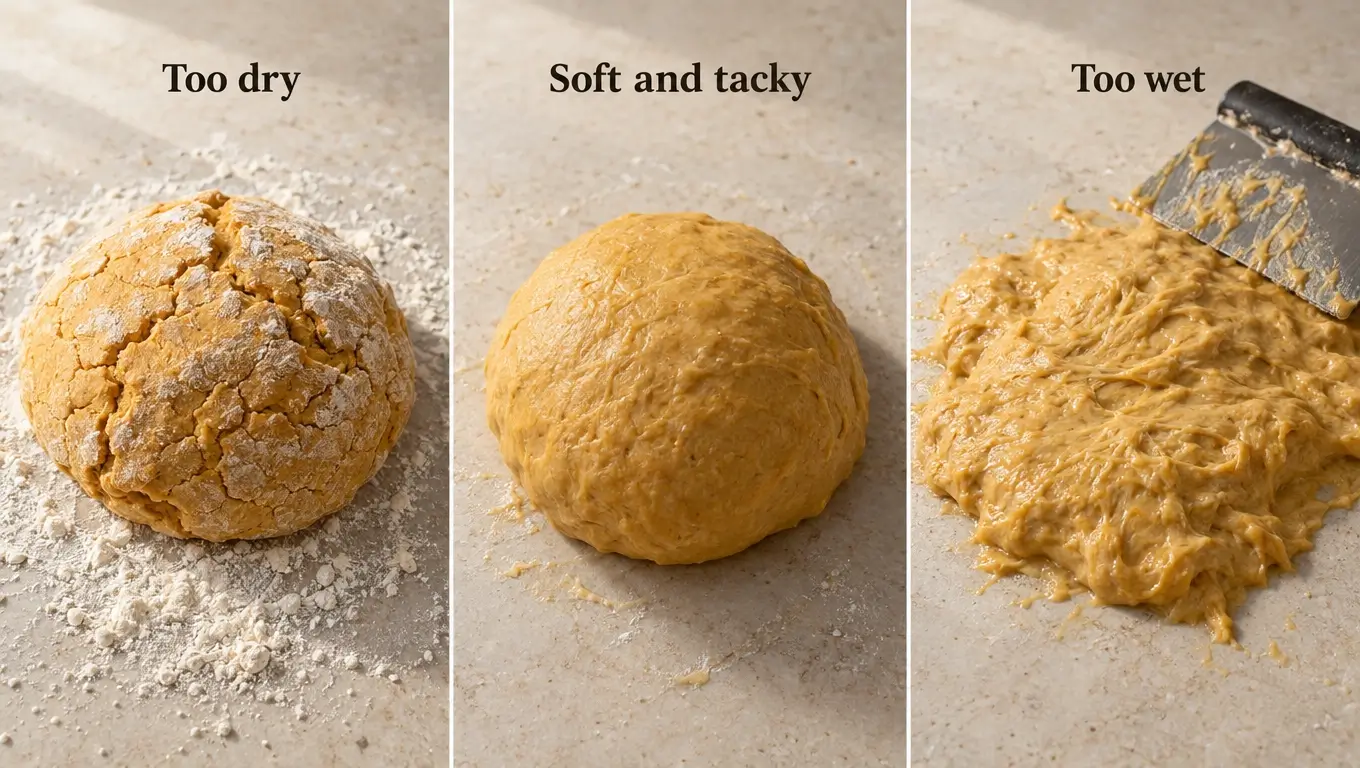
- Add reserved flour if needed, Add the reserved flour 1 tablespoon at a time only if the dough smears across the bowl like thick batter.
- Knead after each addition, Knead for at least 1 minute after each flour addition before adding more.
- Finish kneading, Stop when the dough looks smooth, holds a rounded shape, and remains slightly tacky.
Knead by Hand
- Prepare the counter, Turn the rough dough onto a lightly floured work surface.
- Knead the dough, Fold the dough toward you, press it forward with the heel of your hand, and rotate it.
- Continue kneading, Knead for 10 to 12 minutes.
- Manage sticking, Use a dough scraper to lift the dough rather than covering the counter with flour.
- Add flour carefully, Add reserved flour 1 tablespoon at a time only if the dough remains wet after several minutes of kneading.
- Finish kneading, Stop when the dough feels smooth, elastic, and slightly tacky.
Check the Dough
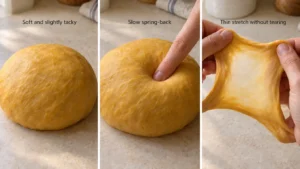
- Test the surface, Press one clean finger lightly against the dough.

- Check the tackiness, The dough should cling briefly, then release without leaving a thick coating on your finger.
- Perform the indentation test, Press the dough about ½ inch deep. The indentation should begin returning slowly.
- Perform the windowpane test, Stretch a walnut-sized piece of dough gently between your fingers.
- Check the stretch, The dough should form a thin membrane before tearing.
- Continue kneading if needed, Knead for another 1 to 2 minutes if the dough tears immediately.
Complete the First Rise
- Shape the dough, Form the dough into a smooth ball.
- Grease the bowl, Lightly grease a clean mixing bowl.
- Add the dough, Place the dough in the bowl and turn it once to coat its surface.
- Cover the bowl, Cover it with a clean kitchen towel or reusable bowl cover.
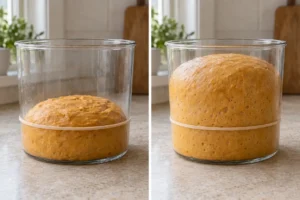
- Let the dough rise, Place the bowl in a warm area without direct heat and let the dough rise until doubled.

- Check the timing, The first rise usually takes 60 to 90 minutes.
- Test the risen dough, Press one lightly floured finger about ½ inch into the dough.
- Continue when ready, Move to the next step when the indentation returns slowly.
Prepare the Cinnamon-Spice Filling
- Combine the filling ingredients, Place the softened butter, dark brown sugar, cinnamon, pumpkin pie spice, and salt in a small bowl.
- Mix the filling, Stir until the ingredients form a thick, even, spreadable paste.
- Break up lumps, Press out any hard pieces of brown sugar.
- Keep at room temperature, Leave the filling at room temperature while you roll the dough.
- Avoid melting the filling, The butter should feel soft without looking oily or liquid.
Roll the Dough
- Prepare the work surface, Lightly flour a clean countertop.
- Add the dough, Turn the risen dough onto the prepared surface.
- Form a rectangle, Press the dough gently into a rough rectangular shape.
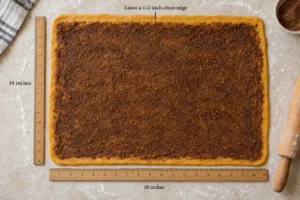
- Roll the dough, Roll it into a rectangle measuring about 14 by 18 inches.
- Check the thickness, Keep the center, edges, and corners as even as possible.
- Rest tight dough, Cover the dough and let it rest for 5 to 10 minutes if it repeatedly shrinks.
- Finish rolling, Continue rolling after the dough relaxes.
Add the Filling
- Add the filling, Spoon the cinnamon-spice filling over the rolled dough.
- Spread evenly, Use an offset spatula to spread the filling into a thin, even layer.
- Cover the surface, Spread the filling from side to side without pushing it beyond the edges.
- Leave a border, Keep a clean ½-inch strip along one long edge.
Roll and Seal the Dough
- Begin rolling, Start at the long edge opposite the clean border.
- Form the log, Roll the dough toward the clean border using even pressure.
- Maintain the shape, Keep the log firm without stretching or crushing the dough.
- Adjust the ends, Tuck or straighten the ends as you roll so the log has an even thickness.
- Seal the seam, Pinch the clean edge against the log.
- Position the log, Turn it so the seam rests against the work surface.
Cut the Rolls
- Measure the log, Use a ruler or measuring tape to check its total length.
- Mark the portions, Mark 12 equal sections before cutting.
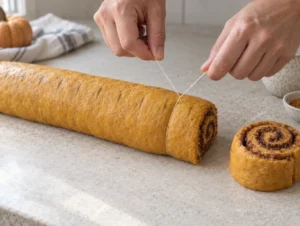
- Position the floss, Slide a piece of unflavored dental floss under the first mark.
- Cut the dough, Cross the ends of the floss above the log and pull them in opposite directions.
- Repeat the cuts, Continue until you have 12 rolls.
- Use a knife if needed, Cut with a sharp serrated knife using light sawing motions if dental floss is unavailable.
- Protect the spirals, Avoid pressing straight down because that can flatten the rolls.
Complete the Second Rise
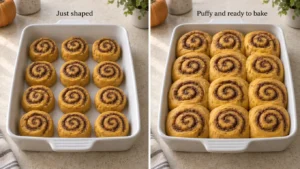
- Arrange the rolls, Place all 12 rolls in the prepared baking dish with their cut sides facing upward.
- Space evenly, Leave similar amounts of space between the rolls.
- Cover the pan, Cover it loosely without pressing against the dough.
- Let the rolls rise, Leave them in a warm area for 35 to 60 minutes.
- Check their appearance, The rolls should look puffy and touch or nearly touch one another.
- Test one roll, Press the edge of one roll lightly with a clean finger.
- Continue when ready, Bake when the indentation returns slowly.
Bake the Rolls
- Position the oven rack, Place it in the center of the oven.
- Preheat the oven, Heat it to 350°F or 177°C while the rolls complete their second rise.
- Bake the rolls, Place the uncovered baking dish on the center rack and bake for 22 to 27 minutes.
- Check dark pans early, Begin checking after 18 minutes if you use a dark metal pan.
- Protect the tops, Cover the pan loosely with foil if the rolls brown before their centers finish baking.
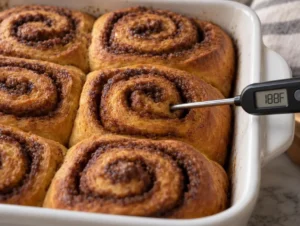
- Check the center roll, Insert an instant-read thermometer into the side of the middle roll.
- Position the thermometer, Keep the tip in the soft center without touching the baking dish.
- Remove the pan, Take the rolls from the oven when the center reaches 185°F to 190°F.
- Cool briefly, Place the baking dish on a wire cooling rack for 10 to 15 minutes.
Make the Maple Cream Cheese Frosting
- Combine the cream cheese and butter, Place both softened ingredients in a medium mixing bowl.
- Beat until smooth, Use an electric hand mixer or sturdy whisk to remove visible lumps.
- Add powdered sugar, Mix it into the cream cheese mixture in three additions.
- Add the flavoring, Mix in the maple syrup, vanilla extract, and salt.
- Check the consistency, The frosting should feel smooth and spreadable.
- Thin if needed, Add whole milk 1 teaspoon at a time until the frosting reaches your preferred consistency.
Frost and Serve
- Frost the rolls, Spread the maple cream cheese frosting over the rolls after they cool for 10 to 15 minutes.
- Create a thin glaze, Apply the frosting sooner if you want it to melt into the spirals.
- Create a thicker layer, Let the rolls cool for 25 to 30 minutes before frosting them.
- Separate the rolls, Use a small knife or serving spatula to divide the edges.
- Serve, Serve the pumpkin cinnamon rolls warm.
Notes
- Use plain pumpkin puree. Pumpkin pie filling contains added sugar and spices that change the dough.
- Weigh the flour and pumpkin puree for the most consistent dough.
- Drain or blot homemade pumpkin puree when it looks watery.
- Warm the milk to 105°F to 110°F before adding the yeast.
- Use fresh yeast. Start again if active dry yeast shows no activity after 10 minutes.
- Hold back 30 grams of flour until you assess the dough after kneading.
- Add reserved flour 1 tablespoon at a time. Large additions can make the rolls dry.
- Keep the finished dough slightly tacky. It should not feel stiff or heavily floured.
- Use softened butter in the filling. Melted butter can carry sugar out of the spirals.
- Rest the rolled dough for 5 to 10 minutes if it keeps shrinking.
- Use unflavored dental floss for round, clean slices.
- Follow visual rise cues instead of relying only on the listed times.
- Check the temperature of the middle roll because it usually finishes after the edge rolls.
- Remove the pan when the middle roll reaches 185°F to 190°F.
- Cover the rolls with foil if the tops brown too quickly.
- Frost warm rolls for a thinner glaze.
- Let the rolls cool longer when you want a thick frosting layer.
- Refrigerate shaped rolls before their second rise when preparing them overnight.
- Refrigerate overnight rolls for no more than 14 hours.
- Let refrigerated rolls become visibly puffy before baking.
- Freeze shaped rolls before their second rise.
- Thaw frozen rolls in the refrigerator before completing their room-temperature rise.
- Refrigerate rolls with cream cheese frosting within 2 hours.
- Store refrigerated rolls for up to 4 days.
- The nutrition estimate includes all the frosting.
Why This Recipe Works
Pumpkin changes yeast dough in several ways. It adds water and fiber, and its thickness varies by brand or preparation method. A controlled amount gives the rolls color and moisture without making the dough too heavy.
Bread flour supports the enriched dough. King Arthur Baking lists its bread flour at 12.7 percent protein and its all-purpose flour at 11.7 percent protein. [1]
Protein contributes to gluten formation, which helps the dough hold the gas that yeast creates.
You can still use all-purpose flour. Your dough may feel softer, and your rolls may spread a little more. Start with the same weight, then add flour only if the dough remains wet after several minutes of kneading.
Softened butter forms a paste with the brown sugar and spices. Melted butter runs toward the bottom of the pan and carries part of the filling with it.
A thermometer gives you a clearer doneness check than color alone. King Arthur Baking identifies 190°F as a useful benchmark for soft yeast breads and rolls. [2]
Pumpkin darkens the dough, so visual browning can mislead you.
“Will 190°F make the rolls dry?” – It should not. Pull the pan when the middle roll reaches 185°F to 190°F. The center continues to heat briefly after you remove the pan.
Troubleshooting
Ingredient Substitutions
Storage, Freezing and Reheating
| Refrigerator storage | Cream cheese frosting makes these rolls perishable. Refrigerate frosted rolls in an airtight container. The FDA advises keeping refrigerators at 40°F or below and refrigerating perishable prepared food within 2 hours. [4] For quality and food safety, eat refrigerated rolls within 3 to 4 days. USDA guidance gives the same range for many refrigerated leftovers. [5] |
| Reheat one roll | Place one roll on a microwave-safe plate. Heat it in short intervals until warm. Avoid long heating because the edges can become firm and the frosting can separate. |
| Reheat several rolls | Place the rolls in a covered baking dish. Warm them at 300°F until the centers feel warm. Add 1 or 2 teaspoons of milk around the edges if the rolls have started to dry. |
| Freeze baked rolls | Cool the rolls fully. Wrap them individually and place them in a freezer container. Freeze the frosting separately when you want the cleanest appearance after thawing. Thaw overnight in the refrigerator. Reheat gently, then add frosting. |
| Freeze unbaked rolls | Shape and cut the rolls, then place them in a freezer-safe metal pan. Freeze until firm. Wrap the pan tightly and keep it frozen for up to 3 months for texture quality. USDA notes that food held continuously at 0°F remains safe while quality declines over time. [5] Thaw the rolls overnight in the refrigerator. Let them finish rising at room temperature before baking. |
Leftover Pumpkin Puree
This recipe uses 225 grams of pumpkin puree. A 15-ounce can holds about 425 grams, leaving close to 200 grams.
Transfer the remaining puree to a sealed container and refrigerate it promptly. You can also freeze measured portions in an ice-cube tray or small container.
Use the remaining pumpkin in pancakes, oatmeal, muffins, quick bread, soup, or pasta sauce.
Write the amount and date on the container. That label saves you from thawing more than you need.
Serving Ideas
Pumpkin spice cinnamon rolls bring sugar, flour, and fat to the meal. Pair them with protein and fresh produce when you serve a full breakfast.
Good options include scrambled eggs, Greek yogurt, fresh berries, sliced apples, bacon, breakfast sausage, or a vegetable egg casserole.
Serve the rolls with coffee, unsweetened tea, cold milk, or a pumpkin spice latte.
For Thanksgiving breakfast, prepare the rolls the night before. Add fruit and eggs in the morning while the dough completes its final rise.
Frequently Asked Questions
Your Next Batch
This pumpkin cinnamon rolls recipe gives you measurable temperatures, clear dough cues, and flexible make-ahead directions. Keep the dough soft, let each rise finish, and check the middle roll before removing the pan.
Save the overnight instructions when you plan a holiday breakfast. You can shape the rolls in the evening, finish the rise the next morning, and serve them warm without starting from scratch.
SOURCES
- [1] King Arthur Baking – “How to Substitute Bread Flour for All-Purpose Flour” – July 21, 2016 – No DOI assigned
- [2] King Arthur Baking – “Using a Thermometer With Yeast Bread” – April 7, 2017 – No DOI assigned
- [3] King Arthur Baking – “Hamburger or Hot Dog Buns Recipe” – Publication date not listed – No DOI assigned
- [4] U.S. Food and Drug Administration – “Tips to Chill Food” – Publication date not listed – No DOI assigned
- [5] U.S. Department of Agriculture Food Safety and Inspection Service – “Freezing and Food Safety” – August 9, 2024 – No DOI assigned
- [6] All Things Mamma – “Overnight Cinnamon Rolls” – Publication date not listed – No DOI assigned
- [7] Sally’s Baking Addiction – “How to Freeze Cinnamon Rolls” – Publication date not listed – No DOI assigned
- [8] U.S. Department of Agriculture, Agricultural Research Service – “FoodData Central” – Updated twice annually – No DOI assigned
