
How Many Calories Do You Need a Day? Turning Your Number Into Real Meals New
A practical guide to estimating your daily calorie needs and turning the number into balanced, satisfying meals.

Enjoying this article?Add FoodNourish as a preferred source on Google and see our research-backed guides more often in your search results.
Most of us know roughly what a calorie is, but far fewer people know how many they actually need in a day, and even fewer know what that number looks like on a plate. Yet that one figure shapes everything from portion sizes to whether a “healthy” eating pattern quietly leads to weight gain.
This guide covers how to estimate your daily calorie needs realistically and then translate them into meals you can build without counting every bite.
What Your Daily Calorie Needs Are Made Of
The calories you burn in a day, often called total daily energy expenditure (TDEE) or maintenance calories, come from three main sources:
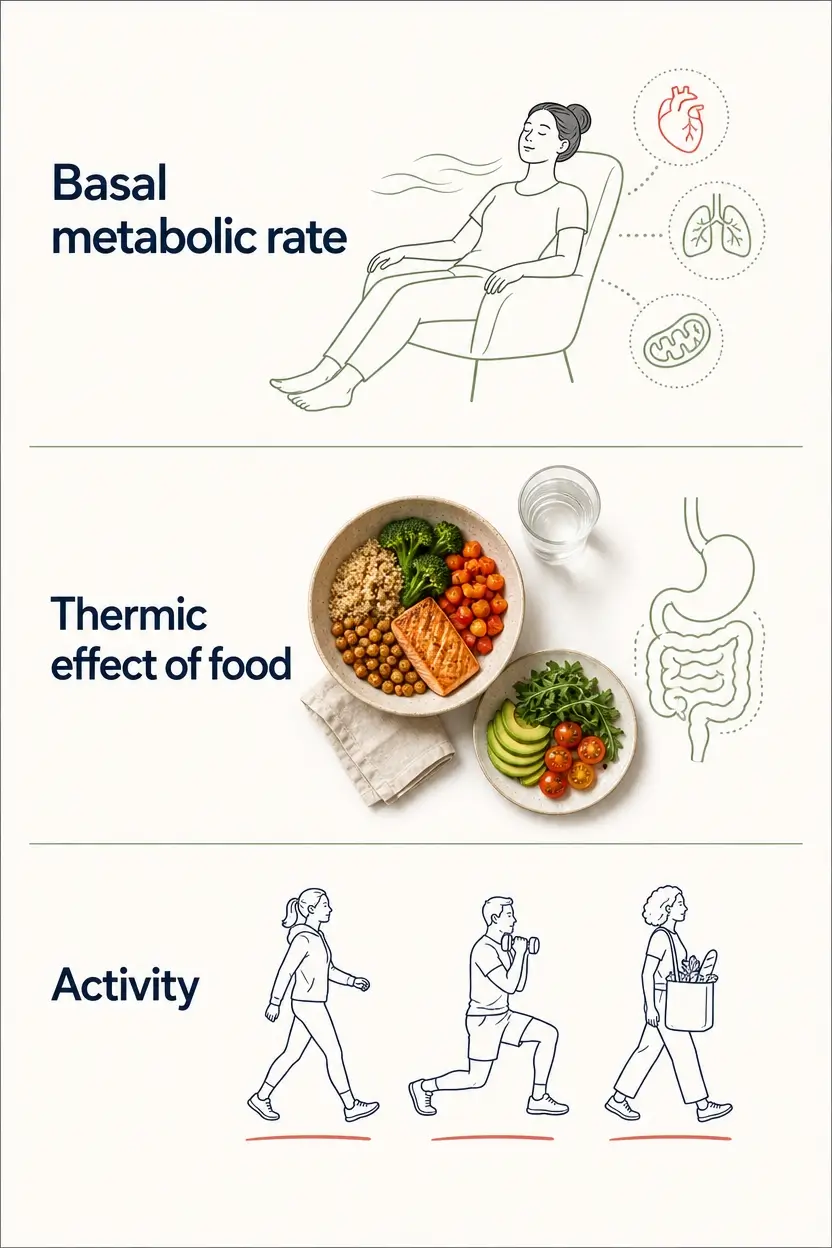
- Basal metabolic rate (BMR): the energy your body uses at rest to breathe, circulate blood and keep organs working. For most people this is the largest share, around 60 to 70 percent.
- The thermic effect of food: the energy used to digest and process what you eat, roughly 10 percent of intake.
- Activity: both planned exercise and everything else you do, from walking to the shops to standing at work and fidgeting. This last part, known as non-exercise activity, varies enormously between people and is often the difference between two people of the same size who need very different amounts of food.
General guidelines put most adult women between about 1,600 and 2,400 calories a day and most men between 2,000 and 3,000, but your own number depends on your body and how much you move.
Estimate Your Number, Honestly
The most reliable everyday estimate combines a resting-energy equation with an activity factor. The Mifflin-St Jeor equation, which uses your age, sex, height and weight, is considered the most accurate of the common formulas for healthy adults, and an activity multiplier then scales it up to cover your day.
A free tool such as the TDEE calculator from TrainCalc does both steps for you, and also lets you add your daily step count for a more grounded estimate.
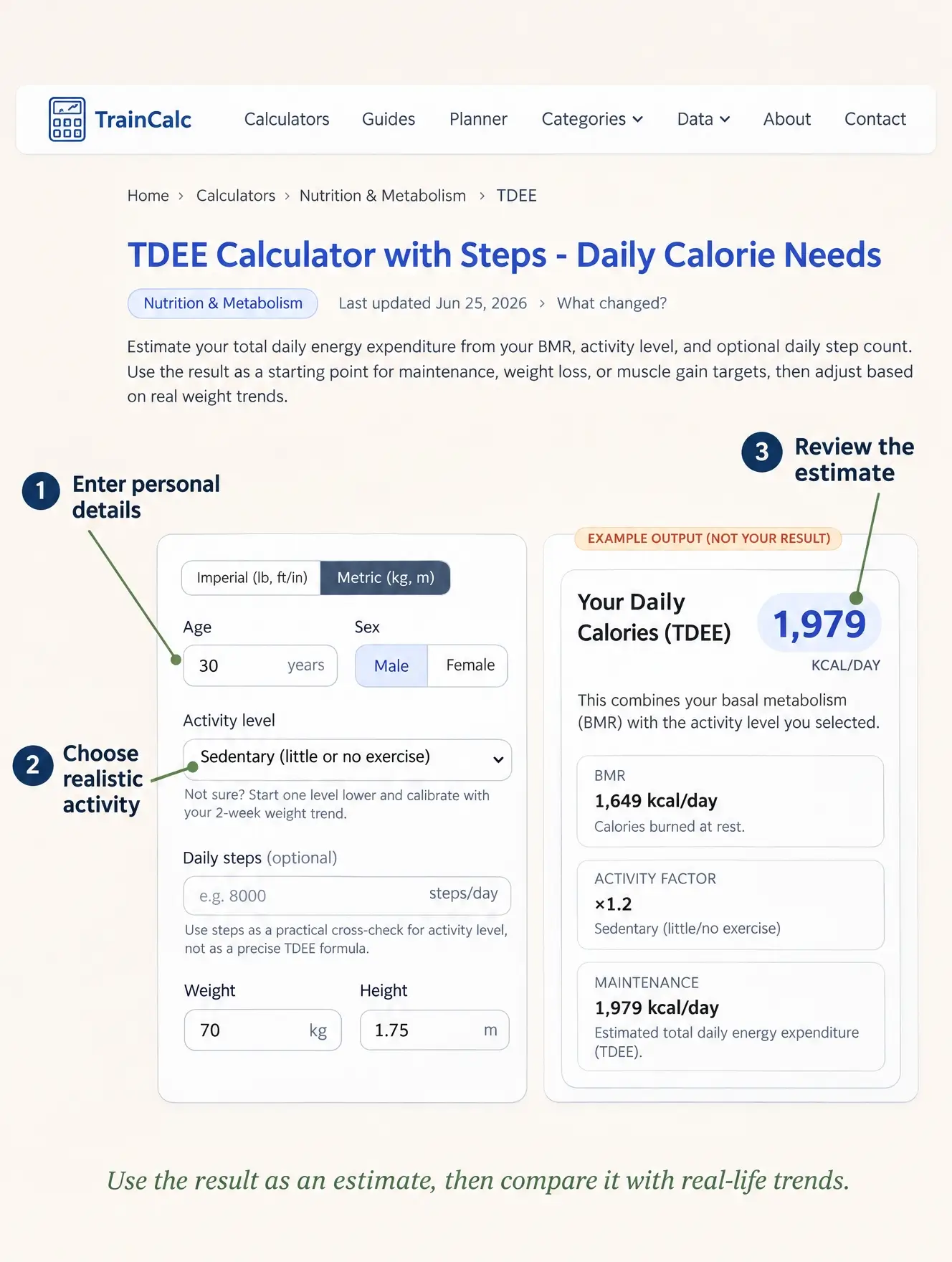
The activity level you choose matters more than most people expect. An analysis of anonymous calculations on TrainCalc found that people who described themselves as “sedentary” reported walking more than 10,000 steps a day on average, slightly more than people who chose “lightly active”. Many people seem to answer the question as “Do I work out?” rather than “How much do I move?”
The difference is not small. Moving from sedentary to lightly active typically adds 200 to 300 calories a day to the estimate. If you walk a lot, have a physical job or are on your feet most of the day, choose the level that matches your movement, not just your workouts. If you track steps, use them as a reality check.
Turn Your Number Into Meals
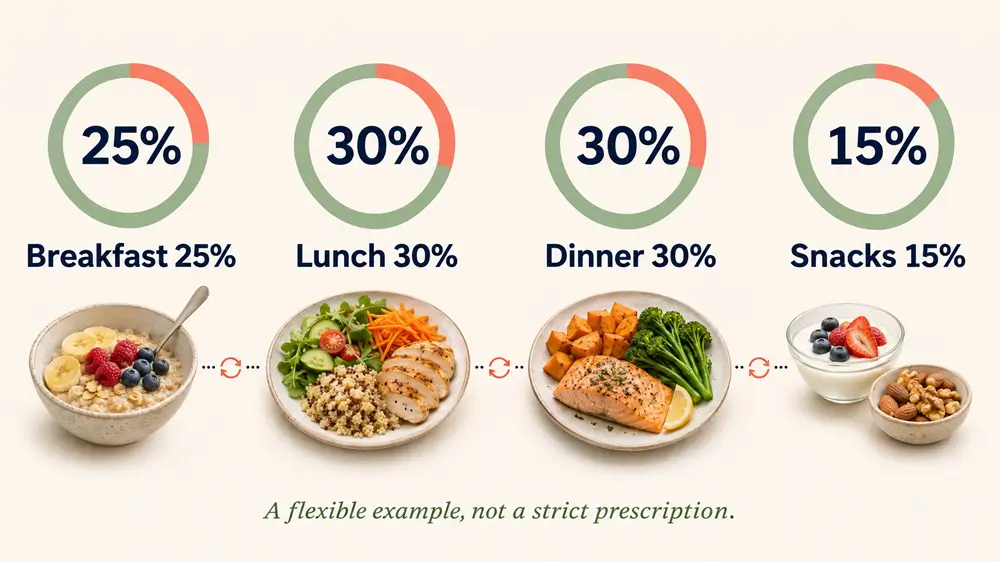
A daily total is easier to use once you split it. A simple pattern that works for most people is about 25 percent at breakfast, 30 percent at lunch, 30 percent at dinner and 15 percent for snacks.
| Daily total | Breakfast | Lunch | Dinner | Snacks |
|---|---|---|---|---|
| 1,800 kcal | 450 | 540 | 540 | 270 |
| 2,200 kcal | 550 | 660 | 660 | 330 |
| 2,600 kcal | 650 | 780 | 780 | 390 |
The split is flexible. If you skip breakfast or train in the evening, move the calories to where you actually eat. What matters is that the day adds up to roughly your target, not that each meal hits an exact figure.
To build a meal without weighing everything, the plate method works well: fill half the plate with vegetables or fruit, a quarter with a protein source and a quarter with whole grains or starchy foods, then add a thumb-sized portion of fats such as olive oil, nuts or cheese. Larger targets get bigger portions of the protein and starch quarters, not a bigger pile of everything.
Food Choices That Make the Number Easier
The same calorie target can feel easy or impossible depending on what fills it. Three habits help most.
Anchor each meal with protein. Protein is the most filling macronutrient, so including a source at every meal, such as eggs, yogurt, fish, chicken, beans, lentils or tofu, makes it easier to stay near your target without feeling deprived.
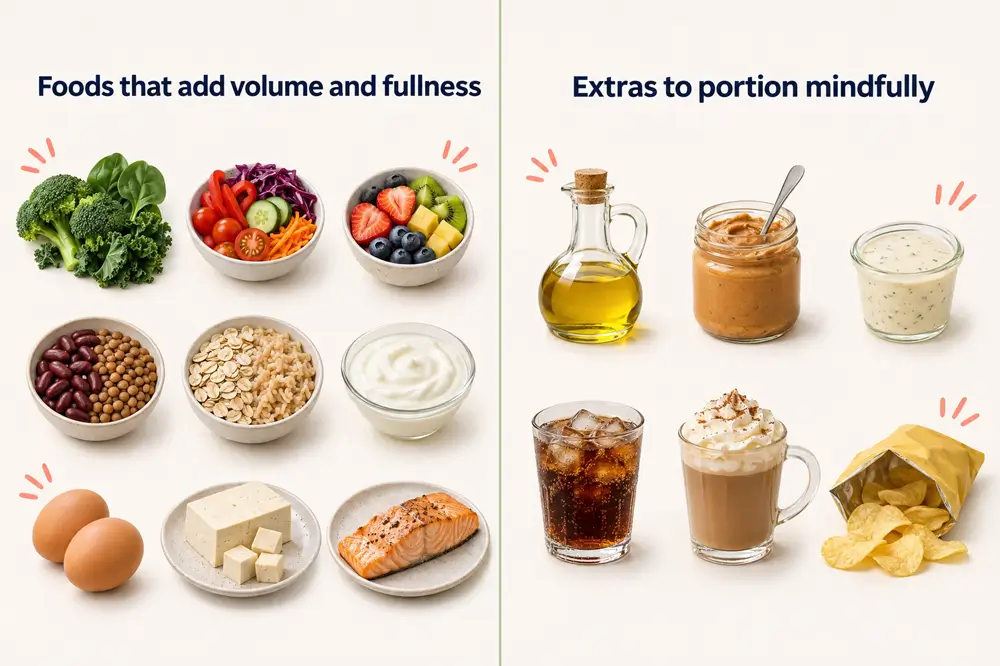
Eat enough fiber. Dietary guidelines recommend about 14 grams of fiber for every 1,000 calories, so roughly 25 grams at 1,800 calories and 36 grams at 2,600. Vegetables, fruit, legumes and whole grains provide it, and they add volume to meals for relatively few calories.
Watch the energy-dense extras. Oils, nut butters, dressings, sugary drinks and snacks are easy to add without noticing. A tablespoon of olive oil is about 120 calories, and a large flavored coffee drink can carry several hundred. None of these needs to disappear; they just need to be counted as part of the day, not on top of it.
Check the Estimate Against Real Life
Every calorie formula is an estimate for an average person, and individuals can differ from it by a few hundred calories a day. The way to find your true maintenance is to eat close to your estimate for two to three weeks and watch your weight trend. Weigh yourself a few times a week under the same conditions and compare weekly averages rather than single days.
If the average is stable, you have found your maintenance. If it is creeping up, trim about 100 to 200 calories a day; if it is drifting down and you don’t want it to, add the same amount. Recheck your number whenever your routine changes, such as a new job, a training block or an injury, since activity is the part that moves most.
If you have a medical condition, are pregnant or breastfeeding, or have a history of disordered eating, a registered dietitian can help you set targets that fit your situation.
The Bottom Line
Your daily calorie needs come down to your body and how much you really move. Estimate them honestly, split the total into meals that suit your day, build those meals around protein, fiber and plenty of plants, and let your weight trend over a few weeks tell you whether the number is right.
References
- Mifflin MD, St Jeor ST, Hill LA, et al. A new predictive equation for resting energy expenditure in healthy individuals. American Journal of Clinical Nutrition. 1990;51(2):241-247.
- Frankenfield D, Roth-Yousey L, Compher C. Comparison of predictive equations for resting metabolic rate in healthy nonobese and obese adults: a systematic review. Journal of the American Dietetic Association. 2005;105(5):775-789.
- Levine JA. Non-exercise activity thermogenesis (NEAT). Best Practice & Research Clinical Endocrinology & Metabolism. 2002;16(4):679-702.
- Westerterp KR. Diet induced thermogenesis. Nutrition & Metabolism. 2004;1:5.
- Leidy HJ, Clifton PM, Astrup A, et al. The role of protein in weight loss and maintenance. American Journal of Clinical Nutrition. 2015;101(6):1320S-1329S.
- U.S. Department of Agriculture and U.S. Department of Health and Human Services. Dietary Guidelines for Americans, 2020-2025. 9th ed.
- TrainCalc. Fitness Calculator Data Report 2026 (aggregated, anonymous calculator data, July-November 2026).
