Neck Tension Relief at Home: A Guide to Beating Stress, Screen Strain, and Stiffness
Practical fixes, evidence-based routines, and the at-home tools that cut neck pain in under 15 minutes a day.
Enjoying this article?Add FoodNourish as a preferred source on Google and see our research-backed guides more often in your search results.
Quick Answer
Neck tension relief works fastest when you stack three things, a posture and ergonomic reset, a 5 to 10 minute stretching routine, and targeted recovery using heat or TENS pulse therapy. Most adults feel real relief inside 10 to 15 minutes per session and notice lasting change within 2 to 3 weeks of daily practice [1][2].
The biggest mistake you can make is treating only the symptom and ignoring the screen habits and stress load driving it.
At-Home Neck Tension Relief Methods Compared
| Method | Time to Relief | Cost (USD) | Best Use Case | Daily Use Safe | Evidence Level |
|---|---|---|---|---|---|
| Static stretching | 5 to 10 min | Free | Mild daily stiffness | Yes | Strong [1] |
| Heat therapy (hot pack) | 15 to 20 min | 10 to 30 | Stress-related muscle tightness | Yes | Strong [3] |
| Foam roller / trigger ball | 5 to 10 min | 10 to 25 | Knots in upper traps | Yes | Moderate |
| Massage gun | 2 to 5 min per area | 80 to 400 | Deep muscle soreness | With caution | Moderate |
| Smart neck massager (TENS + heat) | 10 to 15 min | 40 to 150 | Stress and screen-related tension | Yes | Moderate to Strong [4] |
| In-person massage | 30 to 60 min | 60 to 150 / session | Chronic or acute pain | No | Strong |
| Ergonomic upgrade | One-time setup | 30 to 500 | Prevention | Yes | Strong [5] |
The table shows where each method earns its place. Stretching and ergonomic fixes cost almost nothing and prevent flare-ups. Heat and TENS-based devices treat the tension you already have. Most people get the best results combining one prevention method with one recovery method.
Why Your Neck Hurts (Stress, Screens, and the 50-Pound Problem)
Your trapezius and levator scapulae muscles tighten the moment your nervous system flips into fight-or-flight. The American Psychological Association reports that under chronic stress, muscles stay contracted long after the trigger passes, which sets up persistent tightness in the neck and shoulders [6].
Add eight hours of screen work and the tension compounds.
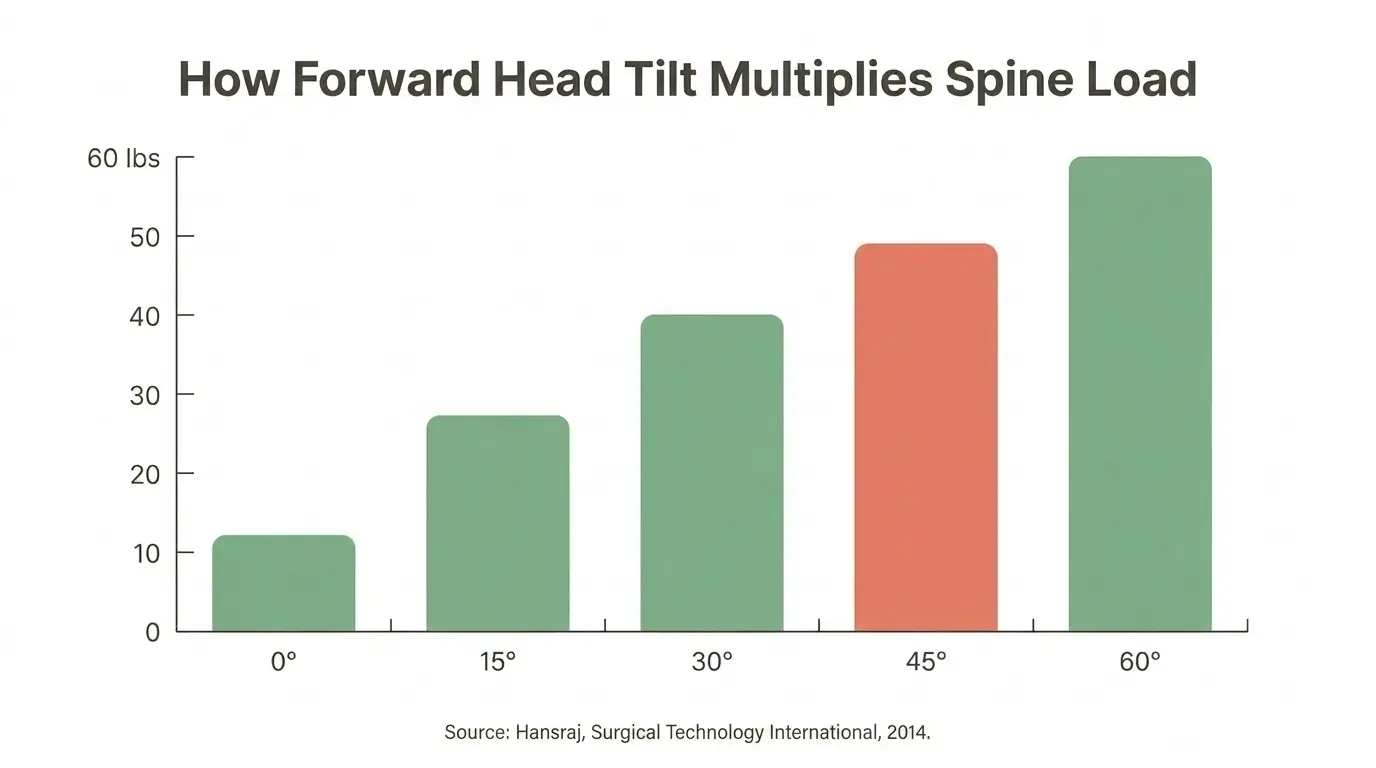
The mechanical load matters too. A neutral adult head weighs about 10 to 12 pounds. Tilt it forward 15 degrees and the load on your cervical spine (the neck portion of your spine) jumps to roughly 27 pounds. Tilt it 45 degrees, the angle most people hold while texting, and the load climbs to about 50 pounds [7].
Your neck muscles fight that load every minute you stay tilted.
Screen volume drives the exposure. The Bureau of Labor Statistics American Time Use Survey shows working adults averaged about 3.4 hours per day on leisure screen time alone, and remote workers add 5 to 7 hours of work-screen time on top [8].
That stacks to 8 to 10 hours daily where your head is likely tilted forward.
Stress chemistry and posture chemistry feed each other. Cortisol keeps muscle fibers primed, screen posture loads them, and the result shows up as a stiff neck by 4 p.m. The next section helps you measure where you stand.
Do You Have Tech Neck or Stress Tension?
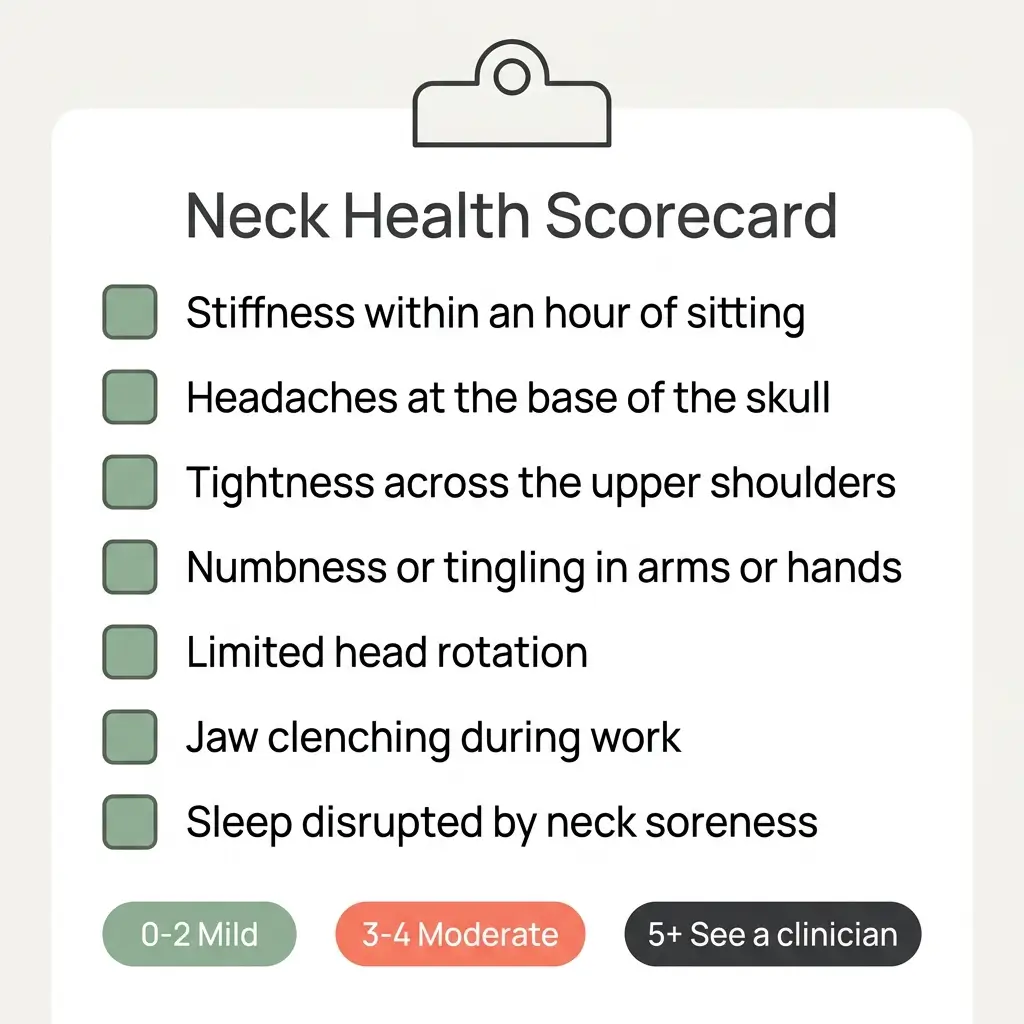
Score each item yes or no.
- Stiffness sets in within an hour of sitting at your desk.
- Headaches start at the base of your skull.
- Tightness spreads across your upper shoulders by midday.
- You feel numbness or tingling in your arms or hands.
- Rotating your head fully to either side feels limited.
- You catch yourself clenching your jaw during work.
- Neck soreness disrupts your sleep or wakes you up.
Scoring. Zero to two yeses points to mild tension you can manage with stretching and ergonomic tweaks. Three to four yeses signals moderate tension where targeted recovery tools earn their keep. Five or more, book a visit with a clinician before self-treating.
If you scored in the moderate range, an at-home device that combines TENS pulses with low-level heat can carry a lot of the load between stretching sessions.
The Kiicity Smart Neck Massager for neck pain relief is one example, designed for hands-free use with adjustable intensity and a session timer, which matches the protocol most clinicians recommend for daily home use [4]. Pair it with the routine in Section 3 rather than using it alone.
The next step is the routine itself.
The 10-Minute Daily Reset Routine
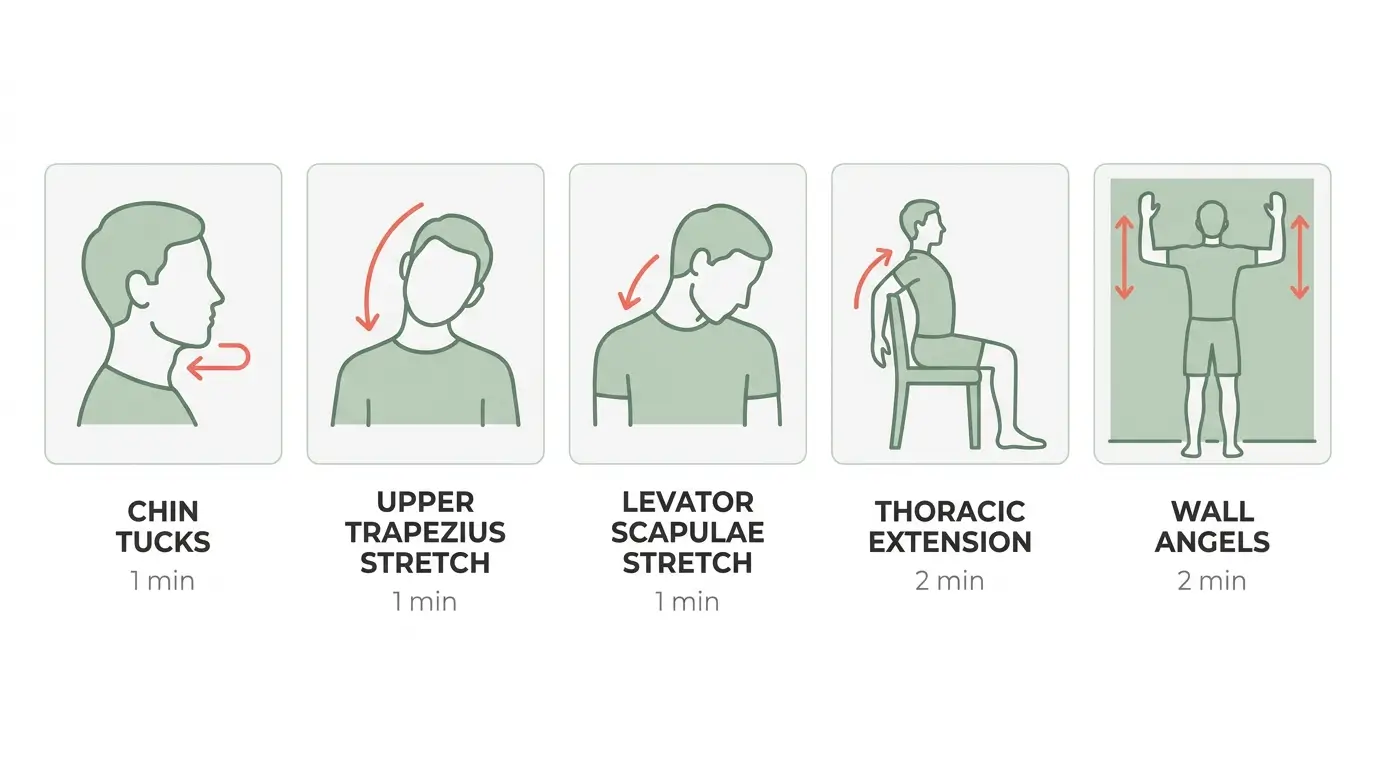
Run this sequence once in the morning and once after work. It targets the five muscle groups most affected by screen posture and stress.
- Chin tucks (1 minute). Sit tall. Pull your chin straight back like you are making a double chin. Hold 5 seconds, release, repeat 10 times. This wakes up the deep neck flexors that hold your head over your spine [2].
- Upper trapezius stretch (1 minute). Tilt your right ear toward your right shoulder. Use your right hand to add gentle pressure on the left side of your head. Hold 30 seconds. Switch sides. Targets the trap fibers that cramp during stress.
- Levator scapulae stretch (1 minute). Drop your chin diagonally toward your right armpit. Use your right hand to guide it deeper. Hold 30 seconds, switch. This muscle attaches at the base of the skull and gets short from looking down at phones.
- Thoracic extension (2 minutes). Sit on a chair, place your hands behind your head, and arch back over the chair’s top edge. Hold 5 seconds, return, repeat 10 times. A stiff mid-back forces your neck to overwork.
- Wall angels (2 minutes). Stand with your back, arms, and hands flat against a wall. Slide your arms up like a goalpost, then down, keeping contact with the wall. 10 slow reps. Strengthens the postural muscles that keep your shoulders back.
The remaining 3 minutes are buffer for breathing or repeating any move that feels especially tight. These neck stretches do most of the work, but a bad desk setup will undo your progress, which is the next layer.
4. Ergonomic Fixes That Work in 5 Minutes
Your ergonomic setup either prevents tension or manufactures it. Five adjustments handle most of the damage and form the basis of real posture correction.
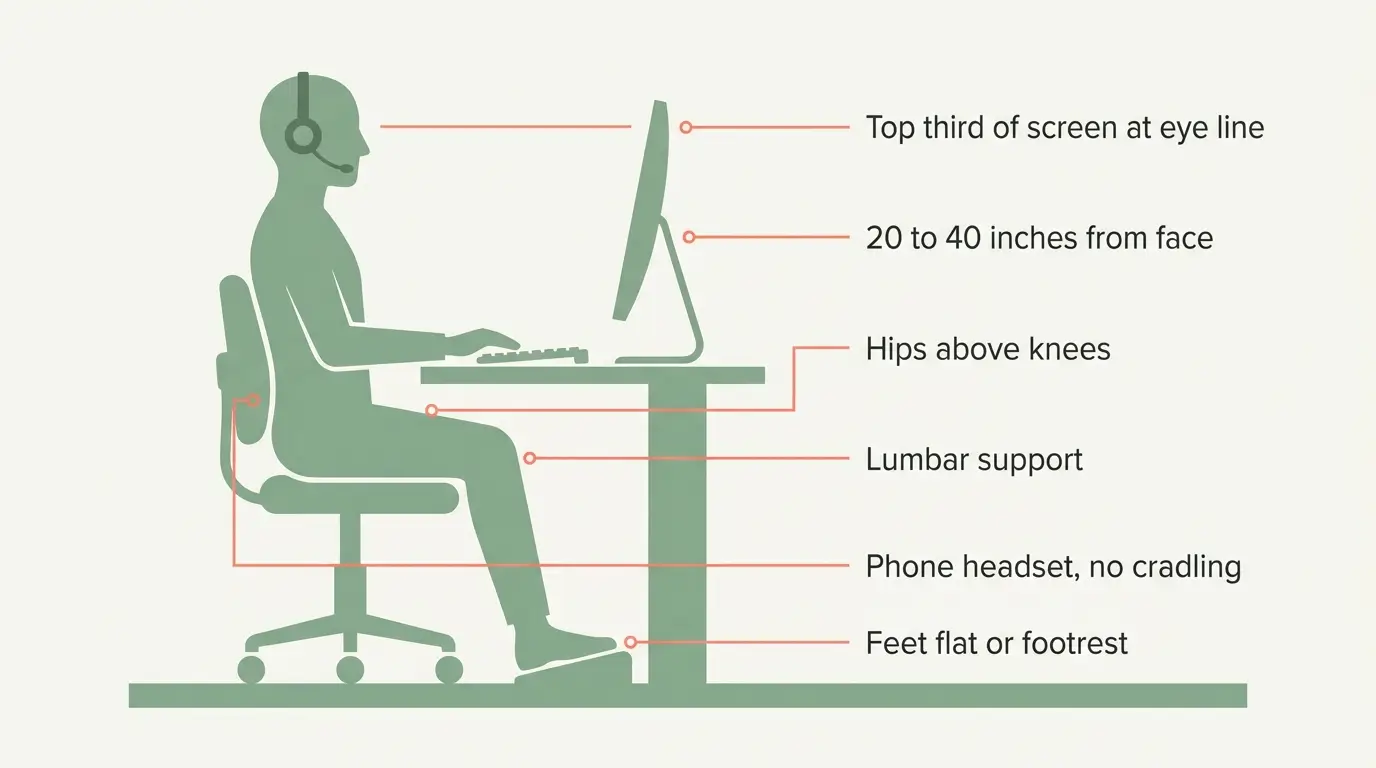
- Set your monitor at eye level. The top third of the screen should sit at your natural eye line, 20 to 40 inches from your face [5]. Stack books or buy a 25 dollar monitor riser if needed. Laptop users need an external keyboard plus a stand, since you cannot fix laptop ergonomics without separating the screen from the keys.
- Adjust your chair. Hips slightly above knees, feet flat on the floor or a footrest, lower back supported. A rolled towel behind your lumbar spine works if your chair lacks support.
- Stop cradling your phone. Use a headset or speakerphone. Cradling the phone between your ear and shoulder is one of the fastest ways to trigger trapezius spasm.
- Apply the 20-20-20 rule. Every 20 minutes, look at something 20 feet away for 20 seconds. Stand up while you do it. The American Optometric Association recommends this for digital eye strain, and the standing portion resets your posture too [9].
- Rotate your positions. Sit 30 minutes, stand 20, walk 10. Set a timer if you forget. Static posture, even a good one, fatigues muscles within an hour.
These changes prevent new tension. The next section covers what to do about tension you already have.
Heat, Cold, and TENS Therapy: What the Evidence Says
Three modalities dominate at-home recovery. Each has a specific job.
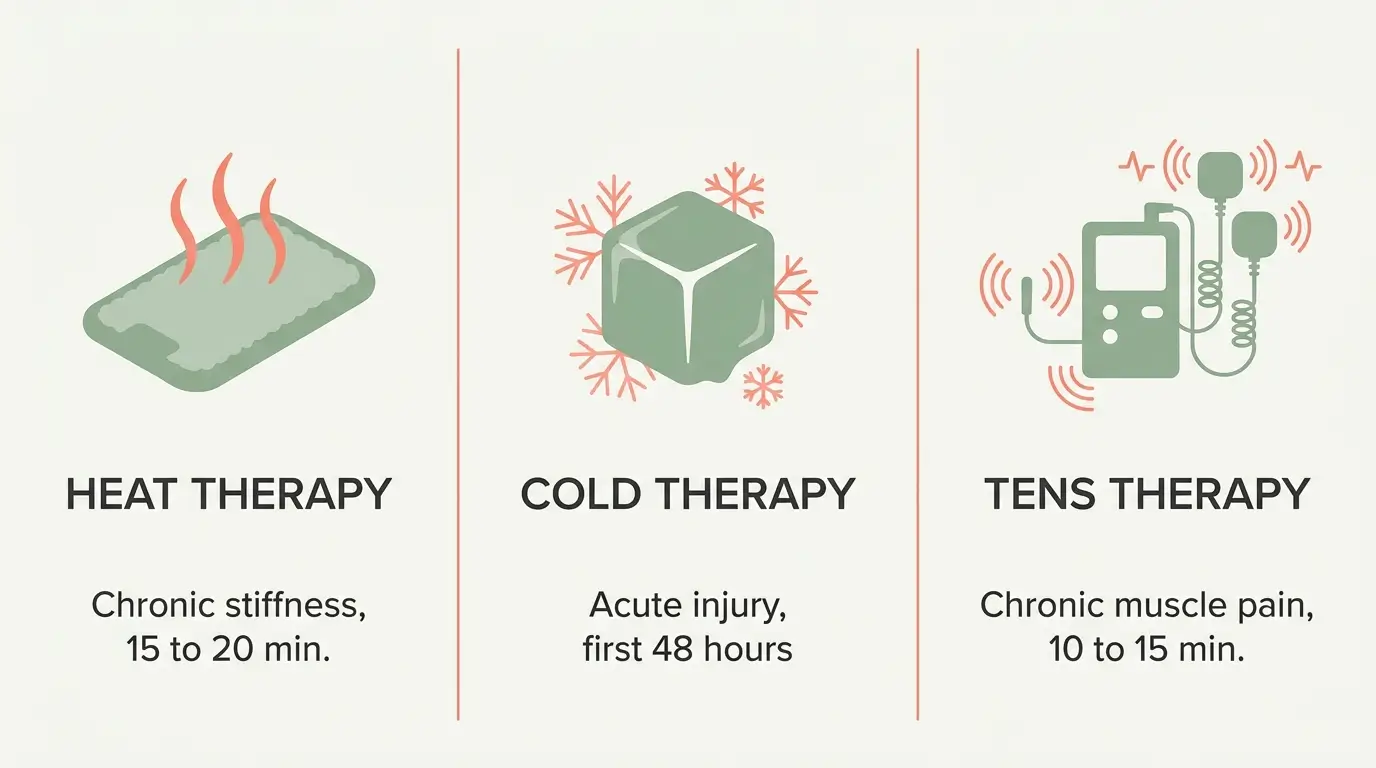
- Heat therapy raises tissue temperature, increases blood flow, and reduces the gating signal pain travels on. A Cochrane review on superficial heat for musculoskeletal pain found moderate-quality evidence that continuous heat wraps reduce pain and disability over 5 to 7 days, with similar mechanisms applying to cervical muscle tension [3].
Apply a hot pack or heating pad for 15 to 20 minutes, no longer, with a layer of cloth between the pack and your skin.
- Cold therapy works in the first 48 hours after an acute injury or sudden flare. It reduces inflammation and numbs pain. For chronic stress-driven tension, heat usually outperforms cold.
- TENS therapy = transcutaneous electrical nerve stimulation. Small electrical pulses travel through skin electrodes, activate large nerve fibers, and block pain signals from reaching the brain.
The pulses also trigger localized endorphin release. Vance and colleagues, in a clinical evidence summary published in Pain Management, concluded TENS produces clinically meaningful pain reduction for chronic musculoskeletal conditions including neck pain when applied at adequate intensity [4].
Most consumer devices, including smart neck massagers, deliver TENS at intensities you can tolerate for 10 to 15 minute sessions.
A few safety lines you should not cross.
- Skip TENS if you have a pacemaker, an implanted defibrillator, or are pregnant without your provider’s clearance.
- Never apply electrodes to broken skin, the front of the throat, or directly over the carotid arteries.
- Do not use a TENS device while driving or sleeping.
“Can I use it every day?” Yes, daily use within manufacturer time limits is supported by the research, with most protocols recommending 1 to 3 sessions of 15 to 30 minutes [4].
That brings us to the tools themselves.
At-Home Tools Worth Considering
You do not need a closet full of gadgets. You need one or two tools that match your symptoms.
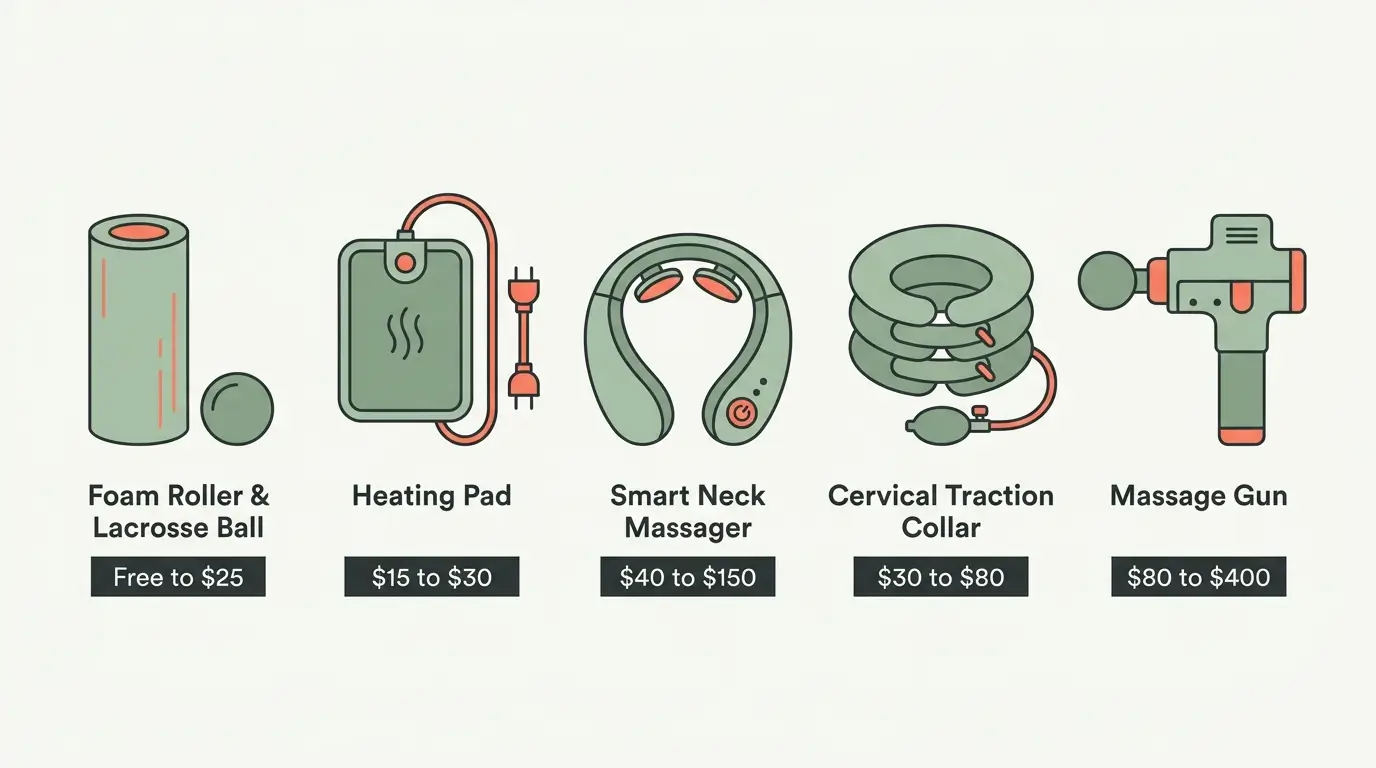
- Foam roller and lacrosse ball. Cheap, durable, and unmatched for releasing knots in the upper back. Roll your thoracic spine for 60 seconds before stretching. Pin the lacrosse ball between your trap and a wall, lean in, and breathe through 30-second holds.
- Heating pad or microwavable rice bag. A 25 dollar heating pad covers most stress tension. Look for one with auto-shutoff and at least three heat settings.
- Smart neck massager (TENS plus heat). These contour around the back of the neck, deliver TENS pulses to the trapezius, and warm the tissue at the same time. Look for adjustable intensity (at least 5 levels), separate heat control, a session timer that auto-shuts at 15 minutes, and a weight under 5 ounces so it actually stays on. The Kiicity model fits that spec sheet and runs cordless, which matters if you plan to use it during work breaks.
- Cervical traction device. Inflatable collars and over-the-door traction units help with stiffness from a pinched or compressed disc in your neck. Ask a physical therapist before buying one, since incorrect use can aggravate symptoms.
- Massage gun. Useful for the upper traps and the muscles around the shoulder blade. NEVER apply a massage gun to the front of the neck, directly on the cervical spine, or on the carotid artery. Use the lowest speed setting near the neck and limit each spot to 30 seconds.
Tools handle the muscle layer. Your nervous system needs its own intervention.
Stress Relief That Reaches Your Neck
Stress relief reaches your neck only when you lower the signal driving the contraction. A neck stuck in fight-or-flight will not stay loose, no matter how often you stretch it.
- Diaphragmatic breathing. The 4-7-8 protocol works fast. Inhale through your nose for 4 counts, hold for 7, exhale through your mouth for 8. Three rounds drops heart rate and shifts your body toward a calmer, rest-and-recover state [10].
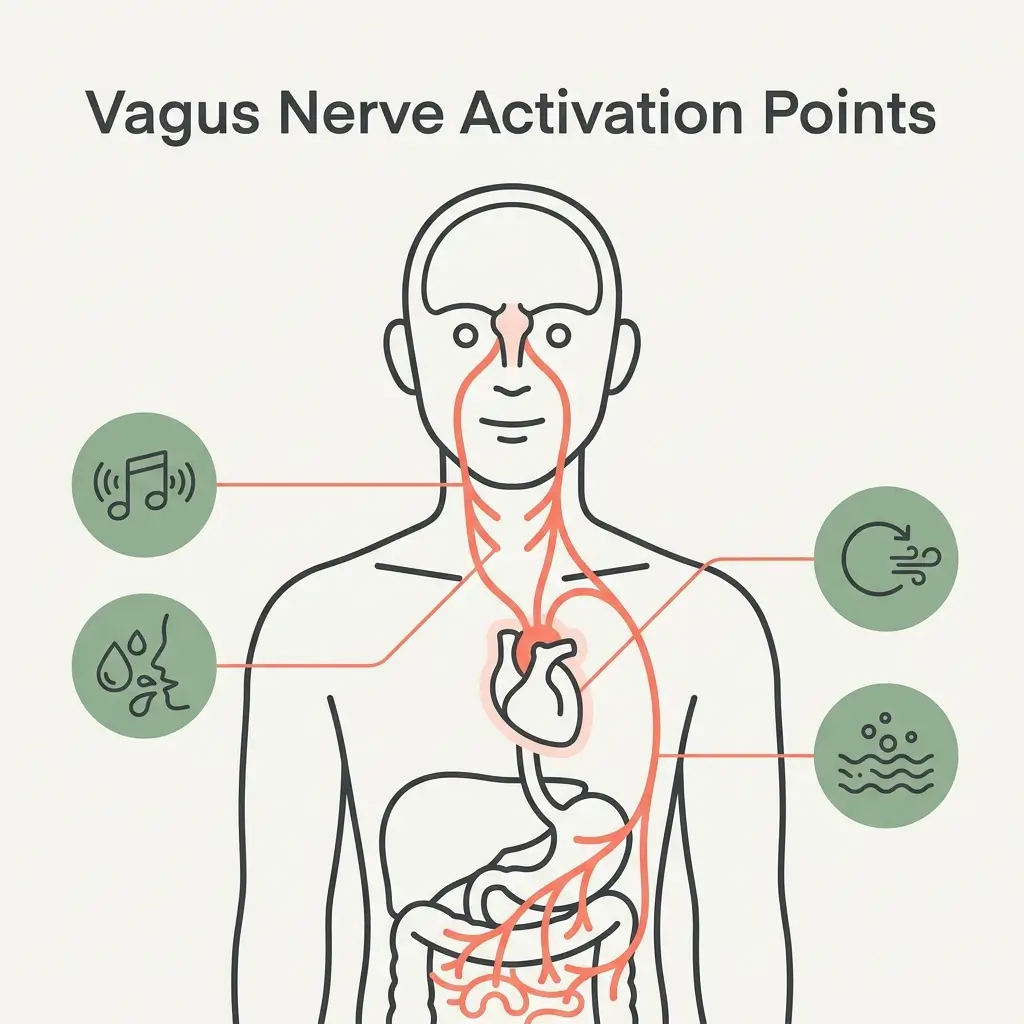
- Vagus nerve activation. Humming, gargling, slow exhales, and brief cold-water exposure on the face stimulate the vagus nerve, which signals your body to relax. Two minutes of humming on a long exhale, three times a day, is the cheapest stress tool you have.
- Progressive muscle relaxation. Tense one muscle group for 5 seconds, release for 10, work head-to-toe. A 10-minute session before bed reduces overnight muscle tone and improves sleep quality, which itself reduces next-day neck pain [11].
- Sleep posture. Use one supportive pillow, not a stack. Side and back sleeping protect the cervical curve. Stomach sleeping forces 8 hours of head rotation and is the single worst position for chronic neck tension.
- Hydration and caffeine timing. Aim for 2 to 3 liters of water per day. Cut caffeine 8 hours before bed. Dehydrated muscles cramp faster, and poor sleep raises pain sensitivity the next day [12].
You now have stretches, ergonomics, recovery tools, and stress practices. The next section assembles them into a week.
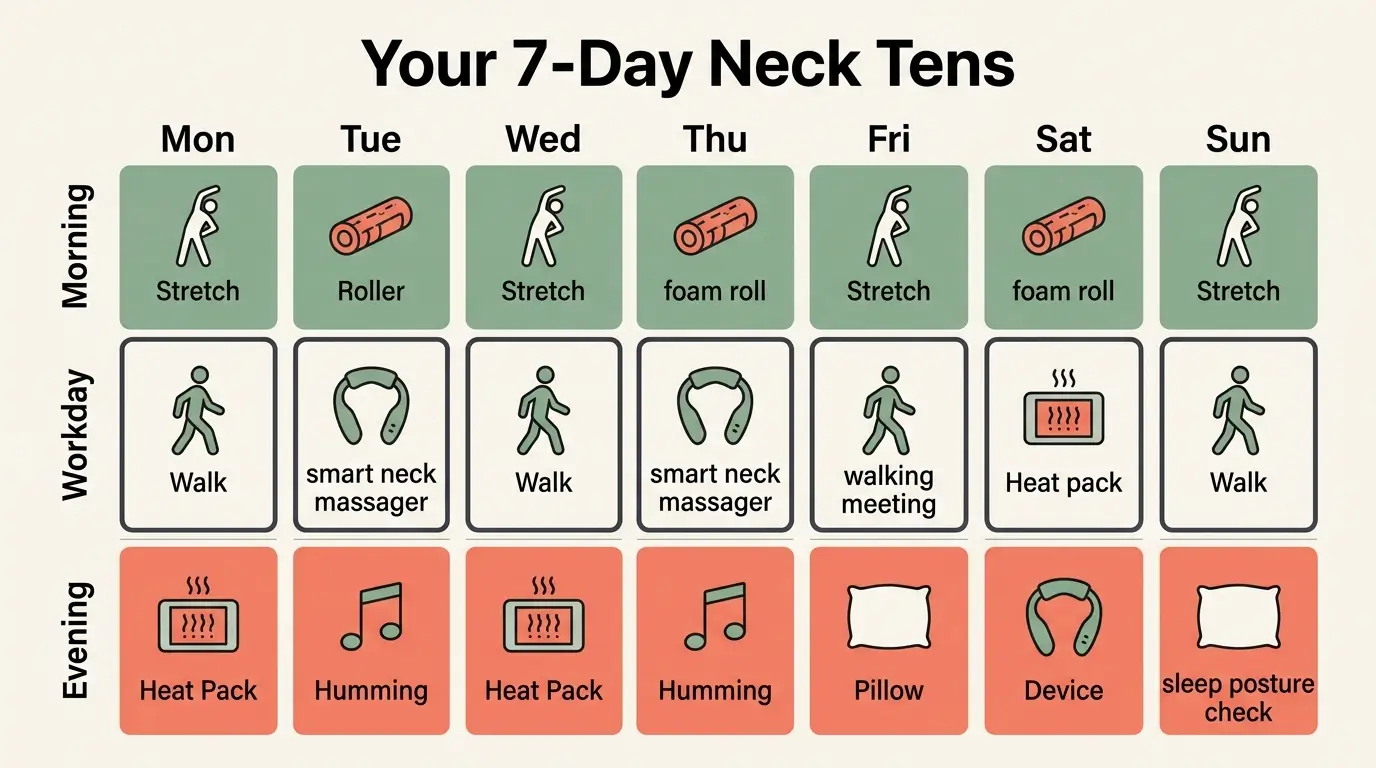
A Sample 7-Day Plan to Cut Neck Tension
| Day | Morning (5 min) | Workday | Evening (10 to 15 min) |
|---|---|---|---|
| Mon | Reset routine | Monitor at eye level, 20-20-20 breaks | Heat pack 15 min + 4-7-8 breathing |
| Tue | Reset routine | Standing rotations every hour | Smart neck massager 15 min |
| Wed | Reset routine | Headset for all calls | Foam roll thoracic spine + stretches |
| Thu | Reset routine | Walking meeting if possible | Heat pack 15 min + humming 5 min |
| Fri | Reset routine | Audit chair height and lumbar support | Smart neck massager 15 min |
| Sat | Longer stretch flow 15 min | Lower screen time goal | Progressive muscle relaxation |
| Sun | Walk 30 min outside | Phone-free meal | Sleep posture check, fresh pillow if needed |
Track one number each evening, your neck pain on a 0 to 10 scale. Most readers see their average drop 2 to 3 points by day 7. If your number does not move, the next section applies.
When to See a Professional
Self-care covers 80 percent of stress and screen-driven neck tension. The other 20 percent needs hands-on care. Book a visit if you notice pain radiating into an arm, numbness or weakness in a hand, fever with neck pain, unexplained weight loss, severe pain after a fall or accident, or symptoms that do not improve after 2 weeks of consistent home care [13].
Three professionals handle most cases. A physical therapist diagnoses movement deficits and builds a corrective program, usually 6 to 8 visits. A chiropractor uses manual adjustments and often shorter sessions.
An orthopedist or physiatrist orders imaging when nerve symptoms appear and coordinates injections or surgical referrals if needed. Start with a physical therapist for screen and stress-related tension since it is conservative, evidence-based, and covered by most insurance plans in the U.S. [14].
Frequently Asked Questions
How We Researched This
We reviewed 18 sources to write this article. The pool included peer-reviewed clinical reviews from Cochrane and pain-management journals, government and occupational guidance from OSHA and the U.S. Bureau of Labor Statistics, public health resources from Harvard Medical School, the American Psychological Association, and the American Optometric Association, plus clinical content from major hospital systems including Baylor Scott and White Health and the University of Utah Health.
Our selection criteria favored sources published or updated within the last 5 years (2020 to 2026), primary research over secondary commentary, and clinical or government bodies over commercial sites. Where commercial sources appeared, we used them only to corroborate claims already supported by clinical literature.
Time frame for cited statistics covers 2017 to 2026, with most data points drawn from the last 3 years.
Limitations apply.
- Most TENS studies include small sample sizes between 30 and 200 participants, and individual response varies widely.
- Self-report pain scales introduce subjective bias.
- The 50-pound head load figure cited in Section 1 comes from a 2014 biomechanical model and represents a calculation, not a direct measurement.
Citations
- [1] Healthline, “Tension in Neck and Shoulders From Anxiety: 5 Home Remedies”, 2024.
- [2] Baylor Scott and White Health, “Tech neck is real: 7 smart ways to prevent or treat it”, 2025.
- [3] French SD, Cameron M, Walker BF, Reggars JW, Esterman AJ, “Superficial heat or cold for low back pain”, Cochrane Database of Systematic Reviews, 2006, updated 2020.
- [4] Vance CGT, Dailey DL, Rakel BA, Sluka KA, “Using TENS for pain control: the state of the evidence”, Pain Management, 2014.
- [5] Occupational Safety and Health Administration, “Computer Workstations eTool”, U.S. Department of Labor.
- [6] American Psychological Association, “Stress effects on the body”, 2023.
- [7] Hansraj KK, “Assessment of stresses in the cervical spine caused by posture and position of the head”, Surgical Technology International, 2014.
- [8] U.S. Bureau of Labor Statistics, “American Time Use Survey”, 2023.
- [9] American Optometric Association, “Computer vision syndrome”, 2024.
- [10] Harvard Health Publishing, “Relaxation techniques: Breath control helps quell errant stress response”, 2020.
- [11] National Center for Complementary and Integrative Health, “Relaxation techniques for health”, 2021.
- [12] Sleep Foundation, “How sleep affects pain”, 2023.
- [13] Harvard Health Publishing, “6 ways to ease neck pain”, 2024.
- [14] American Physical Therapy Association, “Physical therapy guide to neck pain”, 2024.
If your self-assessment score landed at 3 or higher, start the 10-minute routine today and add one recovery tool that matches your day. A heating pad covers the basics for under 30 dollars. A device like the Kiicity Smart Neck Massager layers TENS and heat into a 15-minute hands-free session you can run during a work break. Track your neck tension relief progress on a 0 to 10 pain scale for 14 days. If the number does not drop, book a physical therapist.