Best supplements for glowing skin: 6 picks backed by evidence
The 6 best supplements for glowing skin, with real dosages, study links, and what the research shows.

Enjoying this article?Add FoodNourish as a preferred source on Google and see our research-backed guides more often in your search results.
The best supplements for glowing skin with the strongest evidence are hydrolyzed collagen, vitamin C, and astaxanthin. Collagen peptides improved skin hydration and elasticity across 26 randomized trials [4]. Vitamin C drives collagen synthesis [6]. Astaxanthin cut wrinkle depth and moisture loss in clinical studies [7]. Supplements help, but a good diet, sleep, and daily sunscreen matter more.
Are you tired of dull, lackluster skin? Do you feel like no matter how many skincare products you use, your skin just doesn’t seem to glow like you want it to? The problem may not be with your skincare routine, but with your diet.
Certain supplements can provide the nutrients your skin needs to look its best. In this article, we’ll be discussing the best supplements for glowing skin and how they can help solve your skin concerns.
Say goodbye to dull skin and hello to a radiant complexion with these must-have supplements.
Do supplements actually give you glowing skin?
Yes, some do, but the effect is smaller than most product labels suggest. Here is what the research shows.
Collagen has the most support. A 2023 meta-analysis of 26 randomized controlled trials in 1,721 people found that hydrolyzed collagen supplements improved skin hydration and elasticity compared with a placebo [4].
A 2025 meta-analysis of 23 trials reached the same verdict and added wrinkles to the list of improvements [8].
That is a strong evidence base by supplement standards.
Vitamin C works differently. Your body cannot build collagen without it, and vitamin C stabilizes collagen production inside skin cells [6].
On its own the skin-appearance data is thinner, but paired with collagen and zinc it improves wrinkles and dryness.
Then there is the honest counterpoint. Omega-3 helps skin conditions like acne and psoriasis, but there is little evidence it makes healthy skin visibly glow [5].
Biotin is in almost every “skin, hair, and nails” product, yet there is no evidence it helps unless you have an actual biotin deficiency [5].
“So which pills are worth my money?” – you may think.
The three with real skin-appearance data: collagen, vitamin C, and astaxanthin. The rest are situational.
One rule that holds across every study is that supplements support skin from the inside; they do not replace sunscreen, sleep, hydration, or a diet rich in vegetables and healthy fats. Treat pills as the last 10%, not the foundation.
| Factor | Collagen | Hyaluronic acid | Astaxanthin | Vitamin C |
|---|---|---|---|---|
| Best for | Elasticity, wrinkles | Hydration, plumpness | Wrinkles, UV defense | Collagen support, brightness |
| Typical daily dose | 2.5 to 15 g | 60 to 240 mg | 3 to 12 mg | 500 to 1,000 mg |
| Time to results | 8 to 12 weeks | 2 to 8 weeks | 8 to 16 weeks | 8 to 12 weeks |
| Evidence strength | Strong | Moderate | Moderate | Moderate, best paired |
| Key caution | Needs daily consistency | Hydration, not structure | Stay near tested doses | Weaker alone |
The 6 best supplements for glowing skin
1. Niacinamide (Vitamin B3)
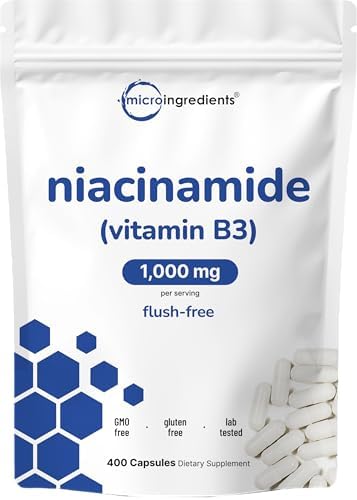
- Micro Ingredients offers flush-free vitamin B3, delivering niacinamide 500mg per capsule (1,000mg per serving) designed …
- Each pouch contains 400 total capsules with every capsule providing 500mg niacinamide, a value sized package that offers…
- Micro Ingredients Niacinamide keeps supplementation simple with convenient capsules made for men and women who want an e…
Niacinamide is a form of vitamin B3 that strengthens the skin barrier and reduces water loss. Skin research on oral nicotinamide uses about 500 mg once or twice daily, and clinical trials show it supports barrier function and calms redness [9].
It will not rebuild collagen, so treat it as support for texture and tone, not anti-aging.
What to look for: a plain nicotinamide or niacinamide product at 500 mg per capsule, so you can adjust from once to twice daily. Avoid “flush” niacin, which is a different form. Choose a brand that lists the exact form and dose and, ideally, publishes third-party testing.
Skin research on oral nicotinamide uses about 500 mg once or twice daily, a dose shown to strengthen the skin barrier and reduce water loss [9].
2. Acnutrol (Vitamin A blend)

- Support Healthy Skin From the Inside – Designed to provide comprehensive support for healthy skin by focusing on the int…
- Help Maintain the Skin’s Balance of Oils – Pantothenic acid plays a significant role in maintaining keratinocytes, the p…
- Vitamins & Minerals – Carnitine helps is necessary for normal cellular repair.* Additional skin-supportive nutrients inc…
Vitamin A supports skin cell turnover, and blends like this pair it with pantothenic acid and minerals aimed at oil balance. The caution is the dose. This product lists 50,000 IU of vitamin A per serving.
The tolerable upper limit for adults is 10,000 IU (3,000 mcg) per day, and going over it for long stretches risks liver strain and, in pregnancy, birth defects [10].
What to look for: this is a short-term, practitioner-supervised product, not a daily habit. If you are not working with a professional on a specific concern, a standard multivitamin covers your vitamin A safely. Do not stack it with other high-dose vitamin A sources.
This product lists 50,000 IU of vitamin A per serving, which is very high. The tolerable upper limit for adults is 10,000 IU (3,000 mcg) per day, so treat this as a short-term, practitioner-supervised product, not a daily habit [10].
3. Astaxanthin 12mg

- Micro Ingredients offers triple strength Astaxanthin 6mg softgels, delivering carotenoids sourced from Haematococcus Plu…
- Infused with MCT Oil for optimal absorption, helping ensure efficient nutrient delivery and utilization with every use.
- Each pouch contains 120 softgels, providing 120 servings that deliver 6mg of pure astaxanthin.
Astaxanthin is one of the more evidence-backed skin antioxidants. Trials show it improves wrinkles, elasticity, moisture, and reduces UV-related damage over 8 to 16 weeks [7]. Skin studies use 3 to 6 mg daily, with some running up to 12 mg [7]. A 12 mg capsule sits at the high end of the tested range, which is fine for most adults but more than the minimum shown to work.
What to look for: natural astaxanthin from Haematococcus pluvialis microalgae, not synthetic, because the natural form is the one used in skin studies. Because astaxanthin is fat-soluble, pick a softgel suspended in oil for better absorption and take it with a meal that contains fat. Confirm the milligram dose on the label rather than the oil weight.
Skin studies use 3 to 6 mg of astaxanthin daily, and trials up to 12 mg have improved wrinkles, elasticity, and moisture over 8 to 16 weeks [7]. A 12 mg capsule sits at the high end of that tested range.
4. Vitamin C

- Immune support supplement: contains one 60 count bottle of Nature Made Vitamin C 1000 mg Time Release Tablets with Rose …
- This time released Vitamin C 1000mg antioxidant supplement supports immune health and offers antioxidant support
- Time release Vitamin C 1000mg tablets extend vitamin absorption by the body and provide Vitamin C, which is needed for c…
Your body cannot build collagen without vitamin C, and it stabilizes collagen production inside skin cells [6]. On its own, the skin-appearance evidence is thinner, but paired with collagen and zinc it improves wrinkles and dryness [6]. A common supplemental dose is 500 to 1,000 mg daily.
What to look for: L-ascorbic acid is the standard, well-absorbed form and the cheapest. If it upsets your stomach, a buffered or liposomal version is gentler, though liposomal costs more without strong proof of better skin results. Split doses above 500 mg across the day, since your body absorbs vitamin C better in smaller amounts. Third-party testing matters here because vitamin C quality varies widely.
Most skin research pairs vitamin C with collagen; a common supplemental dose is 500 to 1,000 mg daily, and your body cannot synthesize collagen without it [6].
5. Hyaluronic acid

- 💪 Triple Strength Formula – 300mg Per Tablet Packed with a powerful 300mg of premium Hyaluronic Acid (as Sodium Hyaluron…
- 🧴 Advanced Sodium Hyaluronate for Maximum Absorption Made with the most bioavailable and effective form of Hyaluronic Ac…
- 📦 Exceptional Value – 6 Month Supply Each bottle contains a generous 180 tablets – a full 6 months’ supply at just one t…
Oral hyaluronic acid works by holding water in the skin rather than rebuilding its structure, so it targets hydration and plumpness. A 2023 review found oral hyaluronic acid improved skin hydration within 2 to 8 weeks [12]. Trials commonly use 60 to 240 mg daily.
What to look for: a product listing the daily dose in the 120 to 240 mg range and, ideally, the molecular weight, since studies used defined-weight sodium hyaluronate. Pair it with collagen if your goal is both hydration and firmness, because the two address different problems. This is one of the faster-acting picks, so judge it by week 8.
Oral hyaluronic acid trials commonly use 60 to 240 mg daily, and a 2023 review found it improved skin hydration within 2 to 8 weeks; it works by holding water in the skin rather than rebuilding structure [12].
6. Collagen (choose hydrolyzed collagen peptides)
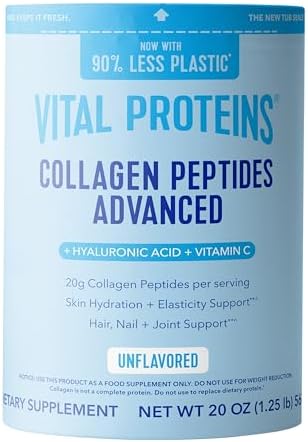
- SUPPORTS COLLAGEN PRODUCTION: With 100% daily value of Vitamin C, this Vital Proteins Collagen Peptides Advanced Powder …
- SUPPLE SKIN HYDRATION: Contains 120mg Hyaluronic Acid to support skin hydration and collagen for skin elasticity
- HIGHLY BIOAVAILABLE: Derived from grass-fed, pasture-raised bovine, our hydrolyzed collagen peptides are easily digested…
Collagen has the strongest evidence of any supplement here. A 2023 meta-analysis of 26 randomized trials in 1,721 people found it improved skin hydration and elasticity, and a 2025 meta-analysis of 23 trials added wrinkles to the list [4][8]. The trials used 2.5 to 15 g daily for at least 8 weeks [4][11].
One clarification worth your money. “Collagen” and “collagen peptides” are the same protein, but peptides are hydrolyzed, meaning broken into smaller fragments your body absorbs faster than whole collagen or gelatin [13].
So the form to buy is hydrolyzed collagen peptides, not raw or undenatured collagen.
What to look for: a hydrolyzed collagen peptide powder or capsule delivering at least 2.5 to 10 g per serving, unflavored, that dissolves in hot or cold liquid. Marine peptides are smaller and absorb slightly faster, while bovine peptides give similar skin results at lower cost, so pick by budget and diet, not hype [14].
Prioritize a brand with third-party testing, since collagen is an animal product and purity varies. Verywell Health, Health.com, and GoodRx all name Vital Proteins Collagen Peptides as a well-tested option, which is why it is a safe default if you want a proven brand [15].
The trials that improved hydration and elasticity used 2.5 to 15 g of hydrolyzed collagen peptides per day, taken for at least 8 weeks [4][11]. Consistency matters more than the exact gram count.
How long until skin supplements work?
Plan for 8 to 12 weeks before you judge any skin supplement. Your skin cells turn over on a roughly 4 to 6 week cycle, and collagen changes sit deeper and take longer, so a two-week trial tells you almost nothing.
The clinical timelines back this up. Collagen trials that showed improved hydration and elasticity ran for at least 8 weeks, with several measuring results at 12 weeks [4].
Astaxanthin studies typically ran 8 to 16 weeks before wrinkles and moisture improved [7].
Hyaluronic acid can show hydration gains faster because it works by binding water, not rebuilding tissue [12].
“What if I see nothing after three months?” – Stop the ones with weak evidence for glow, biotin and stand-alone omega-3, and keep the three with data: collagen, vitamin C, astaxanthin. Track with photos in the same light every two weeks. Memory is a poor judge of gradual skin change.
A note on biotin: it appears in most “hair, skin, and nails” formulas, but there is no evidence it improves skin unless you have a genuine biotin deficiency, which is rare. High-dose biotin can also skew certain lab tests, including thyroid and heart panels, so tell your doctor if you take it [5].
| Your skin goal | Best-matched supplement |
|---|---|
| Dullness | Vitamin C, for collagen support and brightness |
| Fine lines | Collagen, the strongest evidence for elasticity and wrinkles |
| Dryness | Hyaluronic acid, binds water for faster hydration |
| Acne-prone | Niacinamide, supports the skin barrier and calms redness |
| UV and sun stress | Astaxanthin, an antioxidant that reduced UV wrinkle damage |
What factors contribute to the loss of skin’s natural radiance?
There are several factors that can cause the skin to stop glowing:
- Dehydration: If you aren’t drinking enough water, it’ll likely affect the appearance of your skin
- Lack of moisturizer: Skimping on moisturizer, especially if your skin tends to be dry, can affect the health and vitality of your skin.
- Buildup of dead skin cells: Your skin naturally sheds dead cells on a regular basis to make way for new cells. But sometimes the dead cells don’t shed as they should. Instead, they build up the surface of your skin.
- Dryness: Dry skin can quickly take on the appearance of being dull and lifeless.
- Tobacco use: Smoking can impair the production of collagen and degrade the elastic fibers and connective tissue in your skin.
- Aging: Aging is an inevitable part of life. So is aging skin.
Frequently Asked Questions
Bottom Line
In conclusion, there are many supplements out there that can help promote healthy and glowing skin. Some of the key ingredients to look for include Astaxanthin, Vitamin C, Vitamin E, Bamboo Extract, Hyaluronic Acid, Collagen, and Sea Buckthorn. These ingredients are known to protect the skin from damage, promote collagen production, improve skin elasticity and hydration, and achieve a youthful appearance.
It’s worth noting that supplements should be seen as a part of a larger skincare routine. A healthy diet, regular exercise, and proper hydration are also important for maintaining a healthy and glowing complexion. Additionally, using a sunscreen during the day and a moisturizer at night can help to protect the skin from damage and keep it hydrated.
Ultimately, the best way to achieve a glowing complexion is to take a holistic approach, which includes incorporating supplements, a healthy diet, regular exercise, and proper skincare routine. With the right combination of these things, you can help to achieve and maintain a healthy and radiant complexion.
How we researched this
We prioritized human evidence over marketing claims. Every dosage and benefit in this article traces to a peer-reviewed source, favoring systematic reviews, meta-analyses, and randomized controlled trials indexed on PubMed and PMC. Where evidence is weak or mixed, biotin and stand-alone omega-3 for glow, we say so plainly rather than overselling. Product doses are compared against the doses actually used in studies and against established upper intake limits.
References
- [4] Nutrients (MDPI) – “Effects of Oral Collagen for Skin Anti-Aging: A Systematic Review and Meta-Analysis” – 2023. https://pmc.ncbi.nlm.nih.gov/articles/PMC10180699/
- [5] Healthline – “Do You Need Supplements for Better Skin?” – 2023. https://www.healthline.com/health/beauty-skin-care/supplements-for-better-skin
- [6] Nutrients (PMC) – “The Roles of Vitamin C in Skin Health” – 2017. https://pmc.ncbi.nlm.nih.gov/articles/PMC5579659/
- [7] Nutrients (PMC) – “Astaxanthin in Skin Health, Repair, and Disease” – 2018. https://pmc.ncbi.nlm.nih.gov/articles/PMC5946307/
- [8] The American Journal of Medicine – “Effects of Collagen Supplements on Skin Aging: A Meta-Analysis” – 2025. https://www.amjmed.com/article/S0002-9343(25)00283-9/abstract
- [9] The New England Journal of Medicine – “A Phase 3 Randomized Trial of Nicotinamide for Skin-Cancer Chemoprevention” – 2015. https://www.nejm.org/doi/full/10.1056/NEJMoa1506197
- [10] NIH Office of Dietary Supplements – “Vitamin A and Carotenoids: Fact Sheet for Health Professionals” – 2023. https://ods.od.nih.gov/factsheets/VitaminA-HealthProfessional/
- [11] Healthline – “How Much Collagen Should You Take Per Day?” – 2023. https://www.healthline.com/nutrition/how-much-collagen-per-day
- [12] Journal of Cosmetic Dermatology (PMC) – “Oral administration of hyaluronic acid to improve skin conditions” – 2023. https://pmc.ncbi.nlm.nih.gov/articles/PMC10661223/
Read Next