
47 Hydrogen Peroxide Uses With Exact Ratios for Every Job
The dilution chart, dwell times, and the 9 surfaces it ruins. Save it for your cleaning cabinet.
Enjoying this article?Add FoodNourish as a preferred source on Google and see our research-backed guides more often in your search results.
A peroxide and vinegar shower video sent me down this rabbit hole.
Someone in a shower, 3% peroxide in one hand and apple cider vinegar in the other, explaining that the rinse handles body odor and evens skin tone. The comments were full of people on day eighteen. I went looking for what hydrogen peroxide actually does.
Forty tabs later, the brown bottle turned out to do 47 things, and that shower was not one of them.
The hydrogen peroxide dilution and dwell time chart
| Task | Peroxide to water | Dwell time | Rinse after | Watch out for |
|---|---|---|---|---|
| Hard surfaces, counters | 1:1 | 5 min | Only food-contact | Strips wood finish |
| Cutting boards | 1:1 | 5 min | Yes, plain water | Bamboo dries out |
| Produce soak | 1/4 cup per full sink | 5 to 20 min | Yes, thoroughly | Soft fruit goes mushy past 20 min |
| Grout lines | Undiluted + baking soda paste | 10 min | Yes | Colored grout fades |
| Shower mold and mildew | 1:2 | 60 min | Yes | Natural stone etches |
| Toilet bowl | 1/2 cup undiluted | 20 min | Flush | None |
| Laundry whites | 1 cup in drum | Full cycle | Cycle handles it | Colors bleach |
| Blood stains | Undiluted | Until fizzing stops | Cold water only | Hot water sets stain |
| Sweat and deodorant stains | 2 parts peroxide, 1 part dish soap | 60 min | Yes | Test dark fabric first |
| Carpet spots | 1:1 | 30 min | Blot, do not rub | Test hidden corner |
| Mattress stains | 3 tbsp baking soda, peroxide, 1 drop dish soap | 15 min | Damp towel | Over-wetting the foam |
| Mouth rinse | 1 part peroxide, 2 parts water | 30 sec swish | Spit, do not swallow | Limit to 2 or 3 times weekly |
| Toothbrush soak | Undiluted | 5 min | Yes | Fresh solution each time |
| Nail brightening | 3 tbsp in warm water | 3 min | Yes | Skip if cuticles are cut |
| Foot soak | 1:1 | 15 min | Yes | Skip if skin is broken |
| Earwax softening | 1:1 warm water | A few drops, twice daily | Warm water flush | See a clinician first |
| Sponges | 1:1 | 15 min | Yes | Toss it if smell returns |
| Garbage disposal | Undiluted, 1/2 cup | 5 min | Run water | None |
| Humidifier tank | 1:1 | 20 min | Yes, twice | Check manufacturer guidance |
| Kids’ toys | 1:1 | 5 min | Yes | Not on electronics |
| Pet urine on hard floors | 1:1 | 10 min | Yes | Not on hardwood |
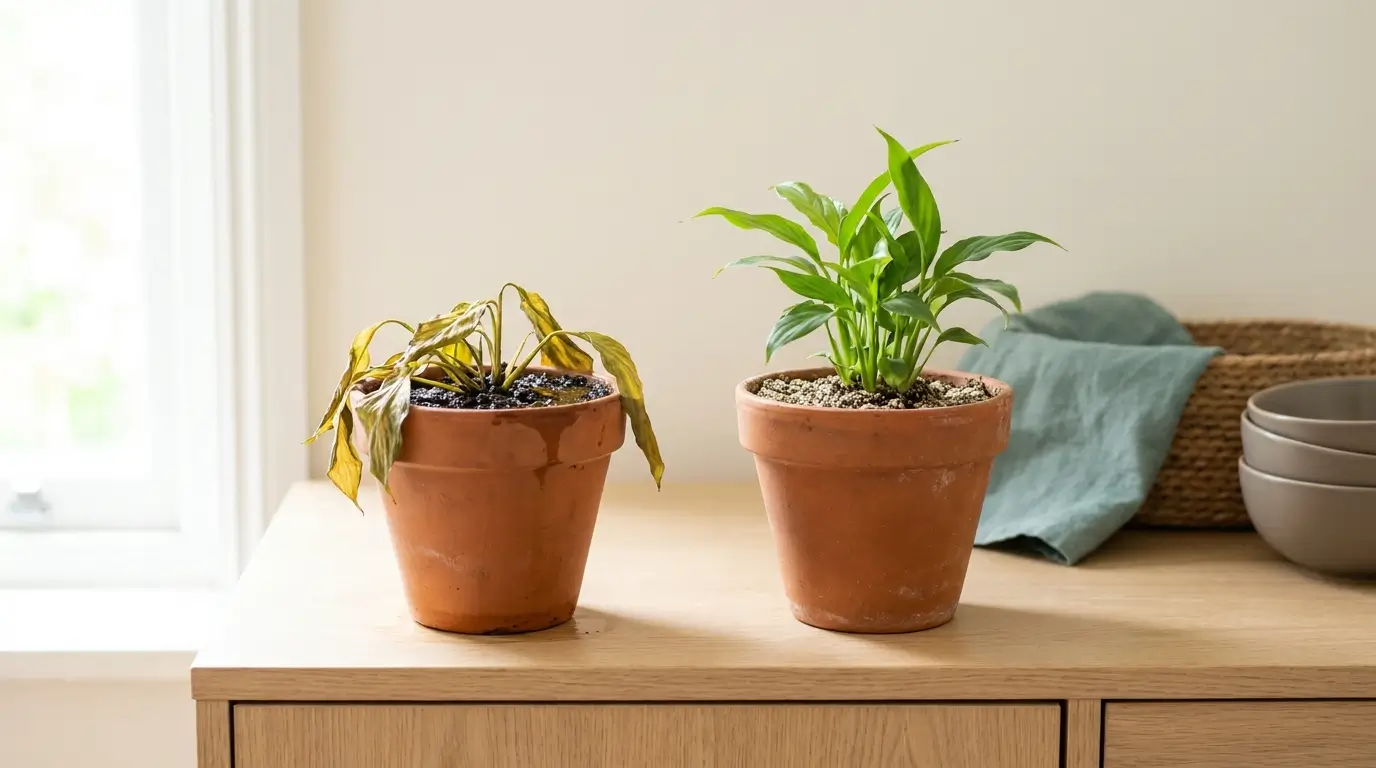
| Houseplant root rot | 1 oz per 1 quart water | Single soak | No | Stronger burns root hairs |
All ratios assume 3% hydrogen peroxide.
Three rules that make the chart work
Hydrogen peroxide is an oxidizer, which means it strips electrons from cell walls and color molecules. That single property explains the germ killing, the stain lifting, and every rule below.
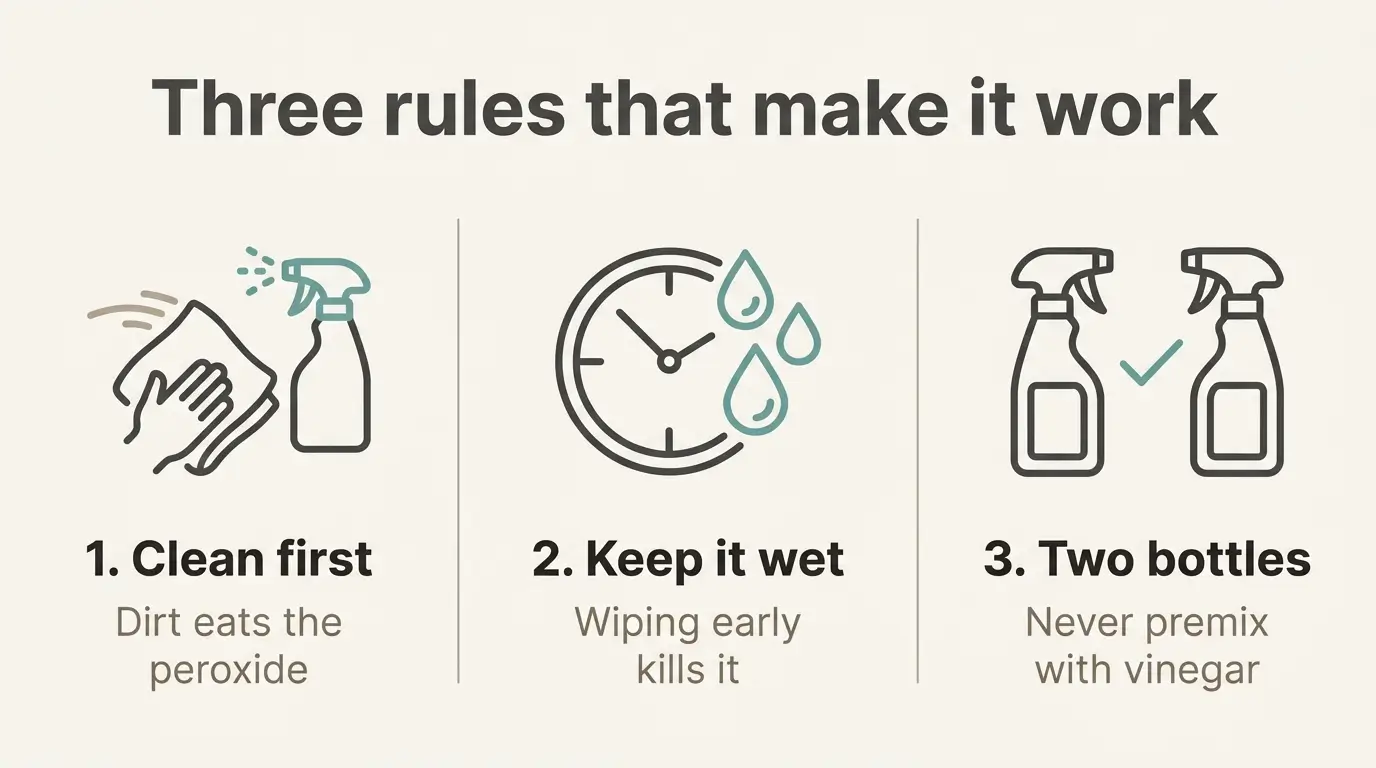
- Clean first, then disinfect. Dirt and grease consume the peroxide before it reaches any germs. This is the reason yours “did nothing.”
- Keep the surface visibly wet for the full dwell time. The U.S. Environmental Protection Agency (EPA) defines contact time as the period a treated surface must stay wet for a disinfectant to work, and some registered hydrogen peroxide products need as little as 3 minutes [1][2]. Wiping early is the most common failure.
- Never mix it with vinegar in the same bottle.
Cleaning and home (16 uses)
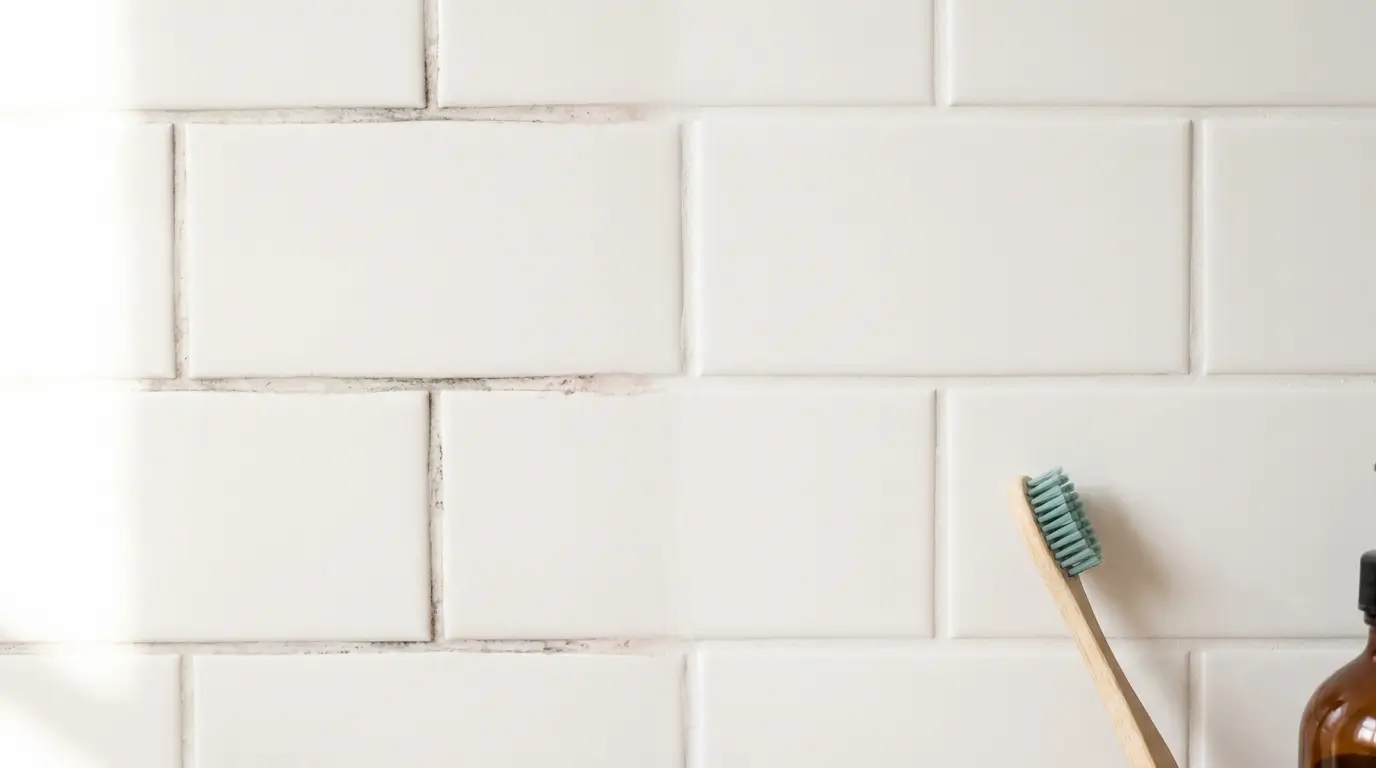
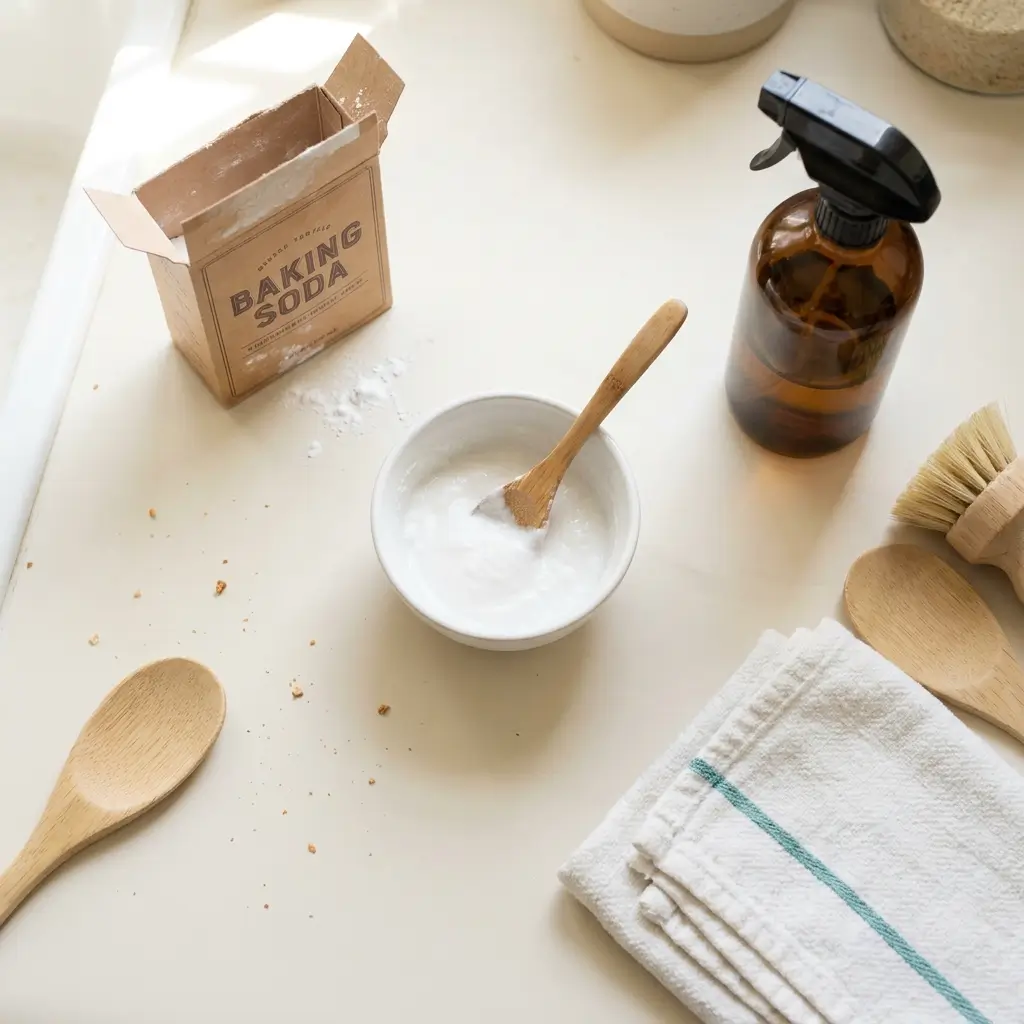
- Grout and tile mildew. Mix undiluted 3% peroxide with baking soda into a paste. Leave it 10 minutes, scrub with an old toothbrush, rinse. Molly Maid president Marla Mock recommends equal parts for this job [3].
- Shower scum and mold. Spray 1 part peroxide to 2 parts water, wait an hour, rinse [4].
- Toilet bowl and rim. Pour half a cup undiluted into the bowl, wait 20 minutes, scrub, flush. No fumes, no bleach smell.
- Kitchen counters. Spray 1:1, wait 5 minutes, wipe. Rinse anything that touches food. [5]
- High-touch spots. Door handles, light switches, cabinet pulls, remotes. Michael Silva-Nash of Molly Maid names these as the highest-value peroxide targets because it kills bacteria, viruses and fungi [6].
- Cutting boards. Spray 1:1, wait 5 minutes, rinse with plain water [5]. Hydrogen peroxide also lifts beet and turmeric staining from board grooves [6].
- Refrigerator shelves. Pull the shelves, spray 1:1, wipe. It removes the sour-milk smell that wiping alone leaves behind.
- Garbage disposal odor. Pour half a cup undiluted down the drain, wait 5 minutes, run water with the disposal on [6]. It eliminates the odor source rather than covering it.
- Sponges and dish brushes. Soak in 1:1 for 15 minutes, rinse hard [4]. If the smell comes back within two days, the sponge is finished.
- Glass and mirrors. Spray 3% directly on a paper towel, wipe. Streak-free, and cheaper than glass cleaner [3].
- Scorched baking sheets. Cover the pan in baking soda, sprinkle peroxide until damp, leave overnight, scrape and wash [3]. This is the use I was most skeptical of, and the one people report the most dramatic results from.
- Stovetop grease. Peroxide plus baking soda into a paste, scrub with the rough side of a sponge [3].
- Kids’ toys and play tables. Spray 1:1, wait 5 minutes, wipe, rinse [5].
- Patio furniture mildew. Spray undiluted on plastic or resin, wait 10 minutes, scrub, hose off [3].
- Trash and recycling bins. Spray the inside undiluted, wait 10 minutes, rinse.
- Humidifier tank. The Mayo Clinic recommends cleaning humidifiers every three days [7]. Wash with soap and water first, then soak the tank in 1:1 for 20 minutes and rinse twice.
Laundry and fabric (7 uses)
- White load brightener. Add 1 cup to the drum or pour it into the bleach compartment [4][5].
- Blood stains. Pour undiluted 3% directly on the stain, let it fizz, rinse with COLD water, then wash normally [3]. Hot water cooks the protein into the fibers permanently.
- Underarm sweat and deodorant yellowing. Mix 2 parts peroxide to 1 part dish soap, apply, wait an hour, rinse [4]. Scrub with baking soda on stubborn ones.
- Red wine, coffee and grass. Apply directly before laundering. These are all protein or tannin based, which is the category peroxide handles best [3].
- Musty towels and washer odor. Add 1 cup to an empty hot cycle [3].
- Mattress stains. Combine 3 tablespoons baking soda, peroxide and one drop of dish soap. Apply, wait 15 minutes, blot with a damp towel, air dry [3].
- Carpet and upholstery spots. Mix 1 cup baking soda with 2 cups peroxide, apply, blot with a clean undyed towel, wait 30 minutes, rinse [3]. Blot. Never rub.
Spot-test every time. Hydrogen peroxide is a bleach, and it fades colored fabric, silk and wool [8].
Kitchen and food (6 uses)
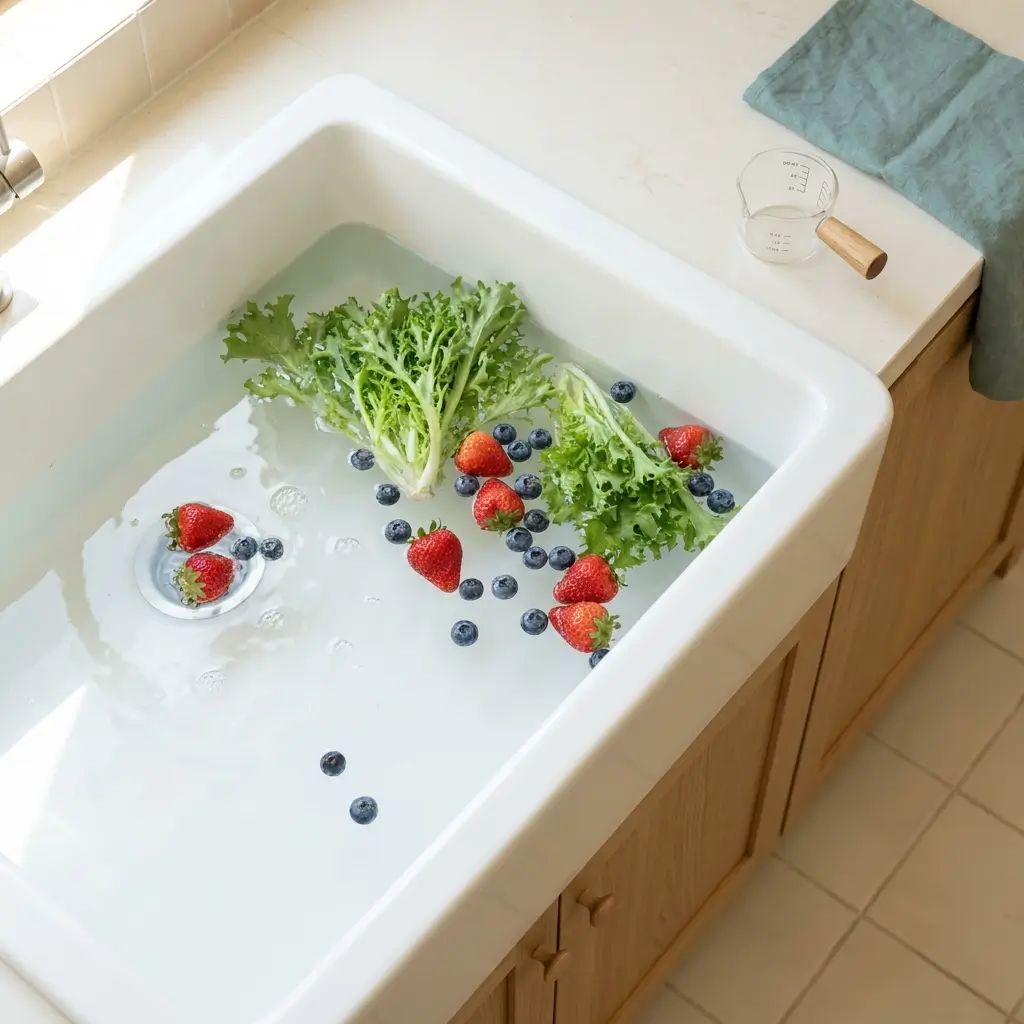
- Produce soak. Add 1/4 cup peroxide to a sink of cold water, soak 5 to 20 minutes, rinse well, dry [5]. Providence puts the longer soak at 20 to 30 minutes [4]. Soft fruit does not survive the long end.
- Berry and greens spray. Mist directly, wait 5 minutes, rinse [4].
- Jars and food containers. Spray the inside, wait 5 minutes, rinse. Useful on containers holding a tomato-sauce smell.
- Dishwasher interior. Spray the empty drum, wait, wipe, run a rinse cycle [7].
- Reusable bags and lunch boxes. Spray 1:1, wait 5 minutes, wipe, air dry.
- Countertop food prep zones. Same 1:1 spray, 5-minute dwell, water rinse [5].
One limit worth stating plainly. A peroxide soak removes surface residue and microbes. It does not remove pesticides the plant absorbed internally. Commercial produce sanitizing runs peroxyacetic acid below 80 parts per million (ppm) with monitoring equipment [9]. Your kitchen sink is not that, and guessing at a stronger mix buys you nothing.
Teeth, mouth and body, with real limits (8 uses)
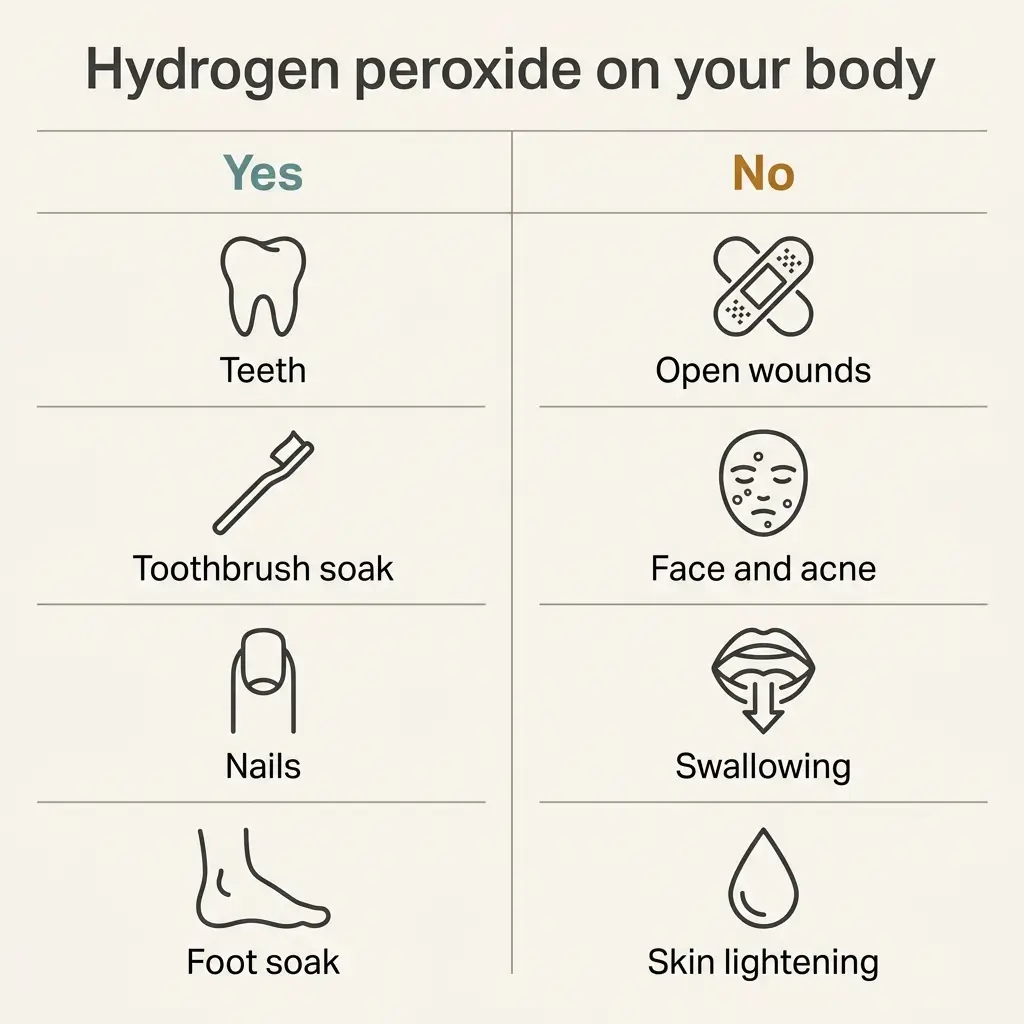
- Mouth rinse for sore gums and canker sores. Mix 1 part 3% peroxide with 2 parts water, swish 30 seconds, spit [10]. Do not swallow. Limit to two or three times a week, because daily use irritates gum tissue [4]. Call a doctor if sore gums last longer than about 7 days [10].
- Toothbrush, retainer and mouthguard soak. Dip 5 minutes, rinse thoroughly, replace the solution daily [5]. Still swap the brush every three to four months.
- Teeth whitening. Hydrogen peroxide is the active ingredient in most over-the-counter whitening products, and it does lift stains [10]. It also raises sensitivity. Cleveland Clinic family medicine physician Sarah Pickering Beers recommends asking your dentist before starting [5].
- Earwax softening. A few drops of 1:1 peroxide and warm water, twice daily for three to five days, then a gentle warm-water flush [4][10].
- Nail brightening. Soak natural nails in warm water with 3 tablespoons peroxide for 3 minutes [5]. Dermatologist Dana Stern suggests 3 to 4 tablespoons in half a cup of water, two or three times weekly [7]. Skip it if the skin around your cuticles is broken.
- Foot odor soak. 1:1 for 15 minutes. Podiatrist Alan Bass notes it works partly by drying the skin, which is also the reason to stop if your feet crack [7].
- Tweezers, nail clippers and lash curlers. Soak 5 minutes, rinse, dry [5].
- Earrings between wears. Soak 20 minutes, scrub with a jewelry brush, rinse warm, dry on a clean cloth [3].
Where it stops
- Wound care gets misquoted constantly, so here is what the research actually found. A 2012 PLOS ONE mouse study tested hydrogen peroxide at two strengths [18]. At 10 millimolar it improved blood vessel formation and sped wound closure. At 166 millimolar it slowed closure down. Household 3% peroxide measures roughly 880 millimolar, about five times the concentration that delayed healing in that study. The dose is the whole argument. Use soap and water on a cut, then a bandage
- Acne. It irritates skin and does not stay active long enough to help [5]. One 1% peroxide cream, Crystacide, performed comparably to benzoyl peroxide in a 2003 trial, and that is a 1% formulated product, not the brown bottle [19].
- Skin lightening. Older research found you need 20% to 30% concentration to lighten skin, roughly ten times what sits in your cabinet [8]. The burn risk is not worth it.
Concentration governs everything here. Murphy and Friedman, writing in the Journal of the American Academy of Dermatology in 2019, put the antimicrobial range at 1% to 6% and document clinical use up to 45%, with higher strengths destroying the outer skin layer [13].
Real clinical uses exist, including surgical site preparation and wound debridement, meaning the deliberate removal of dead tissue. Those happen under supervision.
Cosmetic daily use sits outside all of that. Cleveland Clinic lists hydrogen peroxide among the things to keep off your face [12], and a 2023 review in the Indian Journal of Dermatology, Venereology and Leprology documents damage to skin proteins and fats from that oxidizing action [11].
The vinegar question
Yes, you can use hydrogen peroxide and vinegar together on surfaces. Spray them sequentially, never premixed.
Susan Sumner, a food scientist at Virginia Tech, tested misting surfaces and produce with 5% vinegar followed by 3% hydrogen peroxide as separate sprays. The pairing killed substantially more Salmonella, Shigella and E. coli than either spray alone, and the order did not matter [13].
One caveat on the sourcing, since this method gets repeated everywhere without it. Sumner’s results were reported in Science News in 1996 rather than published as a standalone peer-reviewed paper, so treat the figures as indicative rather than precise.
Keep them in two bottles. Combined in one container they form peracetic acid, which the University of Rochester Medical Center lists among household combinations to avoid [14].
The U.S. Occupational Safety and Health Administration (OSHA) notes peracetic acid causes burns and respiratory illness, and the National Institute for Occupational Safety and Health (NIOSH) documented eye, nose and throat irritation among workers exposed to it [16].
The premixed version also degrades within hours, so it stops working.
Two bottles. One spray, then the other. That is the whole method.
Pets (5 uses)
- Urine odor on hard floors. Spray 1:1, wait 10 minutes, wipe, rinse. Test a hidden corner first, and keep it off hardwood.
- Food and water bowls. Spray 1:1, wait 5 minutes, rinse thoroughly with plain water.
- Bedding and crate trays. Add 1 cup to a hot wash for bedding. Spray trays undiluted, wait 10 minutes, rinse.
- Skunk formula. Combine 1 quart 3% peroxide, 1/4 cup baking soda and 1 teaspoon dish soap. Work it in, wait 5 minutes, rinse. Mix it fresh, never store it in a sealed bottle, and know it lightens dark coats.
- Litter box trays. Spray undiluted after emptying, wait 10 minutes, rinse, dry fully.
Three hard stops. Never in a pet’s eyes or ears. Never on wood or natural stone where they eat. And do not use peroxide to make a dog vomit unless a veterinarian or a pet poison line tells you to on that specific call, because it irritates the stomach lining and many veterinary toxicologists have moved away from recommending it. For cats, never.
Garden and houseplants (5 uses)
- Root rot in overwatered pots. Combine 1 ounce peroxide with 1 quart water. Let the topsoil dry completely, then pour the mixture in, and repeat until the rot clears [4].
- Seed soaking. Soak seeds 30 minutes in 1 teaspoon peroxide per cup of water before planting, then rinse.
- Fungus gnat larvae. Water with 1 part peroxide to 4 parts water once the top inch of soil dries. It kills larvae on contact and fizzes out within minutes.
- Pots, trays and pruners. Soak or spray undiluted between plants, rinse [3]. This stops you from carrying disease from a sick plant to a healthy one.
- Hydroponic reservoirs. Dosing depends entirely on your system volume and nutrient mix, so follow your equipment guidance rather than a blog ratio.
Waterlogged soil runs out of oxygen, and root rot pathogens thrive in those airless conditions. The extra oxygen atom in hydrogen peroxide breaks that up.
Going stronger backfires, because higher concentrations burn the fine root hairs, which explains the wilting people report right after a heavy treatment.
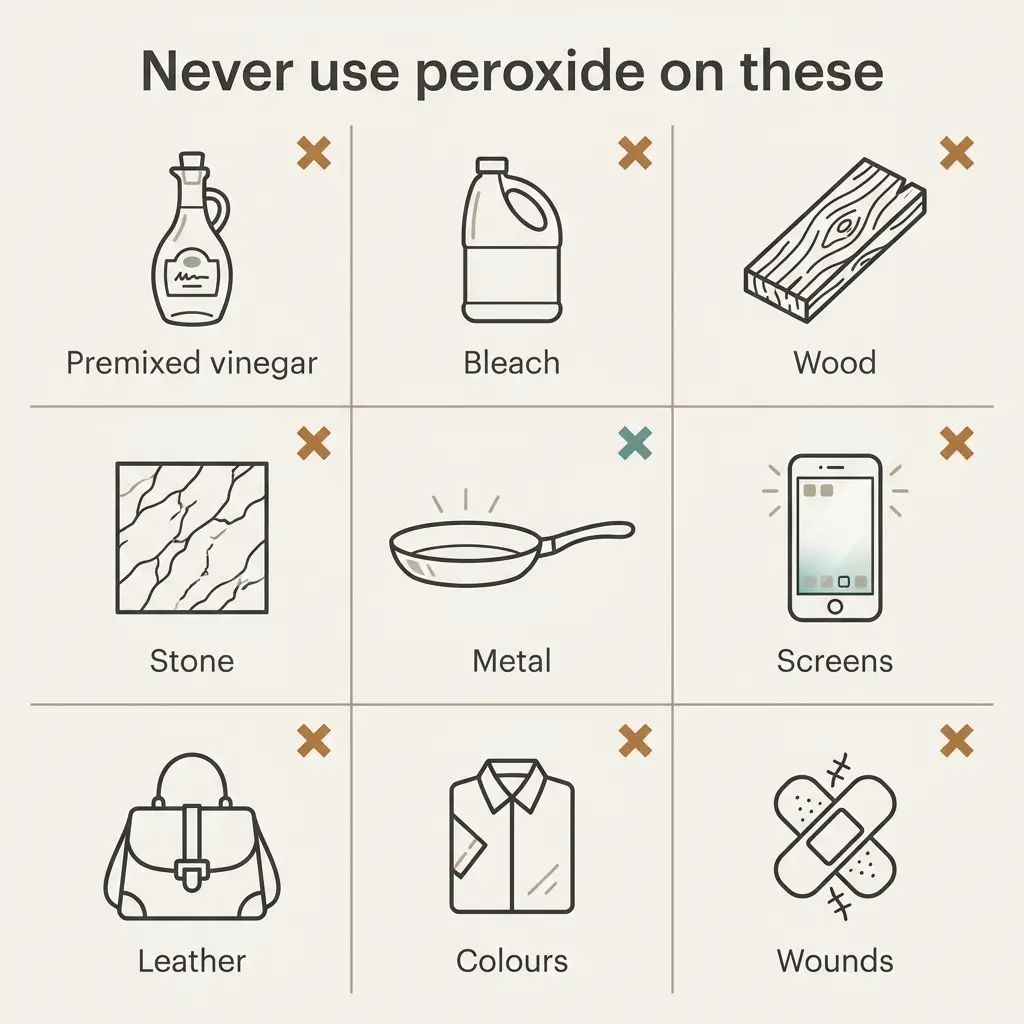
9 things to never clean or do with hydrogen peroxide
| Never | Reason |
|---|---|
| Mix with vinegar in one bottle | Forms peracetic acid, irritates airways and eyes [13] |
| Mix with bleach, ammonia or rubbing alcohol | Produces toxic fumes [20] |
| Wood floors, furniture, cabinets | Strips finish and wax, leaves the surface dull and exposed [20] |
| Natural stone | Etches the sealant on marble, granite, travertine and quartzite [20] |
| Metals | Corrodes copper, brass, iron, aluminum and some stainless, causing pitting and rust spots [20] |
| Electronics and screens | Clouds display coatings, corrodes circuitry, seeps through ports [20] |
| Leather | Breaks down the oils, which leads to cracking and fading [20] |
| Colored, dark, silk or wool fabric | Bleaches color and damages protein fibers [20] |
| Open wounds, acne, anything internal | Damages healing tissue [11], irritates skin [8], toxic when swallowed [17] |
Does hydrogen peroxide expire, and how to test yours
Unopened bottles hold potency for roughly two to three years. Once you break the seal, expect meaningful decline within about six months, because oxygen escapes every time you open the cap.
The test takes five seconds.
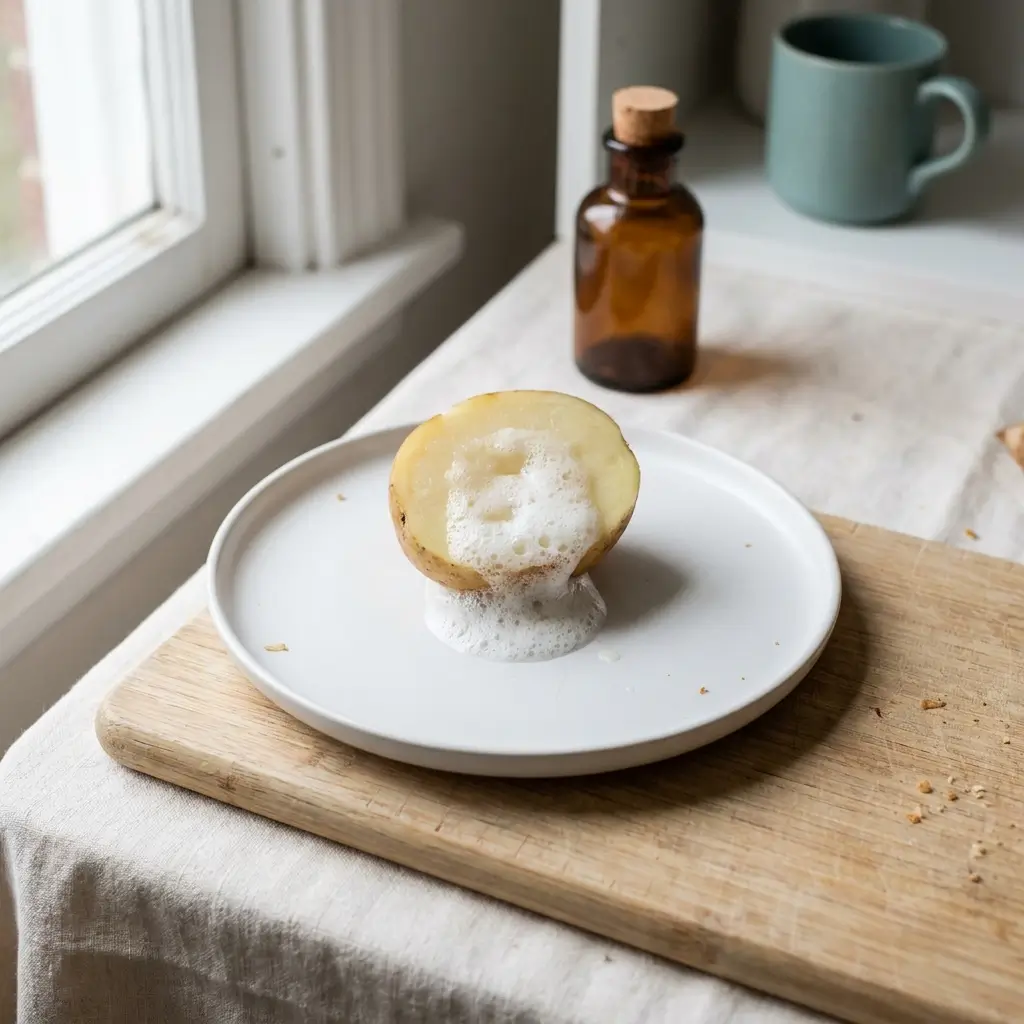
Pour a small amount onto a cut potato or a piece of raw meat. Both contain catalase, an enzyme that splits hydrogen peroxide into water and oxygen on contact.
Strong fizz means the bottle still works. Weak fizz means it is mostly water now.
Storage rules follow from the chemistry. Light accelerates the breakdown, which is why manufacturers sell it in brown bottles [20].
Keep it in the original container, keep it capped, keep it out of the sun, and never decant it into a clear spray bottle for long-term storage. Use an opaque or amber spray bottle and label it.
Disposal is simple. Dilute with water and pour it down the drain. Household 3% breaks down into water and oxygen, so normal household volumes do not harm a septic system.
If yours is flat and you are at the store anyway, here is how it compares.
Hydrogen peroxide vs vinegar vs bleach vs rubbing alcohol
| Hydrogen peroxide 3% | White vinegar | Bleach | Rubbing alcohol 70% | |
|---|---|---|---|---|
| Kills | Bacteria, viruses, fungi, mold [6] | Some bacteria, limited viruses | Broadest kill, including spores | Bacteria, many viruses |
| Fails on | Dirty surfaces, heavy grease | Mold roots in porous surfaces | Nothing, but it damages plenty | Porous surfaces, it evaporates fast |
| Typical dwell | 3 to 10 min [1][2] | 30 min | 5 to 10 min | 30 sec to 2 min |
| Cost per 32 oz | About 1.49 USD [19] | About 2.50 USD | About 2.00 USD | About 3.00 USD |
| Avoid on | Wood, stone, metal, leather, color [20] | Stone, grout, cast iron | Color, metal, most fabric | Screens with coatings, painted wood |
| Best single job | Grout, mildew, white stains | Hard water and soap scum | Whole-house sanitizing after illness | Fast electronics-adjacent wipes |
A single 3% bottle at about 5 cents an ounce [19] replaces separate bathroom spray, oxygen bleach, grout cleaner and produce wash. That math is the reason this bottle stayed in my cleaning caddy after the reel that sent me looking.
Frequently asked questions
Citations
- U.S. Environmental Protection Agency, “Selected EPA-Registered Disinfectants”
- Safer Disinfectants, List N hydrogen peroxide products, 3-minute contact time
- Martha Stewart, “15 Unexpected Ways to Use Hydrogen Peroxide Around Your Home”
- Providence, “8 ways to use hydrogen peroxide in your home”
- Cleveland Clinic, “What Is Hydrogen Peroxide? Uses and How It Works”
- AARP, “11 Surprising Uses for Hydrogen Peroxide”
- The Healthy, “17 Hydrogen Peroxide Uses You Never Knew About”
- Healthline, “Can I Use Hydrogen Peroxide on My Skin?”
- Clemson Cooperative Extension HGIC, “Choosing a Sanitizer for Washing Fresh Produce”
- WebMD, “Health Uses for Hydrogen Peroxide”
- Kapoor P., “Hydrogen peroxide in dermatology,” Indian Journal of Dermatology, Venereology and Leprology, 2023
- Cleveland Clinic, “Don’t Put These 5 Things on Your Face”
- Murphy EC, Friedman AJ, “Hydrogen peroxide and cutaneous biology: Translational applications, benefits, and risks,” Journal of the American Academy of Dermatology, 2019, PMID 31103570
- Sumner S., Virginia Tech, sequential vinegar and hydrogen peroxide spray research, reported in Science News, 1996
- University of Rochester Medical Center, “Do Not Mix These Cleaning Products”
- NIOSH Health Hazard Evaluation Program, peracetic acid exposure findings
- Southern Living, “6 Things You Should Never Clean With Hydrogen Peroxide”
- “Effects of Hydrogen Peroxide on Wound Healing in Mice in Relation to Oxidative Damage,” PLOS ONE, 2012, doi 10.1371/journal.pone.0049215
- Milani M. et al., Crystacide 1% hydrogen peroxide cream versus benzoyl peroxide in acne, 2003, PMID 12740158
- Illinois Poison Center, “Hydrogen Peroxide”
- U.S. Food and Drug Administration consumer advisory on high-strength hydrogen peroxide, 2006
- Pritchett S. et al., “Accidental ingestion of 35% hydrogen peroxide,” 2007, PMC2658134
- Tennessee Poison Center, Vanderbilt University Medical Center, February 2020
- Walgreens retail listing, 3% hydrogen peroxide, 32 fl oz
- Mayo Clinic, humidifier cleaning guidance
