The Truth About Magnesium: What Most Supplement Labels Won’t Tell You
Why your magnesium form matters less than how it’s delivered, absorbed, and tolerated.

Every form of magnesium delivers the same mineral to your body. That mineral, Mg2+ (the ionic form of magnesium your cells actually use), drives over 300 enzymatic reactions regardless of whether it came from a glycinate capsule, a citrate powder, or a taurate tablet [1].
The truth about magnesium is that what separates a good supplement from a mediocre one has little to do with which “type” you pick.
It has everything to do with how that magnesium is delivered, how well your body absorbs it, and whether you can tolerate it day after day without GI (gastrointestinal) discomfort.
Most supplement labels won’t tell you this. Most magnesium articles won’t either.
Why Everyone Is Talking About Magnesium Right Now
Magnesium supplement sales have surged in recent years, fueled by social media claims that specific forms can fix your sleep, calm your anxiety, ease your cramps, and protect your heart.
Some of those claims carry a grain of truth. Many do not.
The problem with most magnesium content online is that it falls into one of two camps.
- Camp one oversimplifies. It assigns a single benefit to each form (“glycinate for sleep, citrate for digestion, taurate for heart health”) as if swapping a companion compound turns magnesium into a different nutrient.
- Camp two dismisses supplementation entirely, arguing that a balanced diet gives you everything you need.
Both camps miss the point.
An analysis of NHANES (National Health and Nutrition Examination Survey) 2013-2016 data found that 48% of Americans across all age groups consume less magnesium from food and beverages than their Estimated Average Requirement, or EAR (the daily intake level estimated to meet the needs of half the healthy population) [2].

That’s nearly half the population falling short. And trendy restrictive diets that cut out legumes, whole grains, or leafy greens make the gap worse.
So the question isn’t whether magnesium matters. It does. The real question is what actually makes one magnesium supplement better than another. And answering that question requires understanding what magnesium does once it enters your body.
What Magnesium Does in Your Body
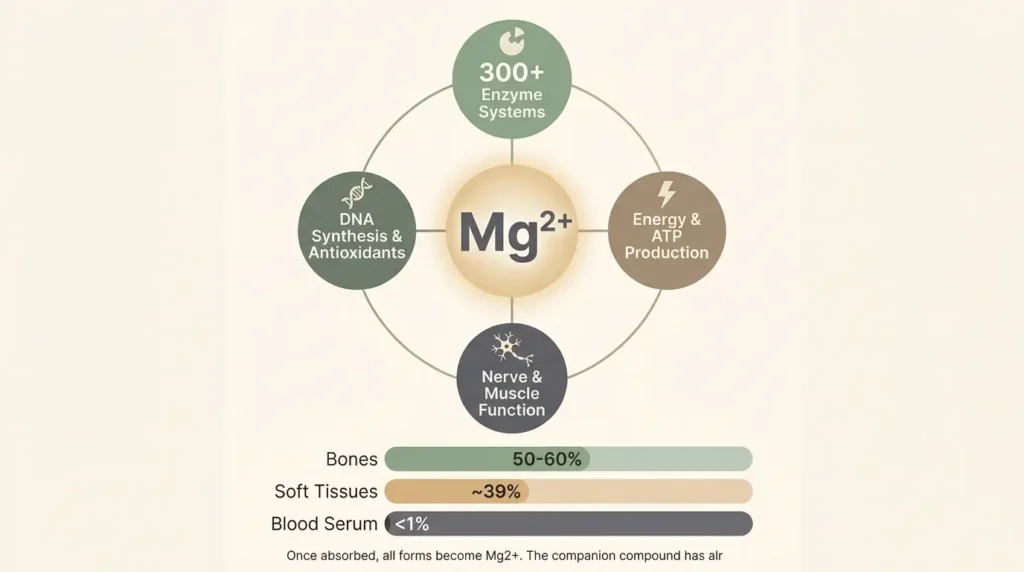
Magnesium acts as a cofactor (a helper molecule that enzymes need to do their work) in more than 300 enzyme systems.
Once absorbed, it supports muscle function, nerve signaling, energy metabolism, and hundreds of enzymatic processes throughout the body.* These systems also regulate blood glucose control and blood pressure [1].
Your body requires magnesium for ATP (adenosine triphosphate, your cells’ primary energy currency) production, DNA synthesis, and the antioxidant glutathione [1].
Magnesium plays a role in calming nervous system activity. It influences neurotransmitter release and muscle relaxation, which is one reason it frequently appears in routines that support relaxation and sleep quality.
Your body stores about 25 grams of magnesium total. Between 50% and 60% sits in your bones. Most of the rest lives in soft tissues. Less than 1% circulates in your blood serum [1].
And here is the point that matters most for supplement selection. Once magnesium is absorbed into your bloodstream, it is Mg2+. Period.
It supports the same functions whether it arrived as bisglycinate, malate, citrate, or any other form. The companion compound that carried it through your digestive tract has already done its job.
So why are there so many forms? Because the journey to absorption is where the real differences live.
The Real Difference Between Magnesium Forms
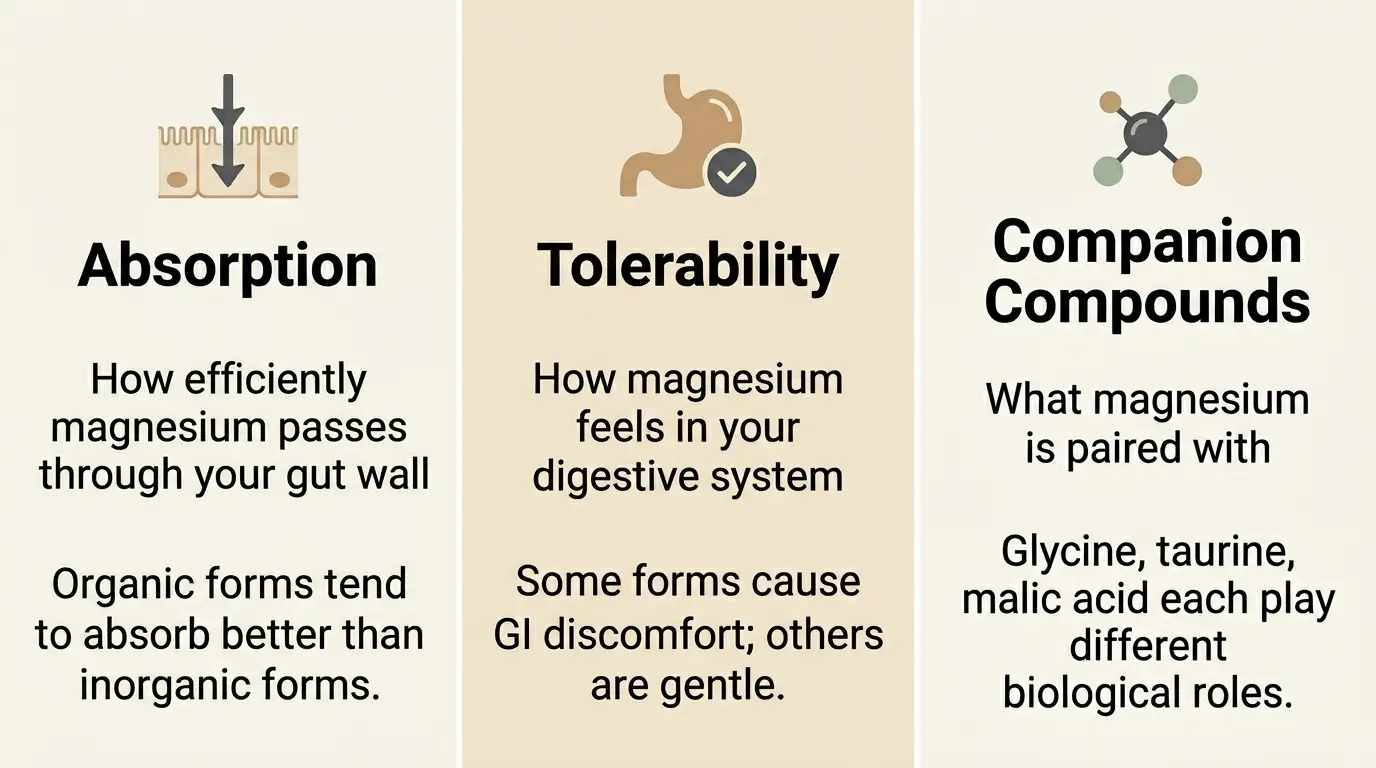
All magnesium supplements pair the mineral with a companion compound. That compound might be an amino acid (like glycine or taurine), an organic acid (like malic acid or citric acid), or an inorganic molecule (like oxide).
The pairing creates what you see on the label, for example “magnesium bisglycinate” or “magnesium citrate.”
These pairings affect three things that directly shape your experience with any magnesium supplement.
Absorption
Some forms dissolve more readily in your gut and are structured to support uptake through the intestinal wall.
The NIH notes that forms of magnesium which dissolve well in liquid are more completely absorbed than less soluble forms.
Small studies have found that the aspartate, citrate, lactate, and chloride forms absorb more completely and have greater bioavailability (the percentage of a nutrient your body actually absorbs and uses) than magnesium oxide and magnesium sulfate [3].
A 2021 systematic review published in the journal Nutrition confirmed that organic forms of magnesium tend to be more bioavailable than inorganic forms [4].
That’s why specific forms are often selected for bioavailability in well-designed formulations.
But “more bioavailable” does not automatically mean “better for you.” Bioavailability is one variable among several.
Tolerability
Different forms feel different in your digestive system. Magnesium oxide and citrate, particularly at higher doses, commonly cause loose stools and GI discomfort. The NIH specifically identifies magnesium carbonate, chloride, gluconate, and oxide as forms most commonly linked to diarrhea [3].
Magnesium bisglycinate, by contrast, is widely regarded as gentler on digestion.
This matters more than most people realize. If a magnesium supplement upsets your stomach, you stop taking it. And a supplement you don’t take consistently provides zero benefit.
Tolerability directly determines whether you actually maintain steady magnesium intake over weeks and months.
Companion Compounds
Some forms pair magnesium with compounds that are naturally involved in specific biological processes. These pairings reflect formulation design, and they may influence how magnesium is delivered and experienced in the body.
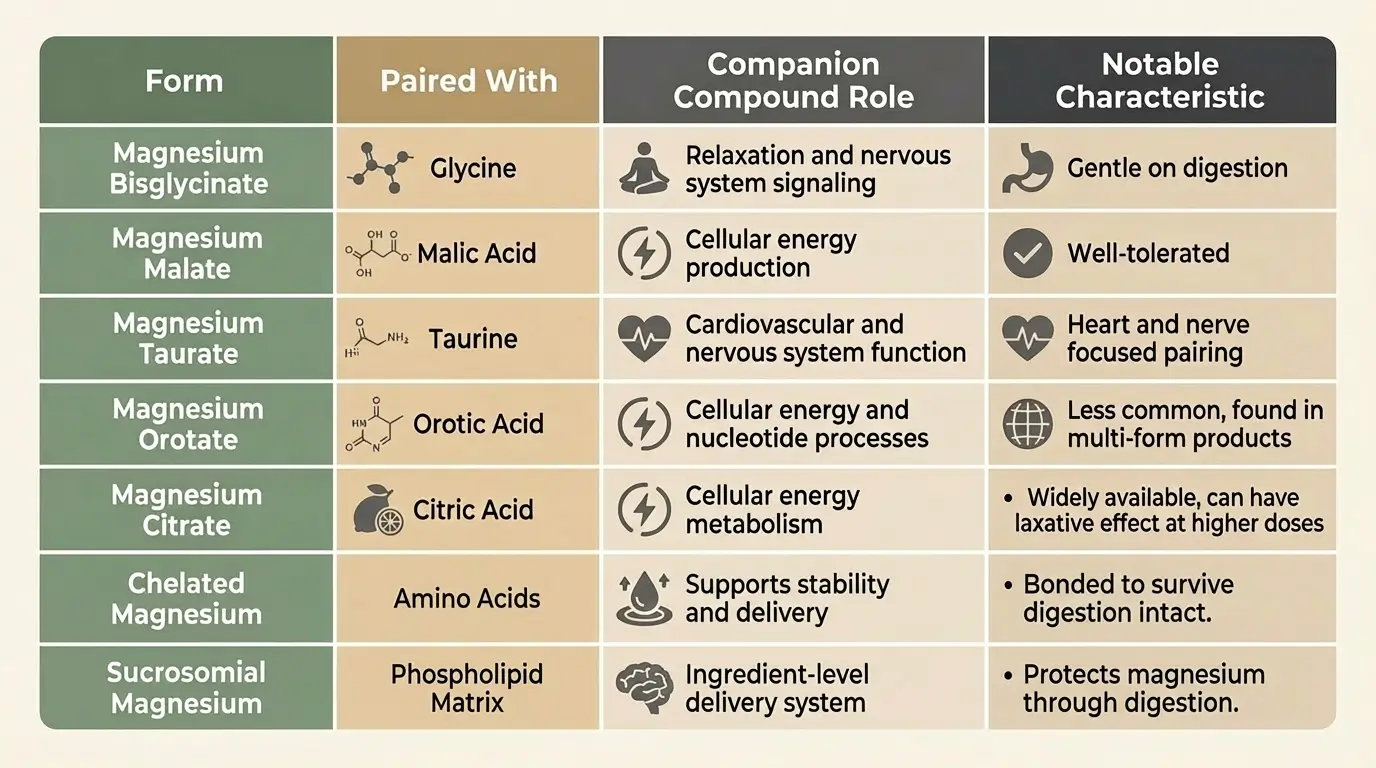
- Glycine is an amino acid involved in relaxation and nervous system signaling.
- Taurine is an amino acid involved in cardiovascular and nervous system function.
- Malic acid is a compound involved in cellular energy production through the Krebs cycle (the metabolic pathway your cells use to generate ATP).
- Orotic acid is involved in cellular energy and nucleotide processes. Citric acid is involved in cellular energy metabolism.
These companion compounds don’t change what magnesium does after absorption. Mg2+ is Mg2+. But the pairing may influence the delivery experience, the tolerability profile, and the context in which your body receives the mineral.
“So does it even matter which form I take?” Yes, it matters.
It matters for absorption. It matters for how your gut feels. And it matters because of what the companion compound brings to the formulation.
What it does NOT mean is that glycinate “becomes” a sleep mineral or that taurate “becomes” a heart mineral. That framing is inaccurate.
With that distinction clear, here is what each of the major forms actually offers.
7 Common Magnesium Forms, Explained
Why Delivery Technology Matters More Than You Think
Most magnesium conversations stop at “which form should I take?” That’s an incomplete question.
Modern formulation science goes beyond the form itself. Some formulations now protect magnesium through digestion at the ingredient level, rather than relying solely on the capsule, tablet, or coating to do the work.
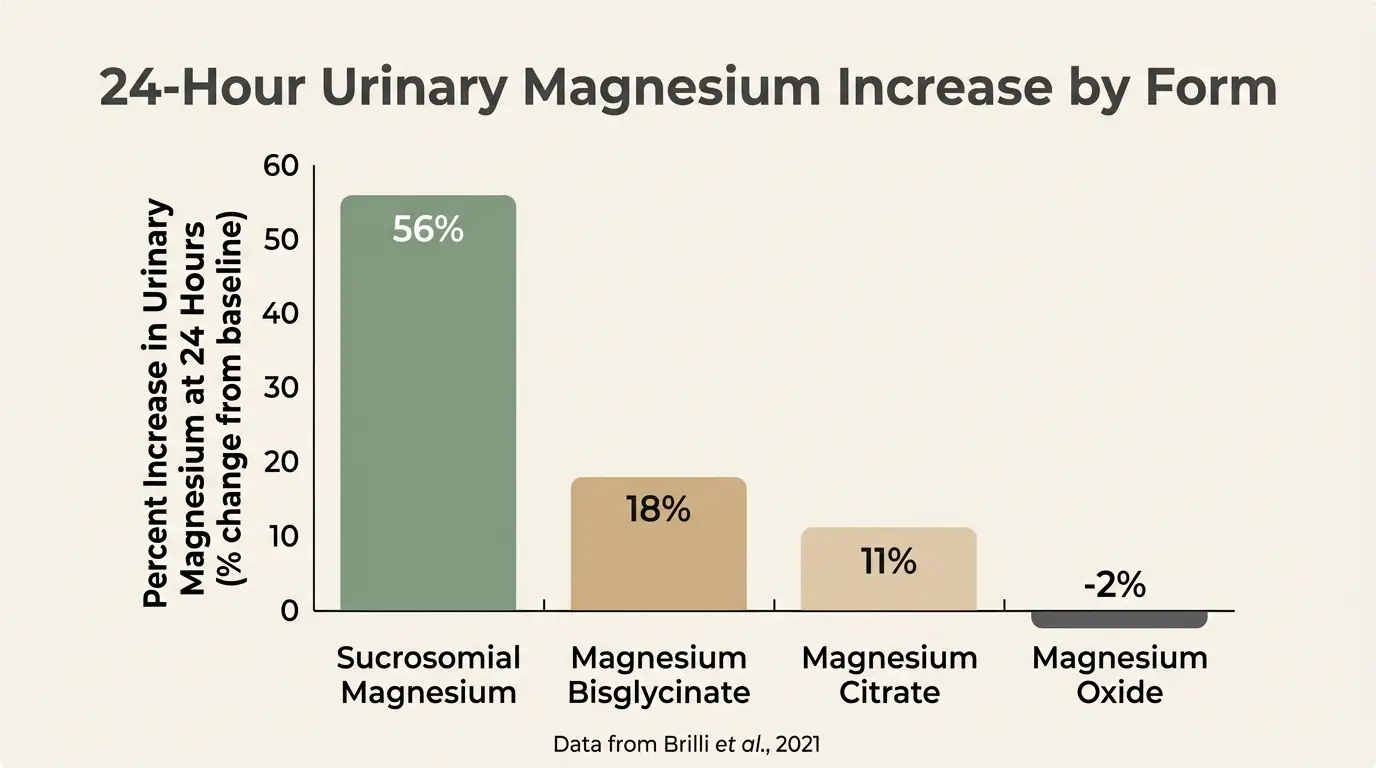
Sucrosomial technology is one example. It encloses magnesium within a phospholipid-based matrix at the ingredient level.

The sucrosome allows Mg2+ ions to pass through the gastric and intestinal environment without interacting directly with the intestinal mucosa, then reach the bloodstream [5].
This is a fundamentally different approach from standard magnesium salts, which dissolve in your stomach and depend on passive absorption through the gut wall.
Why does this matter practically? Because magnesium that breaks down too early in digestion can trigger GI discomfort and reduce the amount that actually reaches your cells.
Delivery technology addresses both problems at once. It can improve how much magnesium gets absorbed AND how the experience feels in your body.
(Note: This is the category of innovation most supplement labels ignore entirely. If a product’s marketing focuses only on the “type” of magnesium and says nothing about delivery, you’re seeing an incomplete picture.)
The advantage of advanced delivery comes from HOW magnesium moves through your body, not from changing what magnesium does once it arrives.
This is also why some formulations now combine multiple forms and multiple delivery strategies into a single product.
The Case for Multi-Form Magnesium
Most magnesium supplements on the market contain a single form. One form, one companion compound, one delivery approach.
All forms of magnesium deliver the same mineral your body relies on for muscle function, nerve signaling, energy production, and more.
What separates a thoughtfully designed product from a basic one is how that magnesium is delivered.
By combining multiple forms, including compounds like glycine, taurine, and malic acid, along with advanced ingredient-level delivery technology, the result is a multi-delivery magnesium system designed around absorption, tolerability, and modern formulation science.
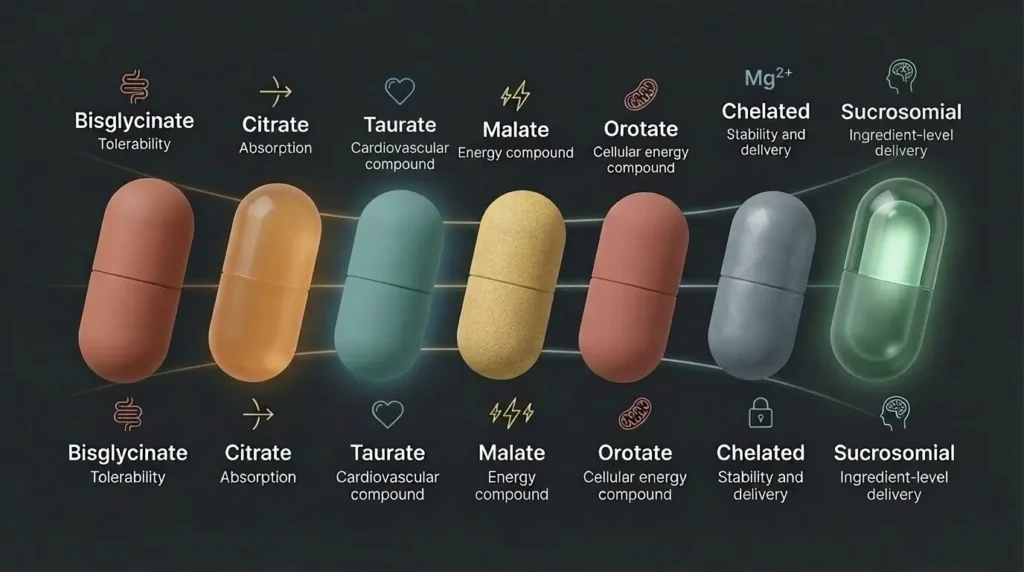
The rationale is straightforward. Different forms may support different aspects of the delivery process, including absorption rate, tolerability, stability through digestion, and the biological context provided by each companion compound.
“Wait, isn’t that just marketing speak for throwing everything together?” No.
A well-designed multi-form product includes bisglycinate for its tolerability profile, citrate for its absorption characteristics, taurate and malate for their companion compound profiles, and sucrosomial magnesium for its ingredient-level delivery technology.
Each form has a specific role in the overall delivery system.
This approach is NOT about “7 forms for 7 different benefits.” That framing is misleading because, again, all forms deliver the same Mg2+.
It IS about building a more complete delivery system for one mineral, designed around absorption, tolerability, and modern formulation science.
Same magnesium. Smarter delivery.
Beyond the formulation itself, practical questions about dosing and quality affect your results.
How Much Magnesium Do You Actually Need?
The Recommended Dietary Allowance (RDA) for magnesium is 310-320 mg per day for adult women and 400-420 mg per day for adult men [1].
The tolerable upper intake level for supplemental magnesium (meaning magnesium from supplements and medications, NOT from food) is 350 mg per day [1].
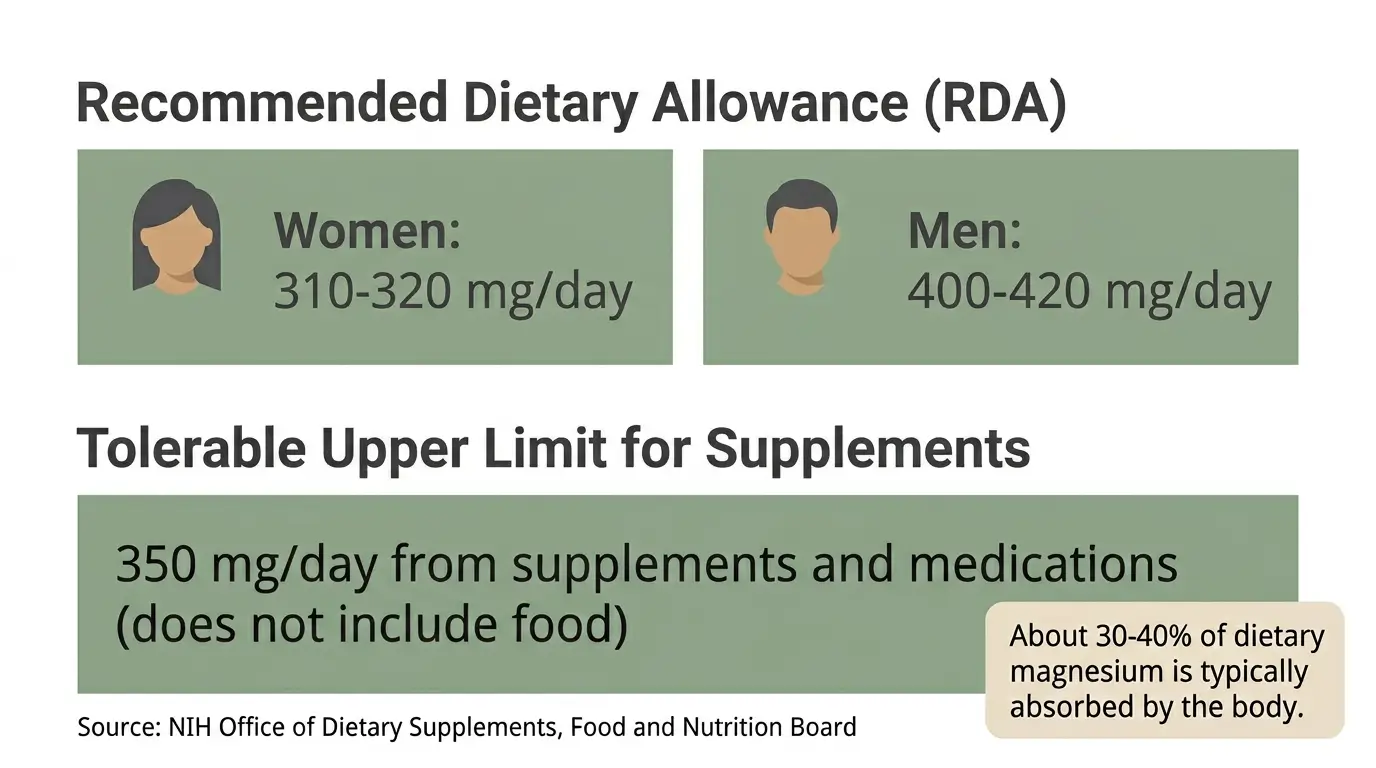
Below that level, you are unlikely to experience digestive side effects.
48% of Americans of all ages consume less magnesium from food and beverages than their Estimated Average Requirement, based on NHANES 2013-2016 data [2].
Certain groups face even higher risk of shortfall. Older adults, people taking proton pump inhibitors or diuretics, those with GI conditions like Crohn’s disease, people consuming highly processed diets, and heavy alcohol consumers all tend to run lower in magnesium [1].
A blood test can check your serum magnesium level. The normal range is 0.75 to 0.95 mmol/L (millimoles per liter, the standard unit for blood mineral levels) [1].
But standard serum tests have a significant limitation. They measure only extracellular magnesium, which represents less than 1% of your total body stores [1].
Your serum levels can appear normal even when your intracellular stores are depleted. The NIH itself acknowledges that no single test method is considered satisfactory for evaluating magnesium status [1].
If you suspect a deficiency, work with your healthcare provider to evaluate your status. A magnesium-loading (tolerance) test, while not widely used, provides a more accurate picture than serum measurement alone [1].
This test involves receiving a dose of magnesium intravenously and measuring how much your body retains versus excretes, which reflects your true magnesium status.
What to Look for in a Magnesium Supplement
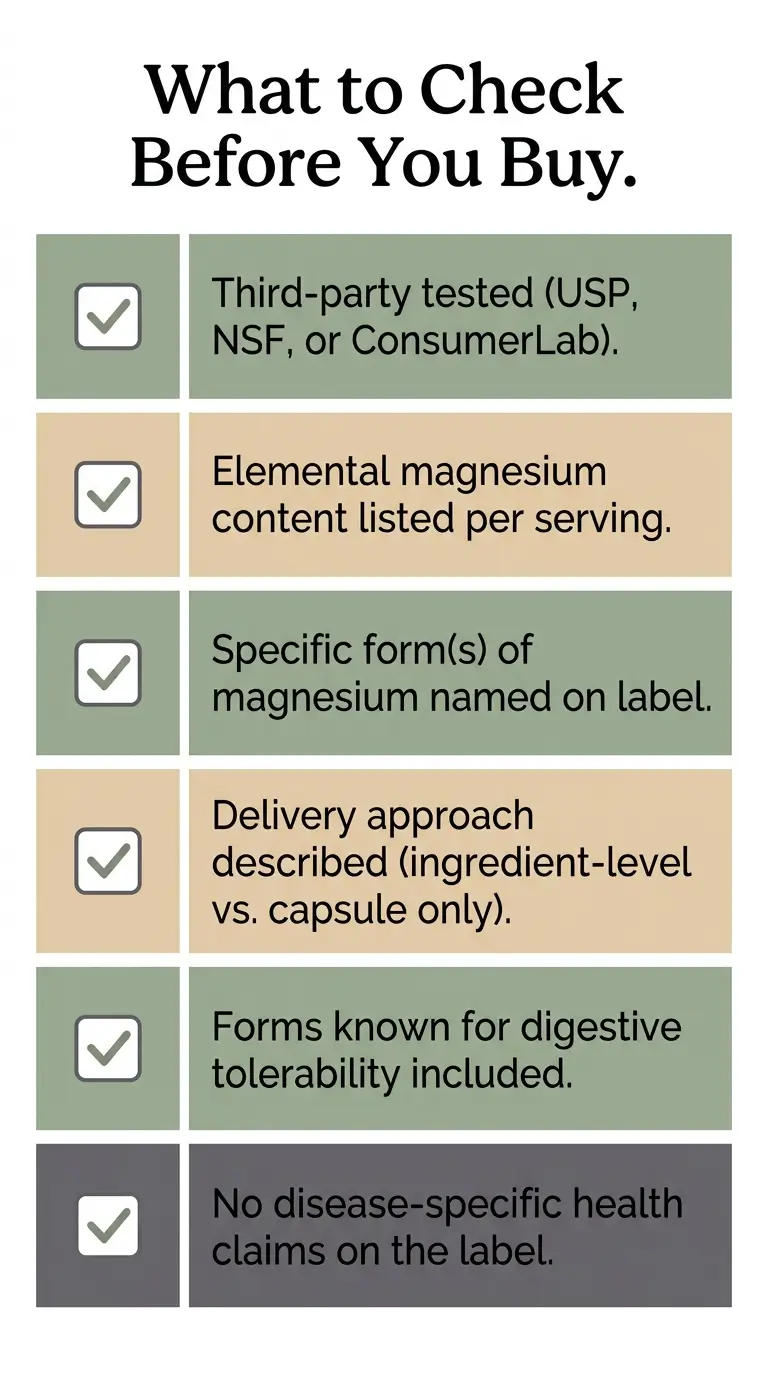
Not all supplements are created with the same rigor. Here is what to evaluate before you buy.
- Third-party testing is your baseline quality check. Look for verification from USP, NSF, or ConsumerLab. These certifications confirm that the product contains what the label says and is free from major contaminants [6].
- Read the elemental magnesium content on the Supplement Facts panel. This number tells you how much actual Mg2+ you get per serving, not the total weight of the entire magnesium-containing compound [1]. A product listing “500 mg magnesium oxide” may deliver significantly less elemental magnesium than a product listing “300 mg magnesium bisglycinate.”
- Check form transparency. The label should specify exactly which form or forms of magnesium are included, not just “magnesium.”
- Evaluate the delivery approach. Does the product rely solely on a standard capsule? Or does it incorporate ingredient-level delivery technology like sucrosomial magnesium? This distinction affects absorption and tolerability, yet most labels don’t address it.
- Consider tolerability. If you have a history of digestive sensitivity to magnesium, prioritize forms known for being gentler (bisglycinate, for example) or products that use advanced delivery to protect magnesium through digestion.
- Be skeptical of products making specific health outcome claims on the label. Magnesium supplements cannot legally claim to diagnose, treat, cure, or prevent any disease. A label that makes such claims is a red flag for both compliance and credibility.
Common Magnesium Myths, Corrected
Which Magnesium Supplement Checks All the Boxes?
If you’ve read this far, you know what to look for.
- Multiple forms.
- Companion compound diversity.
- Ingredient-level delivery technology.
- Third-party testing.
- Digestive tolerability.
Most magnesium products on the market check one or two of those boxes. Very few check all of them.
One product we keep coming back to at foodnourish.net is Magnesium Breakthrough by BIOptimizers.

It contains all 7 forms of magnesium covered in this article: bisglycinate, malate, taurate, orotate, citrate, chelate, and sucrosomial.
That means you get the full range of companion compounds (glycine, malic acid, taurine, orotic acid, citric acid) alongside ingredient-level delivery through sucrosomial magnesium, all in one product.
Each serving delivers 500 mg of magnesium across those seven forms.
What stood out to us when we first reviewed this product, and what keeps it in our recommendation list, is the formulation logic.
It aligns with everything the research supports. Multiple delivery pathways. Multiple absorption profiles. Multiple tolerability characteristics. This is what a multi-delivery magnesium system looks like in practice.
The product is Informed Sport certified, meaning every batch is tested for 250+ substances prohibited in sport.
It holds a 4.5-star rating across 9,500+ reviews on Amazon, with over 30,000 units purchased per month at the time of this writing.
We’ve written about it extensively on foodnourish.net and continue to hear consistent positive feedback from readers who’ve made the switch from single-form supplements.
Is it the only good magnesium supplement out there? No. But if you want a product that applies the multi-form, multi-delivery approach described throughout this article, Magnesium Breakthrough is the most complete option we’ve found.
How We Researched This
This article draws from over 30 sources, including peer-reviewed studies, systematic reviews, and data from the National Institutes of Health (NIH) Office of Dietary Supplements.
Source selection prioritized peer-reviewed clinical studies and systematic reviews indexed in PubMed and ScienceDirect, government health databases (NIH, FDA), and content from accredited medical institutions including Harvard Health, Mayo Clinic, Cedars-Sinai, and Tufts University School of Medicine.
Data on magnesium bioavailability was drawn primarily from a 2021 systematic review published in the journal Nutrition (Pardo et al.), and a 2018 crossover study on sucrosomial magnesium published in the European Review for Medical and Pharmacological Sciences (Brilli et al.).
Deficiency prevalence data references NHANES 2013-2016 dietary intake analysis as cited by the NIH Office of Dietary Supplements. Dosage and safety guidelines follow the Food and Nutrition Board’s tolerable upper intake levels.
Limitations worth noting. Most clinical studies on magnesium supplementation involve small sample sizes and short durations. Bioavailability comparisons between forms are limited by differences in study design, dosing protocols, and measurement methods. The 2018 sucrosomial magnesium study, for instance, included only 10 subjects.
This article does not constitute medical advice. Consult your healthcare provider before starting any supplement regimen.
Citations
- National Institutes of Health, Office of Dietary Supplements. “Magnesium: Fact Sheet for Health Professionals.” Updated January 6, 2026.
- NIH Office of Dietary Supplements, citing NHANES 2013-2016 data. Referenced within source [1]. Original analysis published in: Reider CA, Chung RY, Devarshi PP, et al. “Inadequacy of Immune Health Nutrients: Intakes in US Adults, the 2005-2016 NHANES.” Nutrients. 2020;12(6):1735.
- NIH Office of Dietary Supplements. Referenced within source [1], citing: Firoz M, Graber M. “Bioavailability of US commercial magnesium preparations.” Magnesium Research. 2001;14(4):257-62. And: Lindberg JS, et al. “Magnesium bioavailability from magnesium citrate and magnesium oxide.” J Am Coll Nutr. 1990;9(1):48-55.
- Pardo MR, Vilar EG, Penedo SBM, Padilla MFM. “Bioavailability of magnesium food supplements: A systematic review.” Nutrition. 2021;89:111294. doi: 10.1016/j.nut.2021.111294.
- Brilli E, Khadge S, Fabiano A, Zambito Y, Williams T, Tarantino G. “Magnesium bioavailability after administration of sucrosomial magnesium: results of an ex-vivo study and a comparative, double-blinded, cross-over study in healthy subjects.” European Review for Medical and Pharmacological Sciences. 2018;22:1843-1851.
- United States Pharmacopeia (USP). “USP Verified Dietary Supplements.” Accessed March 2026.
*These statements have not been evaluated by the Food and Drug Administration. This product is not intended to diagnose, treat, cure, or prevent any disease.


You can share and adapt this content for non-commercial purposes, provided you give appropriate credit.