
The 30-Day Challenge: Easy Summer Body Workouts You Can Do At Home
Sculpt lean muscle and burn stubborn fat in just 20 minutes a day, no gym membership or heavy equipment required.
You want a toned, strong body this summer.
You also have about 20 minutes a day and zero interest in fighting for a squat rack at a crowded gym.
Good news. These easy summer body workouts were built for exactly that situation.
I designed this 30-day challenge around bodyweight exercises, HIIT, and Pilates principles that you can do in your living room, your backyard, or a hotel room.
The only gear you might want is a set of resistance bands and optional wearable weights. Everything else runs on your own body and consistency.
This guide gives you the full summer workout plan, a weekly calendar built for Pinterest saving, detailed exercise breakdowns with knee-friendly modifications, an honest gear review, and the nutrition basics that make your training actually stick.
The Mechanics of a Fast, Effective Summer Routine
Twenty minutes sounds short. So does it actually work?
Yes, when you pick the right training style. The key is exercise selection and intensity, not duration.
Combining bodyweight strength training with short HIIT intervals creates what exercise physiologists call Excess Post-Exercise Oxygen Consumption (EPOC), sometimes called “the afterburn effect.”
Your body continues burning calories at an elevated rate for hours after your session ends.
A 2002 study published in the European Journal of Applied Physiology found that a high-intensity resistance training protocol elevated metabolic rate for up to 38 hours post-exercise [1].
That metabolism boost is what makes short sessions viable for fat loss and muscle definition.
The 20-Minute ROI Comparison
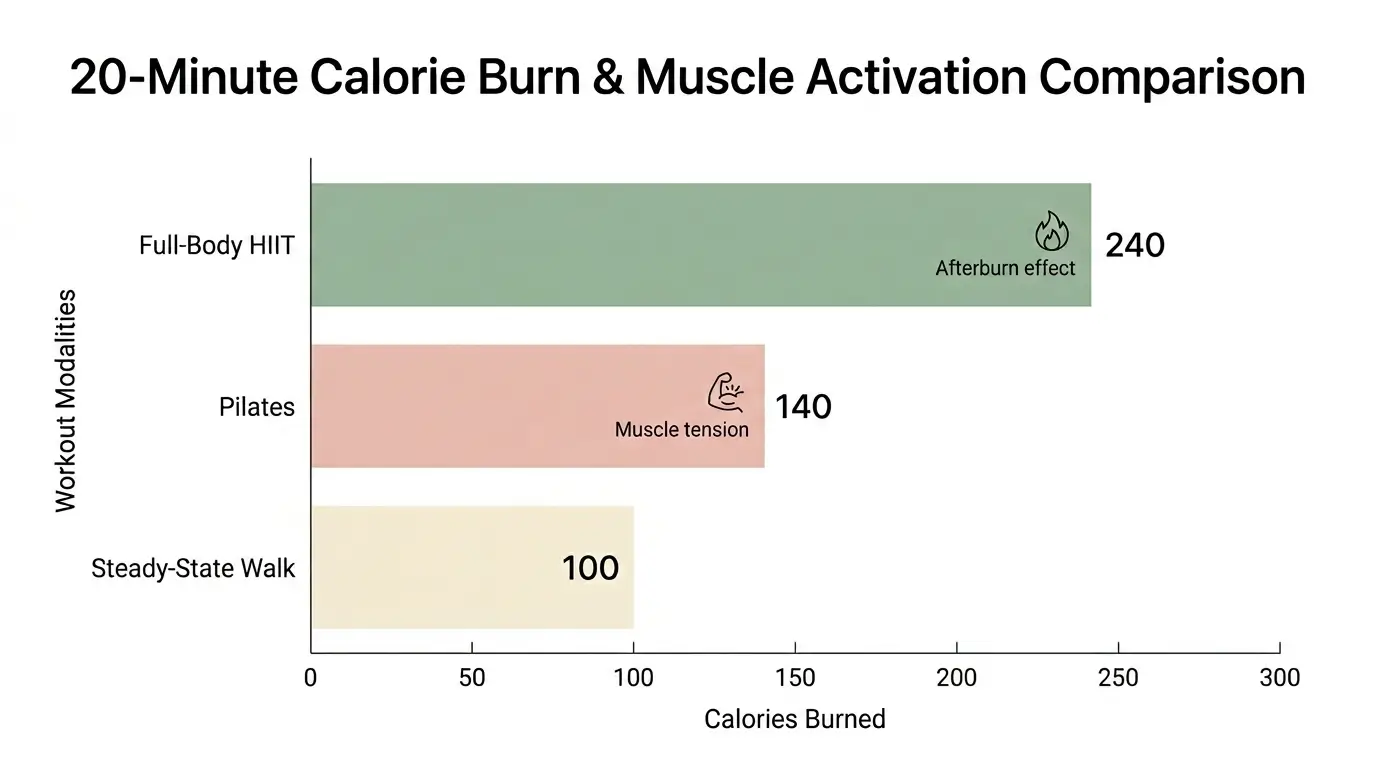
| Metric (20 min session) | HIIT | Pilates | Steady-State Cardio (walking) |
|---|---|---|---|
| Estimated Calories Burned | 200-350 | 90-150 | 70-100 |
| Muscle Groups Activated | Full body | Core, glutes, stabilizers | Lower body (light) |
| EPOC (Afterburn) Duration | 12-38 hours | Minimal | Minimal |
| Equipment Needed | None | Mat (optional) | None |
| Joint Impact | Moderate-High | Low | Low |
(Ed. note: Calorie estimates vary based on body weight, effort level, and fitness background. These ranges reflect data for a 140-160 lb individual training at moderate-to-high intensity.)
The methodology behind this 30-day challenge pairs HIIT days with targeted strength training days.
You get the cardiovascular fat loss benefit from HIIT and the muscle-toning benefit from strength work. Active recovery days prevent burnout and support your joints.
Progressive overload happens through added reps, slower tempos, or wearable weights as the weeks advance.
The 30-Day Workout Calendar
Save this schedule. Pin it. Screenshot it. Put it on your fridge.
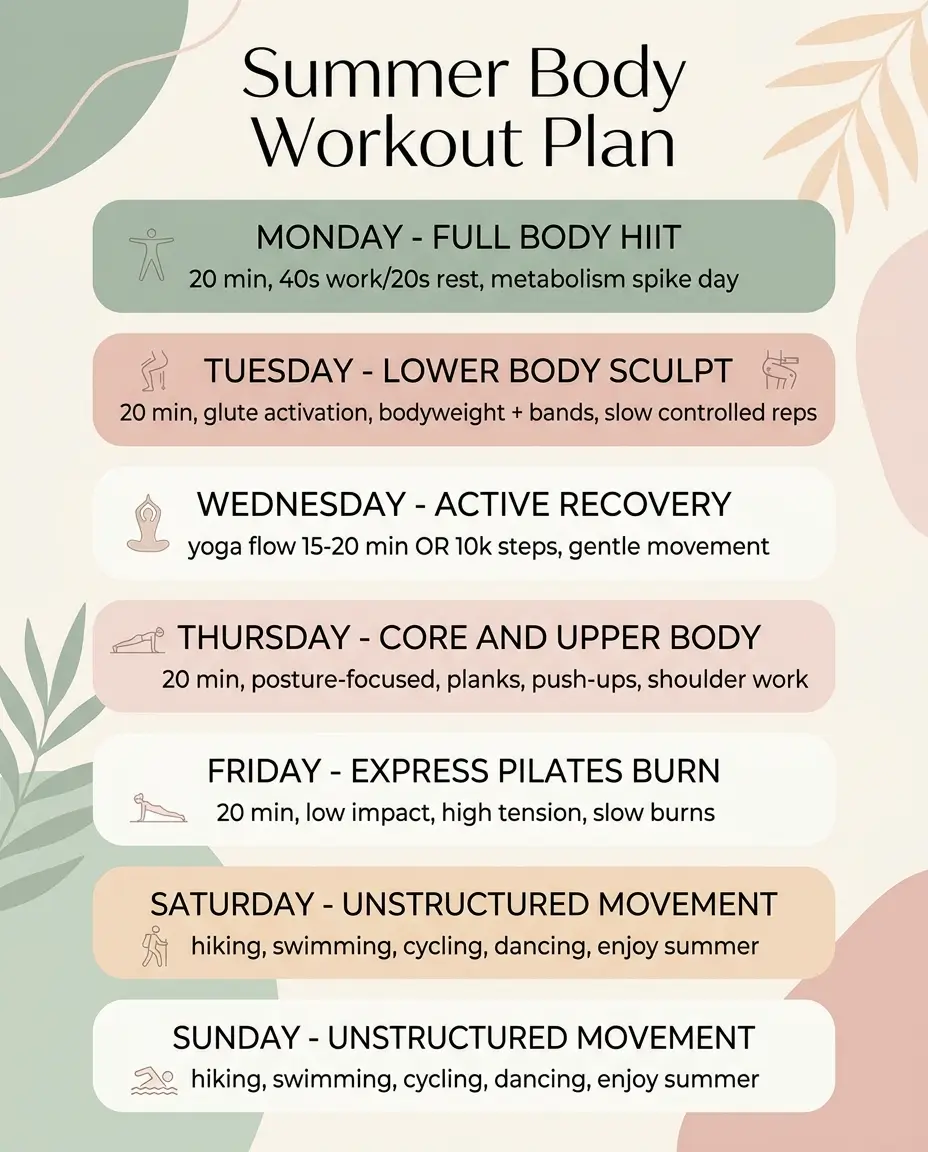
WEEK 1-4 REPEATING SCHEDULE
- Monday, Full Body HIIT. 20 minutes. 40 seconds work, 20 seconds rest. This is your metabolism spike day. You will sweat.
- Tuesday, Lower Body Sculpt. 20 minutes. Focused on glute activation, quads, and hamstrings using bodyweight and optional resistance bands. Slow, controlled reps.
- Wednesday, Active Recovery. Light yoga flow (15-20 minutes) OR hit 10,000 steps. No structured workout. Move your body gently.
- Thursday, Core and Upper Body. 20 minutes. Posture-focused upper body work paired with deep core strength exercises. Planks, push-up variations, and shoulder work.
- Friday, Express Pilates Burn. 20 minutes. Low impact, high time-under-tension. This is your cardio routine without the jumping. Think slow burns and shaking muscles.
- Saturday and Sunday, Unstructured Movement. Go hiking, swimming, cycling, or dancing. The goal is to stay active without following a rigid plan. Enjoy the summer.
WEEKLY PROGRESSION
- Week 1 sets your baseline. You learn the movements and find your rhythm.
- Week 2 adds 2 extra reps per set.
- Week 3 introduces resistance bands or wearable weights to every applicable exercise.
- Week 4 combines increased reps AND added resistance.
That is progressive overload in action, and it is how your body changes shape over 30 days.
The Core Movement Index
Five exercises form the backbone of this program. You will repeat them throughout the week in different combinations and rep schemes. Master the form first. Speed and load come later.
1. SQUAT TO PRESS
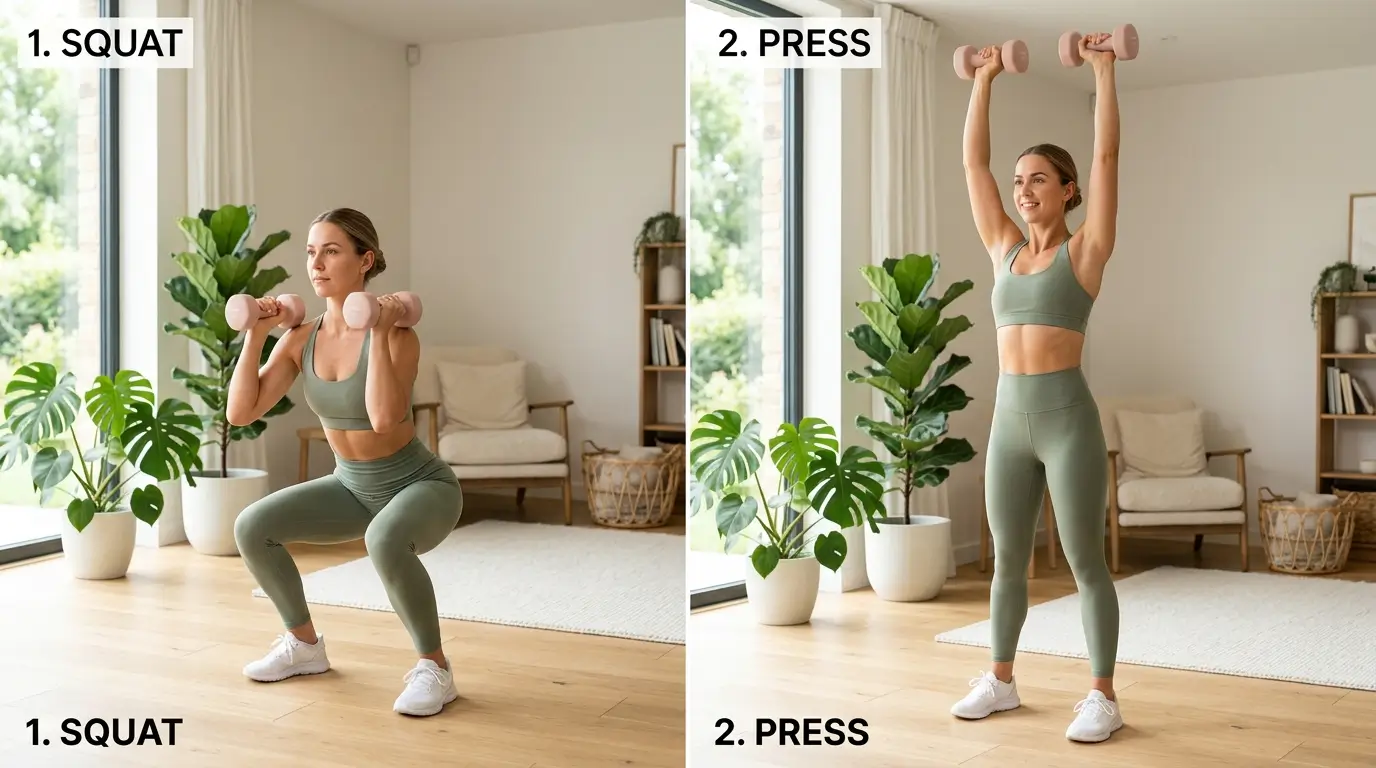
Targets: Glutes, shoulders, core.
- Stand with feet hip-width apart. Hold light dumbbells, water bottles, or nothing at shoulder height.
- Lower into a squat until your thighs reach parallel.
- Drive up through your heels and press your hands overhead as you stand.
That is one rep. Perform 12-15 reps per set.
Check Also: The 30-Day Squat Challenge: How This Simple Commitment Can Transform More Than Just Your Glutes
Knee-Friendly Modification: Reduce squat depth to a quarter squat. Place a chair behind you and tap the seat lightly with your glutes before standing. This limits knee flexion while still activating your glutes and shoulders.
2. PLANK SHOULDER TAPS
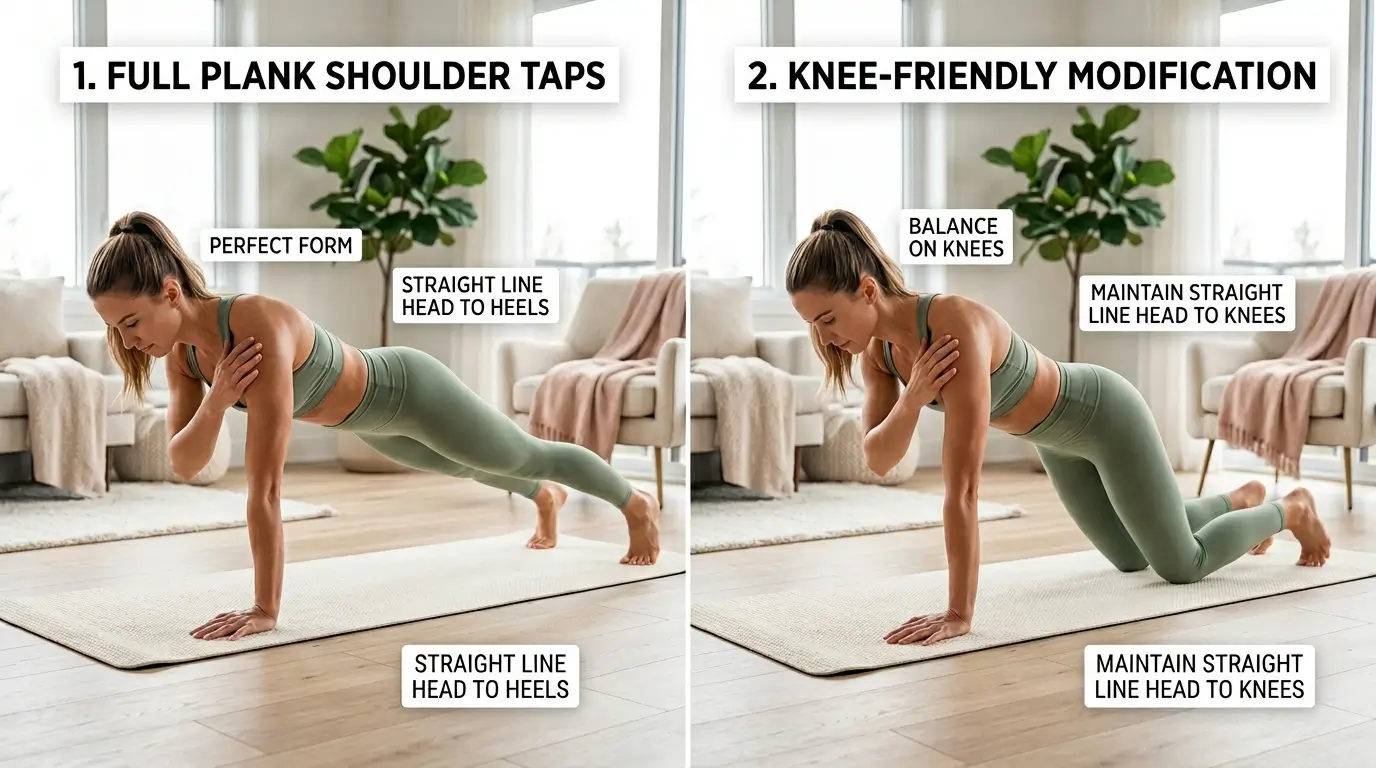
Targets: Transverse abdominis (your deep core muscle), deltoids (shoulder muscles), anti-rotation core strength.
- Start in a high plank position with hands directly under your shoulders.
- Keep your hips square to the ground.
- Lift your right hand and tap your left shoulder.
- Return it. Repeat on the other side.
One tap per side equals one rep. Perform 10-12 reps per set. The slower you go, the harder your core works.
Knee-Friendly Modification: Drop to your knees while maintaining a straight line from your head to your knees. Perform the taps from this position. You still get full core activation with less pressure on your lower body.
3. REVERSE LUNGES
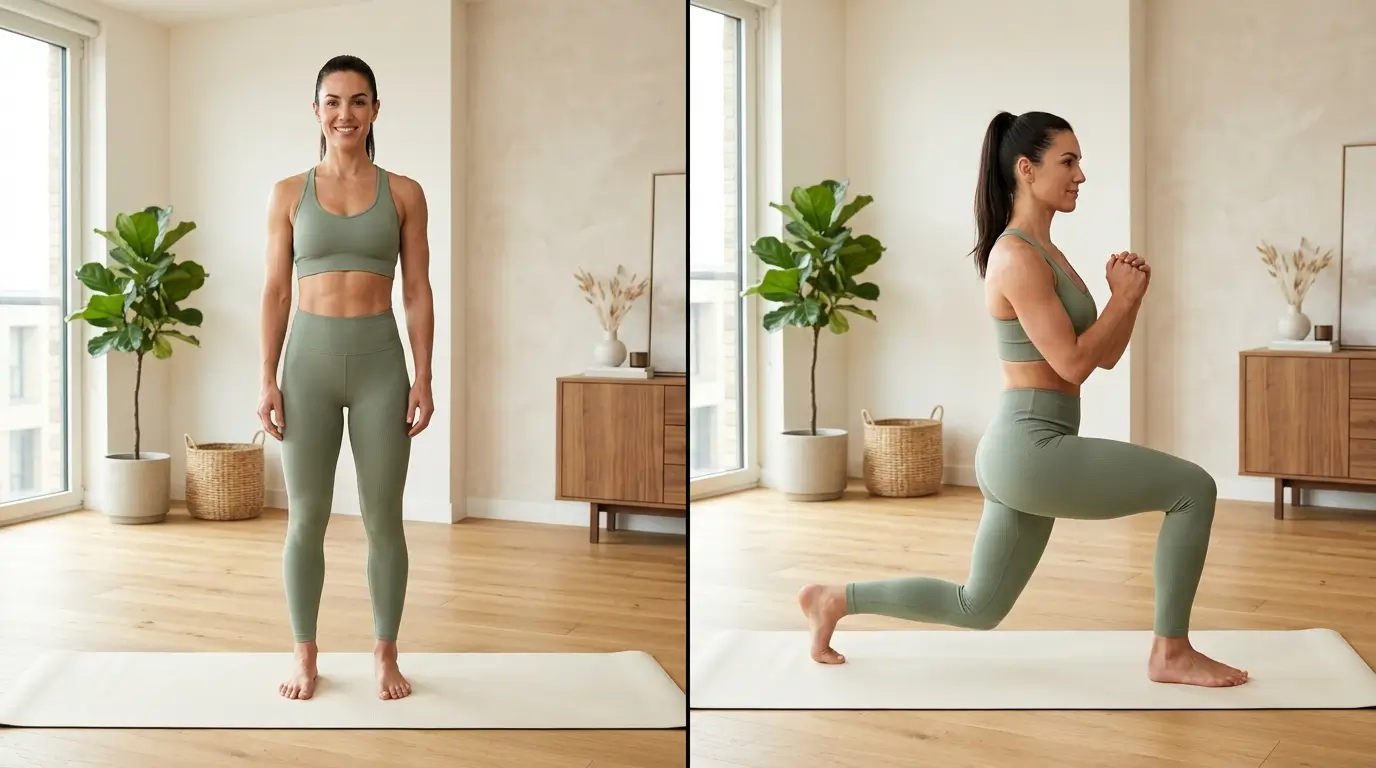
Targets: Hamstrings, glutes, balance.
- Stand tall. Step your right foot backward and lower your back knee toward the ground.
- Stop just before it touches.
- Push through your front heel to return to standing.
- Alternate legs. Perform 10-12 reps per leg.
“Why reverse lunges instead of forward lunges?” Reverse lunges place less forward stress on your knee joint on your front knee because your center of gravity stays over your front foot. They are a smarter choice if you have knee sensitivity.
Knee-Friendly Modification: Reduce your range of motion. Instead of lowering your back knee close to the floor, stop at a half-lunge. Hold onto a wall or chair for balance support.
4. MODIFIED BURPEES (LOW IMPACT)
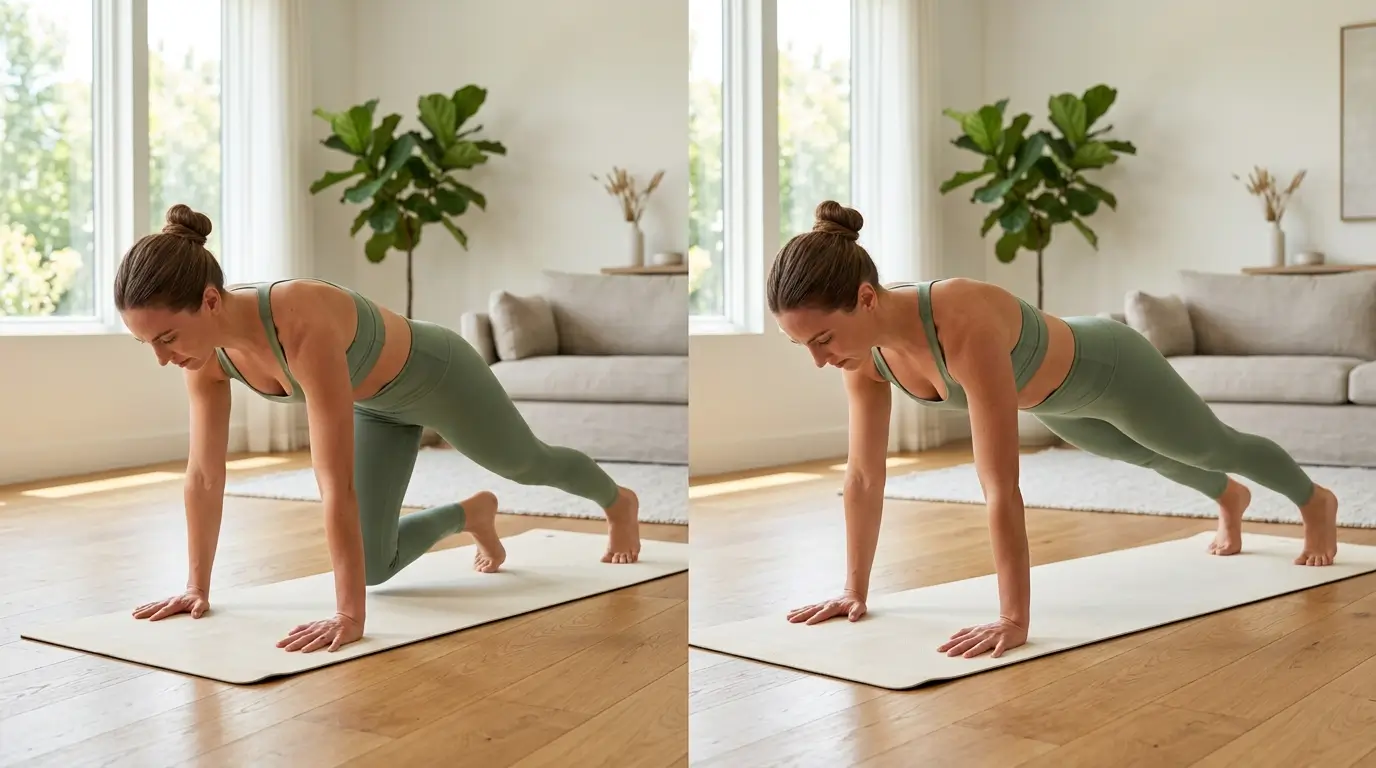
Targets: Full body cardiovascular conditioning.
- Stand tall. Place your hands on the ground, step (do not jump) your feet back into a plank.
- Hold the plank for one second.
- Step your feet forward to your hands.
- Stand up.
That is one rep. Perform 8-10 reps per set.
You get the full-body cardio effect without the high-impact jumping that wrecks your knees and annoys your downstairs neighbors.
Knee-Friendly Modification: Place your hands on a raised surface like a couch or sturdy chair instead of the floor. This reduces how far you need to bend your knees and hips.
5. GLUTE BRIDGES
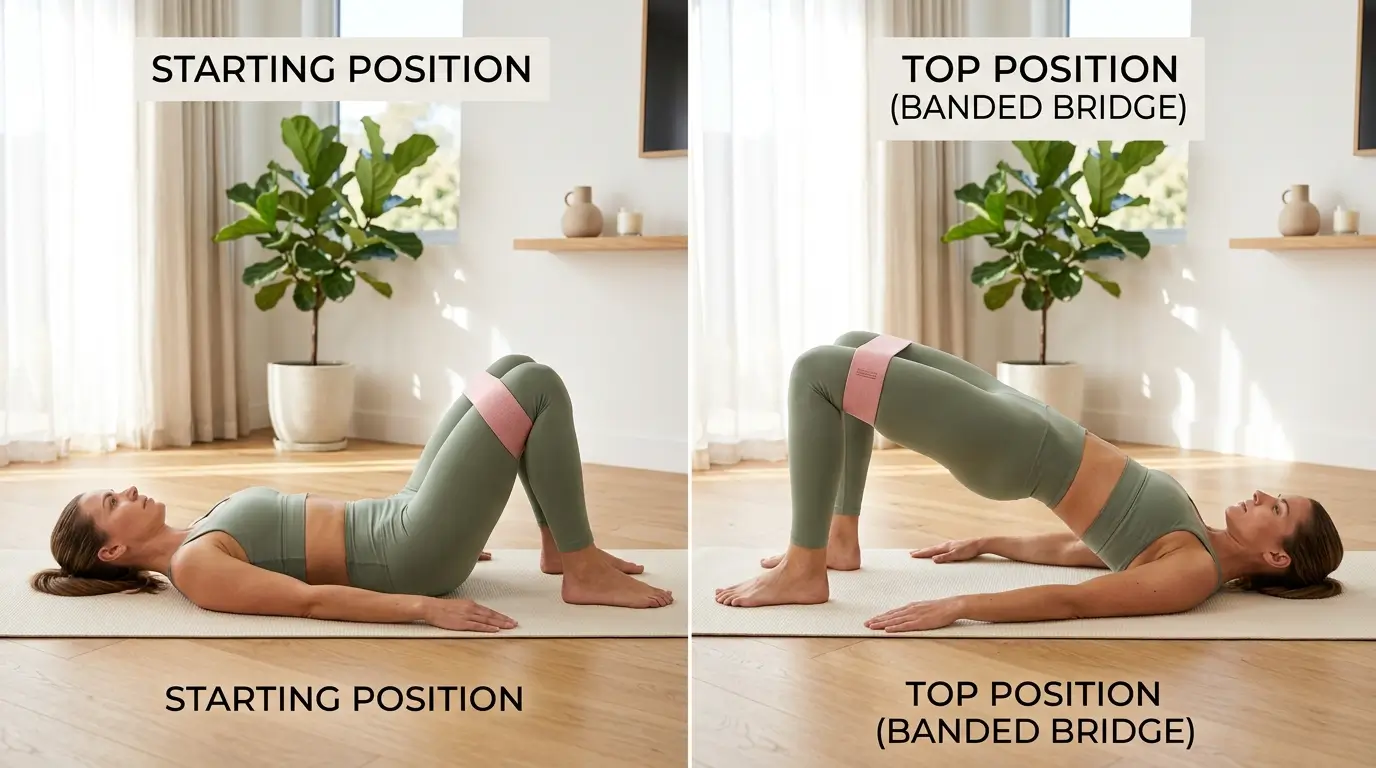
Targets: Glutes, lower back, hip stability.
- Lie on your back with your knees bent and feet flat on the floor, hip-width apart.
- Drive through your heels and squeeze your glutes to lift your hips toward the ceiling.
- Pause at the top for 2 seconds. Lower slowly.
- Perform 15-20 reps per set.
- For extra resistance, loop a resistance band just above your knees and press outward against it during every rep.
Knee-Friendly Modification: This exercise is already low-impact and knee-friendly. If you experience discomfort, bring your feet slightly closer to your glutes and focus on a smaller range of motion.
Gear Review: Bala Bangles (Ankle and Wrist Weights)
Since these easy summer body workouts require minimal equipment, the one accessory I recommend looking into is a pair of wearable weights.
Bala Bangles are the most popular option on Pinterest for a reason. I have used them for over a year across Pilates sessions, walking workouts, and light strength circuits. This is my honest take.
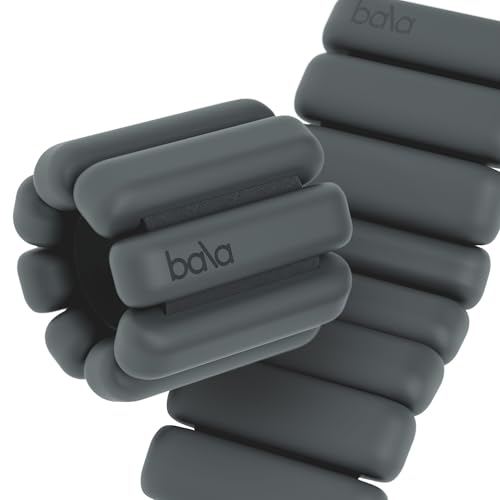
- Bala Bangles: Bala Bangles add constant but comfortable resistance to your workout. Wildly versatile, these wrist and an…
- How to Use: Free yourself from the confines of the gym. Work out anytime, anywhere and any way you please. Use Bala Bang…
- Made for Every Body: Bala is not reserved for the ultra-fit, the ultra-young, the ultra-anything. Our arm and leg weight…
What I Like
- The constant time-under-tension = total seconds your muscles stay contracted during each set, is real. Wearing 1 lb on each wrist during plank shoulder taps or Pilates arm circles makes a noticeable difference by rep 8.
- Your muscles fatigue faster, which means you spend less time working for the same stimulus.
- The design is also genuinely appealing, and that matters because you are more likely to grab gear that looks good sitting on your shelf.
- They work across multiple workout styles, from your Friday Pilates burn to a Wednesday recovery walk.
- Core activation increases automatically because your body has to stabilize against the added weight on your limbs.
What I Do Not Like
- The price is steep. Bala Bangles retail at $55 for the 1 lb pair, $65 for the 2 lb pair, and $79 for the 3 lb pair.
- Even at the heaviest option, 3 lbs per wrist or ankle hits a ceiling fast for anyone chasing progressive overload in strength training.
- They are supplemental tools, not primary resistance. If you are already squatting with heavy dumbbells, these will not challenge your legs. They shine during low-load, high-rep work and walking.
Community Feedback and Common Complaints
I pulled feedback from Reddit’s r/xxfitness community and YouTube review comments to give you a balanced picture of what real users experience.
“Is $55 really worth it for wrist weights?”
Many users raise this point, and it is fair. Cheaper sand-filled weights exist for under $15. The common response from long-term Bala users is that the comfort, secure fit, and lack of chafing justify the cost over time. Several r/xxfitness threads describe it as a “buy once, cry once” purchase because budget alternatives often slip, bunch, or irritate skin during sweaty sessions.
“The velcro stops gripping after a few months.”
Some users report the velcro closure losing stickiness, especially after frequent high-intensity use involving sweat and friction. A helpful community tip is to reserve your Bangles for Pilates and walking days rather than high-impact HIIT sessions. This extends the velcro lifespan significantly.
Nutrition and Hydration Non-Negotiables
Your workouts build the stimulus. Your nutrition determines whether your body actually responds. You cannot out-train a poor diet, especially during a 30-day challenge where recovery matters.
Protein Target for Muscle Tone
Aim for 0.7-1.0 grams of protein per pound of your body weight daily.
A 2018 meta-analysis published in the British Journal of Sports Medicine found that protein supplementation significantly enhanced muscle strength and size gains during prolonged resistance training, with benefits plateauing around 1.6 g/kg per day [2].
For a 140 lb woman, that translates to roughly 100-140 grams of protein daily. Spread your intake across 3-4 meals for better absorption. Prioritize whole food sources like eggs, chicken, Greek yogurt, lentils, and fish.
Hydration Formula
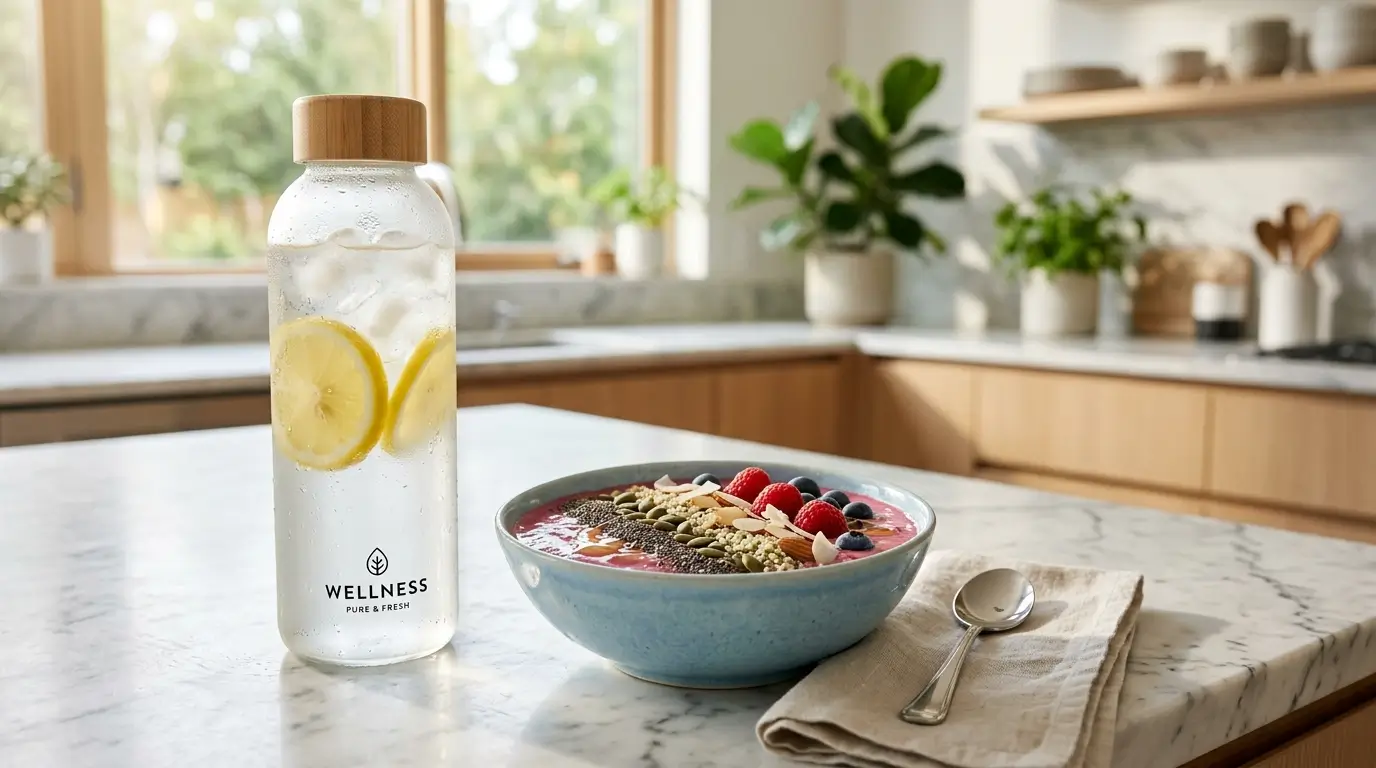
Drink half your body weight (in pounds) in ounces of water per day. If you weigh 150 lbs, that means 75 oz of water minimum. Add 16 oz for every 20 minutes of exercise.
Even 2% dehydration (losing about 2% of your body weight in sweat) can reduce aerobic performance by roughly 10%, according to research reviewed by the American College of Sports Medicine [3].
During summer months, when you sweat more, staying ahead of your hydration is mandatory for both performance and recovery.
Quick Fitness Goals Nutrition Checklist
- Eat protein at every meal. Every single one.
- Drink water before you feel thirsty. Thirst means you are already behind.
- Do not slash calories dramatically. A moderate deficit of 250-500 calories per day supports fat loss without tanking your energy for training.
- Prioritize sleep. Seven to nine hours per night. Sleep deprivation increases cortisol and hunger hormones, directly working against your fitness goals [4].
FAQ
REFERENCES
- Schuenke, M.D., Mikat, R.P., & McBride, J.M. “Effect of an acute period of resistance exercise on excess post-exercise oxygen consumption: implications for body mass management.” European Journal of Applied Physiology, 2002. https://doi.org/10.1007/s00421-001-0568-y
- Morton, R.W., Murphy, K.T., McKellar, S.R., et al. “A systematic review, meta-analysis and meta-regression of the effect of protein supplementation on resistance training-induced gains in muscle mass and strength in healthy adults.” British Journal of Sports Medicine, 2018. https://doi.org/10.1136/bjsports-2017-097608
- Sawka, M.N., et al. “American College of Sports Medicine position stand: Exercise and fluid replacement.” Medicine & Science in Sports & Exercise, 2007. https://doi.org/10.1249/mss.0b013e31802ca597
- Spiegel, K., et al. “Brief communication: Sleep curtailment in healthy young men is associated with decreased leptin levels, elevated ghrelin levels, and increased hunger and appetite.” Annals of Internal Medicine, 2004. https://doi.org/10.7326/0003-4819-141-11-200412070-00008
- Staron, R.S., et al. “Skeletal muscle adaptations during early phase of heavy-resistance training in men and women.” Journal of Applied Physiology, 1994. https://doi.org/10.1152/jappl.1994.76.3.1247
- Mitchell, C.J., et al. “Resistance exercise load does not determine training-mediated hypertrophic gains in young men.” Journal of Applied Physiology, 2012. https://doi.org/10.1152/japplphysiol.00307.2012
