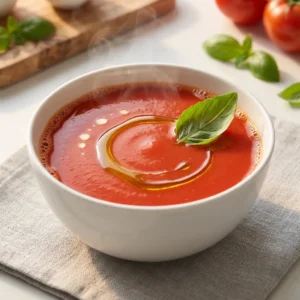
Nutrient-Rich Tomato Soup with Lycopene Boost
A straightforward, health-focused tomato soup that maximizes lycopene bioavailability through cooking and fat addition. This recipe prioritizes nutrition without sacrificing flavor. Perfect for meal prep, pairing with sandwiches, or enjoying as a standalone warm bowl. Takes under 45 minutes from start to finish.
Equipment
- 1 Large stainless steel pot (6-8 quart capacity) Must accommodate 4 cups broth plus ingredients without overflow. Aluminum or non-stick discouraged as they can interact with acidic tomatoes.
- 1 Sharp chef's knife (8-inch blade) For efficiently dicing tomatoes, onions, and garlic. Dull knife increases prep time and injury risk.
- 1 Cutting Board Preferably wooden or plastic to protect knife edge. Use separate board if concerned about tomato staining.
- 1 Wooden spoon or silicone spoon For stirring to prevent sticking and allow scraping of pot bottom. Avoid metal spoons which conduct heat.
- 1 Immersion blender (hand blender) Preferred method for easy blending without transferring hot soup. Standard blender works but requires careful handling of hot liquid.
- 1 Fine-mesh strainer or sieve (optional) Use if you prefer ultra-smooth soup without tomato seeds or skin fragments. Not required but recommended for refined texture.
- 1 Measuring spoons For accurate olive oil and seasoning measurement.
- 1 Measuring cups For measuring broth volume.
- 1 Can opener Only needed if using canned tomatoes instead of fresh.
- 1 Ladle For serving soup evenly into bowls (approximately 1.5 cups per ladle).
- 1 Instant-read thermometer (optional) Useful to confirm soup reaches 165°F for food safety.
Ingredients
- 2 lbs Fresh ripe tomatoes (Roma or San Marzano preferred) Select deep red tomatoes that yield slightly to gentle pressure. If using mid-winter tomatoes (less flavorful), increase to 2.5 lbs. Can substitute with one 28 oz can crushed tomatoes if fresh unavailable.
- 1 medium Yellow or white onion, diced Do NOT use red onion (too sharp). Dice into ¼-inch cubes for even cooking.
- 4 cloves Fresh garlic, minced Use fresh garlic, not pre-minced. Garlic oxidizes quickly once minced; use within 5 minutes of cutting.
- 4 cups Vegetable broth or bone broth, unsalted Use unsalted broth so you control final sodium level. Low-sodium store-bought works; homemade broth optimal. Warm broth slightly (5-10 minutes in pot on low heat) before adding to tomatoes to maintain cooking temperature.
- 3 tbsp Extra virgin olive oil (CRITICAL FOR LYCOPENE ABSORPTION) Must be extra virgin for both flavor and antioxidant content. Refined olive oil lacks these compounds. Do NOT reduce this amount—fat is essential for nutrient absorption, not optional.
- ½ tsp Sea salt (adjust to taste) Use sea salt or kosher salt, not iodized table salt which has chemical additives. Start with ½ teaspoon; adjust upward gradually as you taste.
- ½ tsp Black pepper, freshly ground Use freshly ground pepper, not pre-ground, which loses volatile flavor compounds.
- 1 small handful Fresh basil leaves (optional but recommended) Add at very end of cooking (last 2 minutes) to preserve bright flavor. Dried basil can substitute (1 teaspoon) but fresh is superior.
- 1 pinch Red pepper flakes (optional) For subtle heat. Use only if your target audience enjoys spice.
Instructions
PREPARE TOMATOES (Fresh Tomato Method)
- Blanch tomatoes (if using fresh tomatoes): Bring a separate pot of water to rolling boil. Using a small knife, score an X on the bottom of each tomato (cut just through skin). Carefully place tomatoes in boiling water for 60-90 seconds until skin begins to loosen. Remove with slotted spoon and immediately place in bowl of ice water to stop cooking. This prevents thermal shock that would make peeling difficult.
- Peel tomatoes: Once cooled (2-3 minutes), gently pull away skin starting from the X. Skin should separate easily. If resistant, return to hot water for 30 more seconds. Discard skins. Roughly chop peeled tomatoes into 1-2 inch chunks. Save any juices that accumulate and add to pot with tomato pieces.
SAUTÉ AROMATICS
- Heat olive oil: Pour 3 tablespoons extra virgin olive oil into large pot over medium heat. Allow oil to warm for 1-2 minutes until shimmering appears on surface (small ripples, not smoke). Do NOT let oil smoke; this indicates temperature is too high and will damage the oil's nutritional profile.
- Cook onions first: Add diced onion to hot oil. Stir constantly for 3-4 minutes until onion becomes translucent (see-through) and edges turn golden. This is called "sweating" the onion and develops subtle sweetness. Do not rush this step—proper onion cooking creates flavor base.
- Add garlic: Add minced garlic to onions and stir immediately. Cook for 30-60 seconds only until fragrant (you should smell strong garlic aroma). Do NOT cook longer than 1 minute; garlic burns easily and becomes bitter. Garlic should remain pale, not brown.
BUILD THE SOUP
- Add tomatoes: Carefully pour blanched (or canned) tomato chunks and all accumulated juices into pot with sautéed onion and garlic. Stir to combine. You should hear slight sizzle as tomatoes hit hot oil, which is correct.
- Add broth: Pour 4 cups warm broth into pot. Stir thoroughly, scraping bottom of pot with wooden spoon to release any stuck bits (this is called "deglazing" and adds flavor). Broth should completely submerge tomatoes. If liquid appears insufficient, add additional broth in ¼-cup increments.
- Add seasonings: Add ½ teaspoon sea salt, ¼ teaspoon freshly ground black pepper, and red pepper flakes (if using). Stir to distribute evenly. Do NOT add all salt at once; you'll adjust after blending when true flavor emerges.
- Bring to simmer: Increase heat to medium-high and bring mixture to gentle simmer (small bubbles breaking surface constantly, not aggressive boil). Once simmering, reduce heat to medium-low and maintain gentle simmer.
COOK AND DEVELOP FLAVOR
- Simmer soup: Cook at gentle simmer for 25-30 minutes, partially covered (lid partially off, allowing some steam to escape). During this time, tomatoes break down completely, onions become very soft, and flavors meld. Stir occasionally (every 5 minutes) to prevent sticking.
- Taste and adjust seasoning: After 25 minutes, carefully ladle small amount into separate bowl, let cool for 30 seconds, and taste. Assess: Is it salty enough? Does it need more pepper? This step is critical—taste before blending so you know target flavor.
BLEND AND FINISH
- Blend soup: Carefully submerge immersion blender into center of pot until completely covered by liquid (prevents splattering). Turn blender on to medium speed and blend for 60-90 seconds until desired consistency is reached. Move blender around pot to blend all chunks evenly.
- Heat soup again (if blended in standard blender): If you transferred soup to standard blender, return all blended soup to pot and reheat over medium heat for 3-4 minutes until steam rises (approximately 165°F). Do NOT boil. Then proceed to next step.
- Final seasoning and basil: Taste soup one final time. Add salt or pepper as needed (usually just small adjustment). If using fresh basil, tear leaves by hand (cutting releases less flavor than tearing) and add during last 2 minutes of cooking, stirring gently to distribute.
SERVE
- Serve immediately: Ladle soup into bowls (approximately 1.5 cups per bowl, or 4 servings total). Soup is ready to eat immediately.
- Add optional finishing touches: Consider adding one of these per bowl (not required, but recommended):- 1 tablespoon extra virgin olive oil drizzled on top and swirled (CRITICAL for lycopene absorption if recipe was made without oil, though our recipe includes 3 tbsp throughout)- 1 tablespoon fresh crème fraîche or sour cream swirled on top- ¼ ounce shredded parmesan cheese sprinkled on top- Small handful of crispy croutons for texture- Fresh basil leaf for garnishAny of these additions further improves nutrient absorption and adds textural interest.
Notes
- The Fat Rule is Non-Negotiable: This recipe includes 3 tablespoons of extra virgin olive oil specifically to enable lycopene absorption. Lycopene is fat-soluble, meaning your body cannot absorb it without dietary fat present. Removing the olive oil or substituting with fat-free broth defeats the nutritional purpose of this soup. If concerned about calorie content, remember that the 11g of fat per serving is essential for nutrient absorption and provides satiety (keeps you fuller longer). Do not reduce olive oil below 2 tablespoons.
- Fresh vs. Canned Tomatoes: Fresh tomatoes taste superior during peak season (June-September in Northern Hemisphere), but off-season fresh tomatoes (January-May) lack flavor and lycopene. Canned tomatoes are actually more nutrient-dense than winter fresh tomatoes because they're processed at peak ripeness. If using canned, select crushed tomatoes without added sugar or sodium (read labels—some brands add surprising amounts). San Marzano canned tomatoes are higher quality and worth the premium price ($2-3 vs. $1-1.50). Never use "tomato sauce" or "tomato paste" straight—they're too concentrated and acidic.
- Broth Selection Significantly Impacts Final Flavor: Low-quality broth creates mediocre soup regardless of how well you execute other steps. Invest in good broth (store-bought or homemade). Store-bought options ranked by quality: (1) Bone broth with collagen (most flavorful, supports joint health), (2) Organic vegetable broth from brands like Imagine or Kettle & Fire, (3) Regular store-bought unsalted broth. Always use unsalted broth so you control sodium. If your broth is salted, reduce added salt in recipe to ¼ teaspoon or less.
- Blending Texture is Personal Preference: Some home cooks prefer completely smooth soup (90-second immersion blend or fine-mesh straining). Others prefer rustic texture with small tomato pieces visible (45-60 second blend). Neither is "correct"—choose based on your preference and audience. If serving to children or elderly people with difficulty chewing, aim for completely smooth. If serving to food lovers who appreciate texture, leave some small pieces. There's no single "right" consistency; your preference is valid.
- Storage and Make-Ahead Strategy: This soup stores perfectly for 3-4 days in an airtight container in the refrigerator. Reheat gently over medium heat, stirring occasionally, until steam rises (do NOT boil). Soup can be frozen for up to 3 months in freezer-safe containers (leave ½ inch headspace for expansion). Thaw overnight in refrigerator before reheating. This recipe is ideal for meal prep—make on Sunday, refrigerate in 2-serving containers, and reheat for weeknight dinners with minimal effort.
- Elevation Adjustment: If you live at high altitude (above 3,000 feet elevation), water boils at lower temperature, requiring longer cooking time. At high altitude, increase simmering time by 5-10 minutes. Soup will reach proper flavor development at lower boiling point, but requires extended exposure. If you live below 2,000 feet, use times as stated.
- Troubleshooting Common Issues:
- Soup tastes acidic or causes reflux: Add pinch of baking soda (¼ teaspoon at a time, stir immediately as it fizzes) to neutralize acid. Alternatively, add ¼ teaspoon sugar to balance acidity. Acid perception also decreases with fat addition, so ensure you're not reducing olive oil.
- Soup is too thin/watery: Simmer uncovered for additional 10 minutes to allow water to evaporate. Alternatively, blend additional ¼ of soup again (creating thicker base) and stir back in. Do NOT add cornstarch or flour unless you cannot achieve desired consistency—these mask natural tomato flavor.
- Soup is too thick: Add warm broth in ¼-cup increments until desired consistency reached. Soup thickens slightly as it cools, so if just-cooked soup seems perfect consistency, it may be slightly thick when cold.
- Soup tastes flat/boring: Almost always indicates insufficient salt or insufficient cooking time. Add salt gradually (¼ teaspoon at a time) while tasting, or extend simmer time by 5-10 minutes to develop deeper tomato flavor.
- Garlic burns and tastes bitter: You added garlic to pot when oil/onions were too hot. Next time, add garlic after onions have cooked 3-4 minutes (when temperature has moderated). If already burned, discard soup and start over—burnt garlic flavor cannot be removed.