live_tv
Livestream Starting Soon
00
Hours
:
00
Minutes
:
00
Seconds
Up next in 10

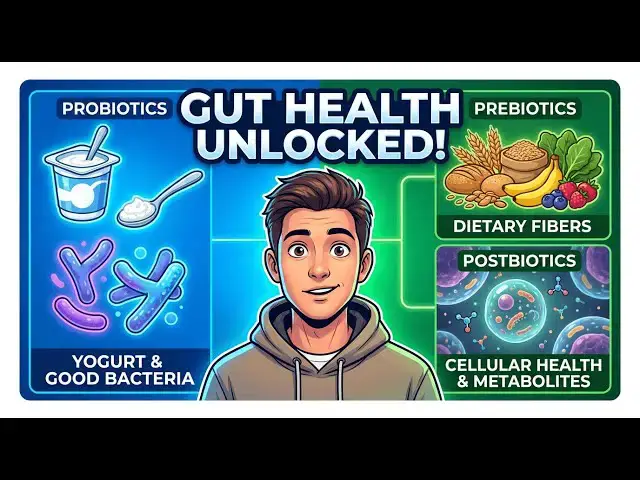
Probiotics vs. Prebiotics vs. Postbiotics: The Complete Gut Health Triad You Need To Know!
Dec 28, 2025
In today's episode we're decoding the complex world of Probiotics vs. Prebiotics vs. Postbiotics to help you stop guessing about your gut health.
Think of your microbiome as a garden: probiotics are the seeds, prebiotics are the fertilizer, and postbiotics are the harvest that actually heals your body.
We explore why prebiotics like fiber are often more important than pills, how postbiotics like butyrate fight inflammation, and how to rebuild your gut after antibiotics.
Whether you struggle with IBS or want better immunity, this guide simplifies the science for total health.
References:
[1] Probiotics Vs. Prebiotics Vs. Postbiotics: What’s The Difference? - https://foodnourish.net/probiotics-vs-prebiotics-vs-postbiotics/
➡️ Facebook: https://www.facebook.com/foodnurish
➡️ Instagram: https://www.instagram.com/foodnurish
➡️ X: https://x.com/foodnurish
➡️ TikTok: https://www.tiktok.com/@foodnourish
➡️ Podcast: https://www.spreaker.com/podcast/foodnourish-deep-dives--6602003
--------------------------------------------------------------------------------
✅ Visit our deals page at https://foodnourish.net/deals to get discount codes up to 35% OFF on over 30 well known health brands including iHerb, Goli Nutrition, Bioptimizers, Source Naturals and many more.
Show More Show Less View Video Transcript
0:01
Welcome to another video of Foodn
0:02
Nourish Deep Dives, the video cast of
0:05
foodnnerish.net, where we explore topics
0:07
like health, food, supplements, and
0:09
alternative approaches to health and
0:10
wellness. Today, we're going to tackle a
0:13
question that, let's be honest, confuses
0:15
just about everyone standing in the
0:16
supplement aisle. You know the scene,
0:18
right? You're staring at rows and rows
0:20
of bottles. Probiotics promise better
0:22
digestion. Prebiotics say they'll feed
0:25
your gut. And now there's this new kid
0:27
on the block, postbiotics, talking all
0:29
about immune support. It totally feels
0:31
like you've got to make a choice. Pick a
0:33
side. But what if I told you that's
0:36
right? The real answer is you're asking
0:38
the completely wrong question. See, the
0:41
thing is, it's not about picking a
0:43
winner. These three biotics, they aren't
0:45
competing against each other at all. Not
0:48
even close. They're actually three
0:50
stages of one single powerful biological
0:53
process that's happening inside you like
0:56
right now. Okay, so let's really dive
0:58
into this because getting this one
1:00
concept, it changes everything. The
1:02
absolute best way to wrap your head
1:04
around it is with a simple analogy. Just
1:06
imagine for a second that your gut is a
1:08
garden. And for that garden to really
1:10
flourish, you're going to need three key
1:12
things. All right, first up, you
1:14
absolutely need seeds. In our gut
1:17
garden, the probiotics are the seeds.
1:19
These are the live beneficial
1:21
microorganisms. We're talking about the
1:22
good bacteria and yeasts that you're
1:25
planting into your system. It's simple.
1:27
Without them, absolutely nothing can
1:29
grow. So, what do seeds need to grow?
1:32
It's obvious, right? They need food.
1:34
They need fertilizer. And that is
1:36
exactly what prebiotics are. They're
1:38
these special types of non-digestible
1:41
fibers, stuff your body can't break
1:42
down, but your good bacteria, they
1:45
absolutely love to munch on it.
1:47
Prebiotics are the essential fuel that
1:49
helps those seeds you planted really
1:51
take off. And this leads us to the final
1:53
and maybe the most important part of our
1:55
garden, the harvest. So, when your
1:58
well-planted seeds, your probiotics get
2:00
fed with that excellent fertilizer, the
2:02
prebiotics, they get busy and produce
2:05
all these incredibly beneficial
2:07
compounds. And those compounds, well,
2:09
those are the postbiotics. This is the
2:12
good stuff, the harvest that actually
2:14
makes you healthier. Okay, let's break
2:16
this down a little more clearly. If you
2:18
take a look at the nature row here, you
2:20
can see the big difference right away.
2:22
Probiotics are live organisms.
2:24
Prebiotics are just fibers. And
2:27
postbiotics, those are the metabolites,
2:29
the stuff the live organisms produce.
2:31
Now, check out the stability row. This
2:33
is huge. Because probiotics are alive,
2:36
they can die off really easily from heat
2:38
or even your own stomach acid. That
2:40
makes them best for very specific
2:41
situations, like after a round of
2:43
antibiotics. Prebiotics, on the other
2:45
hand, are super stable fibers, so
2:47
they're perfect for just daily
2:48
maintenance. and postbiotics. Well, they
2:51
deliver the benefits directly, which
2:53
makes them a great option for more
2:54
targeted issues like leaky gut. All
2:56
right, let's zoom in on each of these,
2:58
starting with the living workers
2:59
themselves, the probiotics. Think of
3:02
these guys as the active crew in your
3:04
gut. They're the bacteria and yeasts
3:06
that work to restore your gut flora.
3:08
They help your digestion by producing
3:10
enzymes, and they even help defend you
3:12
against bad guys by basically crowding
3:14
them out. And the great news is you can
3:16
get these guys directly from food. Look
3:19
for yogurt that specifically says live
3:21
active cultures. The regular pasteurized
3:23
stuff just won't cut it. Kefir is a
3:26
powerhouse. It's even better. Often
3:28
packing 30 to 50 different strains of
3:30
good bacteria. Oh, and don't sleep on
3:32
unpasteurized sauerkraut and kimchi.
3:34
With those, you get a double whammy.
3:36
Probiotics and the prebiotic fiber from
3:38
the cabbage. But remember those living
3:41
workers, they need fuel to do their job.
3:44
And that's exactly where prebiotics come
3:46
in. These are the non-digestible fibers
3:48
that make it all the way down to your
3:50
colon where they selectively feed your
3:52
good bacteria. It's this whole process
3:54
that keeps your microbiome diverse and
3:57
really truly healthy. And you know what?
4:00
You're probably already eating some of
4:01
these things like garlic and onions.
4:04
They're packed with prebiotic fibers
4:05
that a type of bacteria called bifido
4:07
bacteria just loves. Oats have that
4:10
special fiber betalucan. And here's a
4:12
fantastic little tip for you. Slightly
4:14
unripe, kind of greenish bananas are
4:16
loaded with something called resistant
4:18
starch, which is an amazing prebiotic.
4:21
As the banana ripens and turns yellow,
4:23
that starch turns into sugar. So, get
4:25
them while they're green. Okay, so we've
4:27
got the seeds and the fertilizer. When
4:29
your probiotics, the seeds, start
4:31
fermenting those prebiotics, the
4:33
fertilizer, they produce the harvest.
4:35
And this brings us to what's really the
4:37
new frontier in gut health, postbiotics.
4:40
Now, remember, these aren't live
4:41
bacteria. They are the bioactive
4:43
compounds that the good bacteria create.
4:45
Things like short- chain fatty acids,
4:47
enzymes, even little pieces of their
4:48
cell walls. And the benefits you get
4:50
from these, they're direct and they are
4:52
powerful. There's a key postbiotic
4:54
called butyrate, for example. That's
4:56
literally the main fuel source for your
4:58
colon cells. This helps strengthen your
5:00
gut barrier and reduce what people call
5:02
leaky gut. But it's not just about the
5:04
gut. By lowering systemic inflammation,
5:06
postbiotics can have a real positive
5:08
effect on things like your skin and even
5:10
how your joints feel. They also act like
5:12
little messengers talking directly to
5:14
your immune system to help it react the
5:15
right way. And here's a really important
5:17
point. Since they don't contain any live
5:19
organisms, they're a much much safer
5:21
option for anyone with a compromised
5:23
immune system. So after all that, it
5:26
really leads to the big question,
5:28
doesn't it? Let's say you had to
5:30
prioritize. If you could only pick one
5:33
of these three biotics to focus on for
5:35
your overall health, which one should it
5:37
be? the seeds, the fertilizer, or the
5:40
harvest. Believe it or not, the answer
5:42
for most people is prebiotics. So, why
5:46
is that? Well, think about it. Most of
5:48
us already have plenty of good bacteria
5:50
in our gut. The problem is they're
5:52
starving. Adding more probiotics without
5:55
the fuel to sustain them, that's kind of
5:57
like throwing seeds onto concrete. They
5:59
just won't last. So, by focusing on
6:01
prebiotic fiber, you're nourishing and
6:03
multiplying the good guys you already
6:05
have, and they will then naturally
6:07
produce all the postbiotics you need.
6:09
Now, of course, there is one really big
6:11
exception to this rule, and that's post
6:13
antibiotic recovery. If you've just
6:16
finished a course of antibiotics, your
6:18
gut garden has basically been scorched.
6:20
It's been wiped out. In that specific
6:23
case, probiotics absolutely become the
6:25
number one priority. You've got to
6:27
reseed that barren soil before you can
6:29
even think about fertilizing it. Okay,
6:32
let's just hit pause for a second here.
6:34
If you're thinking about adding some
6:35
supplements to support your gut health
6:37
journey, you know that finding
6:38
highquality stuff is absolutely key. So,
6:41
our team at Food Nourish put together a
6:43
special deals page just for you. You can
6:45
find some fantastic offers on top tier
6:47
wellness and supplement brands by going
6:49
to foodnourish.net/dealss.
6:51
We've got discounts from major brands
6:53
like Perpetual Life, IH Herb, Source
6:55
Naturals, Neutropics Depot, Bio
6:57
Optimizers, the whole shebang. And to
6:59
make it super easy, the link is right
7:01
there for you in the description of this
7:03
video. So, how do you actually put all
7:05
of this into practice? Let's make it
7:07
simple. Here's a four-step action plan
7:09
you can start today. First, start with
7:11
prebiotics. Just gradually increase your
7:14
fiber from foods like oats, onions, and
7:16
beans. Aim for about 25 to 35 g a day.
7:20
Second, add in one serving of a
7:21
fermented food each day. Think yogurt,
7:24
kefir, or sauerkraut to get a nice
7:26
regular dose of probiotics.
7:28
Third, and this is important, think of
7:30
supplements strategically. Use them for
7:33
specific issues like after antibiotics,
7:35
not just as a crutch for a bad diet. And
7:38
finally, number four, just monitor how
7:40
you feel. Your body is the best feedback
7:43
system you have. It will absolutely tell
7:45
you what's working. So, when it all
7:47
comes down to it, the main takeaway is
7:49
this. It all goes back to our garden.
7:51
Stop worrying so much about just
7:53
planting more and more seeds. Instead,
7:56
shift your focus to creating rich,
7:58
nourishing soil. Feed your microbiome.
8:01
Give it that prebiotic fiber. If you can
8:03
do that consistently, I promise you the
8:06
harvest of all those beneficial
8:07
postbiotics, it will naturally follow.
8:10
And that really just leaves us with one
8:12
final thought to chew on. Your gut is a
8:15
garden. It's this incredibly complex
8:17
ecosystem that affects your entire body
8:19
from your brain to your skin. So, the
8:21
real question isn't which supplement
8:23
should I buy. The real question is, are
8:26
you giving that internal garden
8:27
everything it needs to truly deeply
8:29
thrive? If you want to dive even deeper,
8:31
be sure to check out the full resource
8:33
article we've linked for you in the
8:34
video's description. And hey, if you
8:36
found this explainer useful, do us a
8:38
huge favor and give it a like. It really
8:40
does help us grow our channel and keep
8:41
delivering these deep dives into health
8:43
matters. And of course, make sure you
8:45
subscribe so you never miss another
8:46
video.
#Nutrition